
March 23, 2026
AI fraud detection software is a category of advanced analytical tools that use artificial intelligence (AI) and machine learning (ML) to identify, prevent, and respond to fraudulent activities in real time.
Unlike traditional systems that depend on static, predefined rules (e.g., "block all transactions from X country"), AI-powered platforms analyze vast datasets and complex user behaviors to spot suspicious patterns that humans would miss. This includes everything from the speed of a mouse movement and a user's typing cadence to the hidden connections between seemingly unrelated accounts.
The industry is rapidly moving beyond isolated fraud solutions toward interconnected ecosystems. The core innovation is the ability for these systems to learn and adapt continuously. As fraudsters develop new tactics, the AI models ingest new data, recognize emerging threats, and update their algorithms automatically.
This makes modern AI tools for fraud detection a dynamic defense mechanism, crucial for protecting revenue, maintaining customer trust, and ensuring a smooth user experience in an increasingly digital world. These are some of the leading AI fraud detection platforms features and reviews.
In today's digital economy, relying on manual reviews or outdated rule-based systems is no longer viable. Fraud has become a sophisticated, automated, and large-scale enterprise. Businesses need AI fraud prevention software to survive and compete.
The core problem these platforms solve is balancing robust security with a frictionless customer journey. Declining a legitimate customer's transaction (a false positive) can be more damaging than missing a fraudulent one, as it erodes trust and sends customers directly to competitors.
The financial impact of fraud is staggering. Global e-commerce losses to online payment fraud were estimated at $48 billion in 2023 and are projected to rise.
AI fraud detection software directly addresses this by automating the decision-making process with incredible speed and accuracy. This transforms a company's fraud management from a reactive cost center into a proactive, data-driven strategy. It enables businesses to approve more legitimate transactions confidently, reduce chargeback costs, and protect their brand reputation from the damage associated with security breaches and account takeovers.
AI fraud prevention tools are vital for a range of businesses that operate in the digital space.
The specific needs may vary, but the underlying challenge of mitigating risk while maximizing growth is universal.
PSPs and acquirers sit at the center of the payment ecosystem, processing transactions for thousands of merchants simultaneously.
They need a highly scalable and accurate solution to protect their entire portfolio, as a weakness in their system can have cascading effects across all the merchants they serve.
A powerful centralized AI gives them a competitive edge and a new value-added service to offer clients.
Card issuers and the processors that serve them must protect cardholders from unauthorized use across all transaction types - card-present, card-not-present, and instant payments.
They require real-time scoring at authorization combined with robust AML capabilities to meet regulatory obligations and prevent financial losses from chargebacks and fraud rings.
Payment facilitators manage sub-merchants, inheriting the risk associated with their transaction activity.
They need a multi-tenant solution that allows them to onboard merchants quickly while maintaining complete oversight and control over fraud risk.
With approximately 3% of new digitally boarded SMEs turning out to be fraudsters, proactive merchant monitoring is not optional - it is essential.
Banks and fintech companies face a complex web of threats, from application fraud and synthetic identities to sophisticated money laundering schemes.
They require platforms that offer both robust fraud detection and strict regulatory compliance (AML), often through a unified FRAML approach, with full audit trails and case management capabilities to satisfy regulators.
Digital-first financial institutions face unique exposure to Authorized Push Payment (APP) fraud and money mule networks.
They need a platform that can monitor peer-to-peer transfers and account-to-account payments in real time, profiling account behavior continuously to detect coordinated fraud campaigns before funds are dispersed.
Companies operating cross-border remittance or instant payment networks must monitor high volumes of transfers across multiple jurisdictions, often with strict data residency requirements.
They need a solution that can deploy locally in regulated markets, adapt to regional regulatory frameworks, and flag suspicious activity without adding friction to legitimate transfers.
Here is an in-depth review of some of the top AI fraud detection platforms, software features, and fraud prevention capabilities.
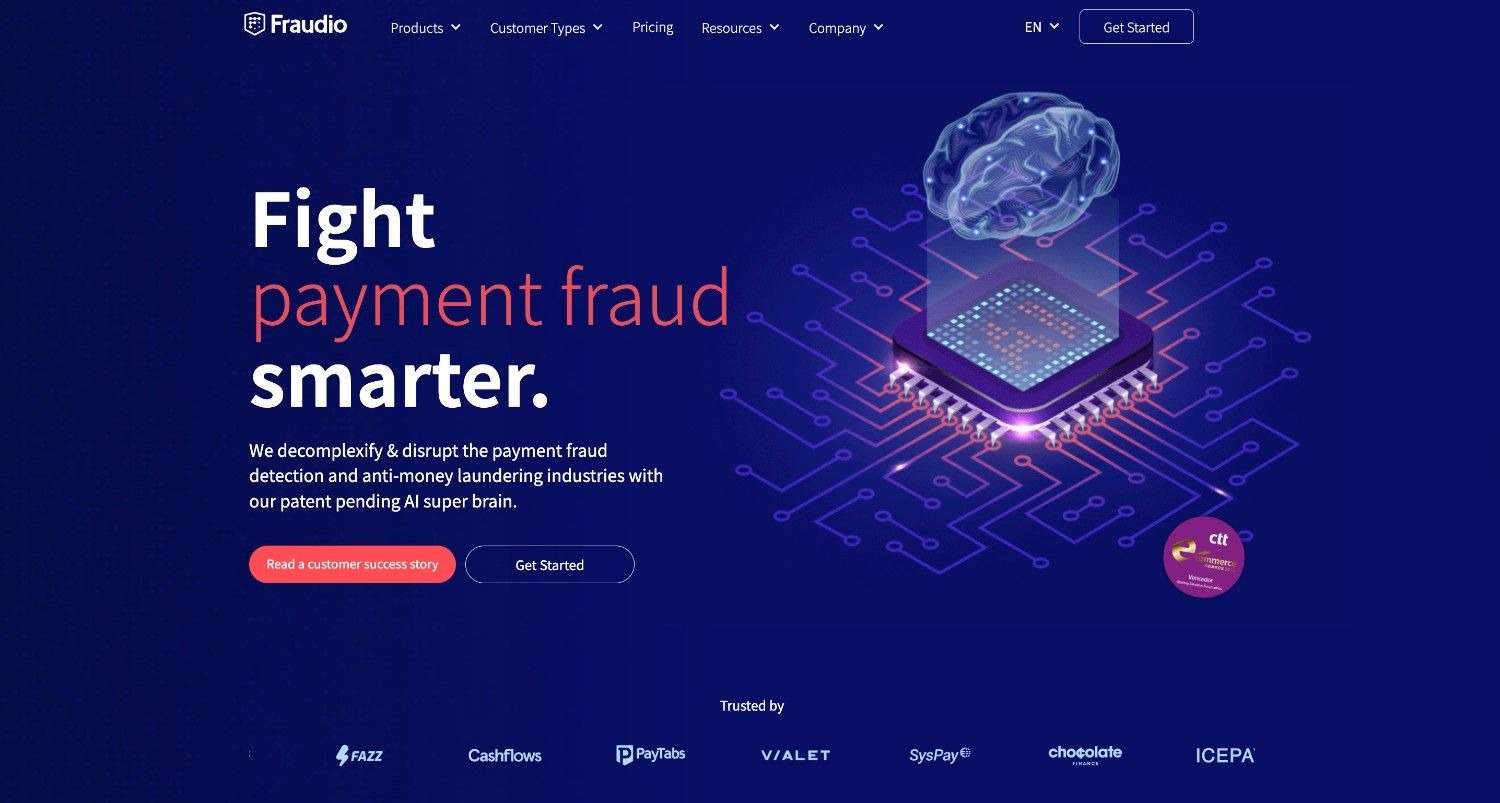
Fraudio is a next-generation AI fraud prevention company that has built one of the largest centralized AI brains for payment fraud detection.
Its patented technology connects merchants, payment service providers, and card issuers to a single, shared intelligence network. This approach solves the core problem of siloed data, where individual businesses only see a small piece of the fraud puzzle.
By training its AI on billions of transactions from across the entire payment ecosystem, Fraudio delivers unmatched accuracy in identifying and stopping complex fraud rings.
Fraudio’s key differentiator is its powerful network effect. While competitors build models on their own customer data, Fraudio’s AI learns from a connected ecosystem, making it significantly more powerful.
Our performance speaks for itself: we deliver 15x better results than a major card scheme solution and 40% better results than one of the top three legacy fraud vendors. This is not just an incremental improvement; it is a fundamental shift in how fraud is detected.
The pay-per-use model also makes this cutting-edge technology accessible without massive upfront investment.
Fraudio operates on a custom, pay-per-use pricing model. This ensures that businesses only pay for the value they receive, making it a highly efficient and scalable solution.
Fraudio is the best choice for any payment-focused business that prioritizes accuracy and intelligence.
Its unique network-based AI provides a definitive competitive advantage, catching fraud that other systems simply cannot see.
For PSPs, acquirers, and large merchants, Fraudio represents the future of AI fraud prevention software.
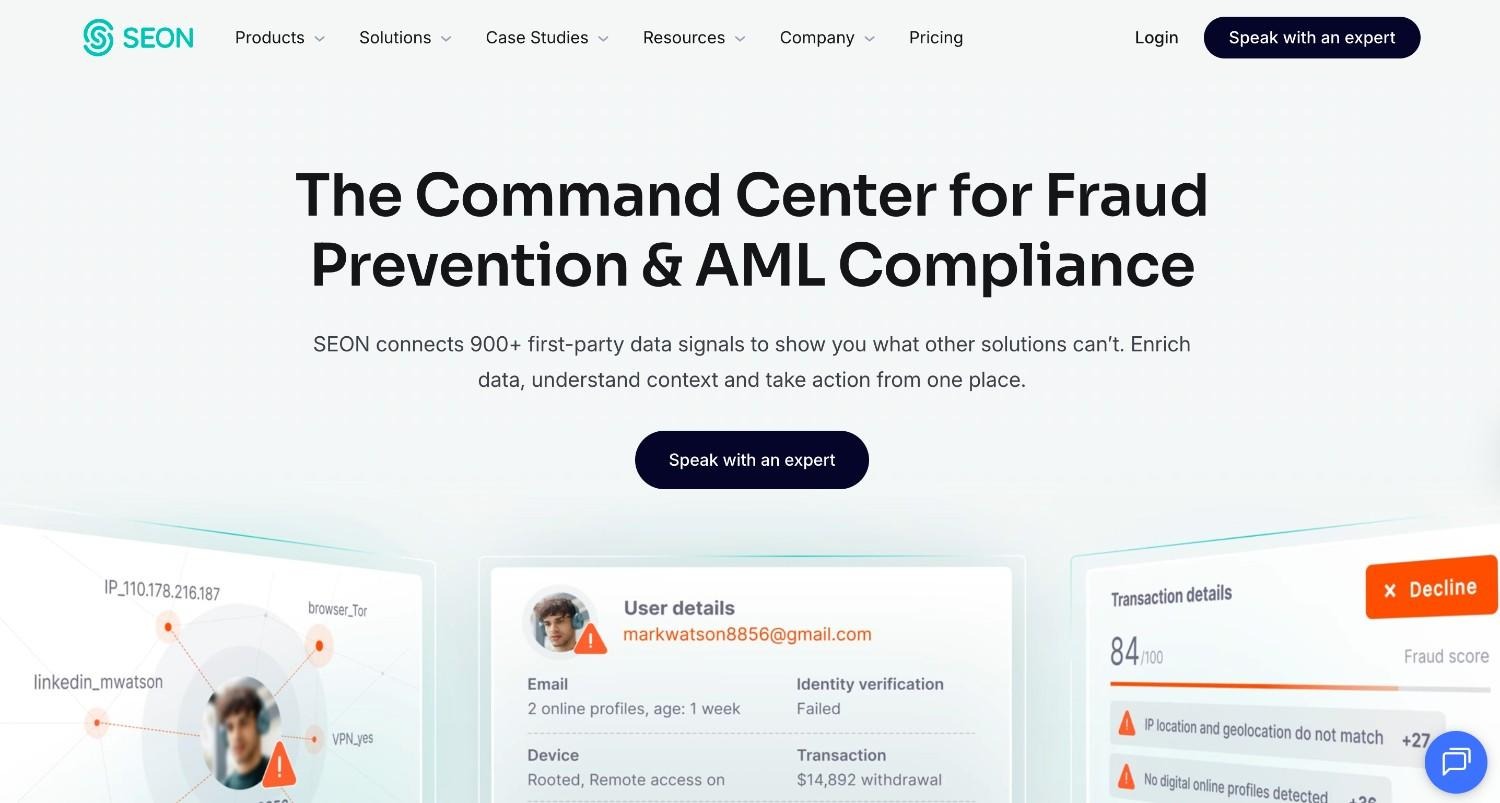
SEON positions itself as a modern and modular fraud prevention tool, focusing heavily on digital footprint analysis.
It enriches data points like email addresses and phone numbers with information from over 50 social and online sources to build a comprehensive user profile.
This approach is designed to catch fraudsters by verifying their online presence, or lack thereof. SEON is popular among mid-market companies and fintechs that value transparency and ease of integration.
SEON's strength lies in its data enrichment and transparency.
The ability to instantly check if an email address is linked to active social media accounts provides a powerful, intuitive signal for fraud analysts.
Their commitment to "whitebox" AI is a strong selling point for teams that want to understand and customize the logic behind their risk scoring.
SEON offers a monthly subscription starting at $599, with pricing scaling based on the number of API calls and features required.
SEON is a strong choice for mid-sized businesses that want to enhance their manual review process with rich data and transparent machine learning. It's particularly effective for user onboarding and application fraud.
However, it lacks the powerful network-level intelligence of a solution like Fraudio, making it less suited for stopping coordinated, large-scale payment fraud attacks.
Sift is a major player in the fraud detection space, leveraging a massive global data network from over 34,000 websites and apps.
It offers a comprehensive "Digital Trust & Safety" suite that protects against payment fraud, account takeovers, and content abuse.
Sift's platform is built around the entire user journey, applying risk analysis from the moment an account is created to every login and transaction.
Sift excels at protecting complex digital platforms where user interactions go beyond simple payments.
The ability to monitor content and account security in addition to transactions makes it a holistic solution for marketplaces and social platforms.
The user-friendly dashboard also makes it accessible to non-technical fraud teams.
Sift uses a custom pricing model based on transaction volume and the specific products used.
Sift is a powerful and well-regarded platform, especially for businesses that need to manage content and account integrity alongside payment fraud. It is one of the strongest choices for marketplaces.
However, its pricing can be a barrier for some, and businesses focused purely on optimizing payment fraud detection might find more targeted and cost-effective solutions elsewhere.
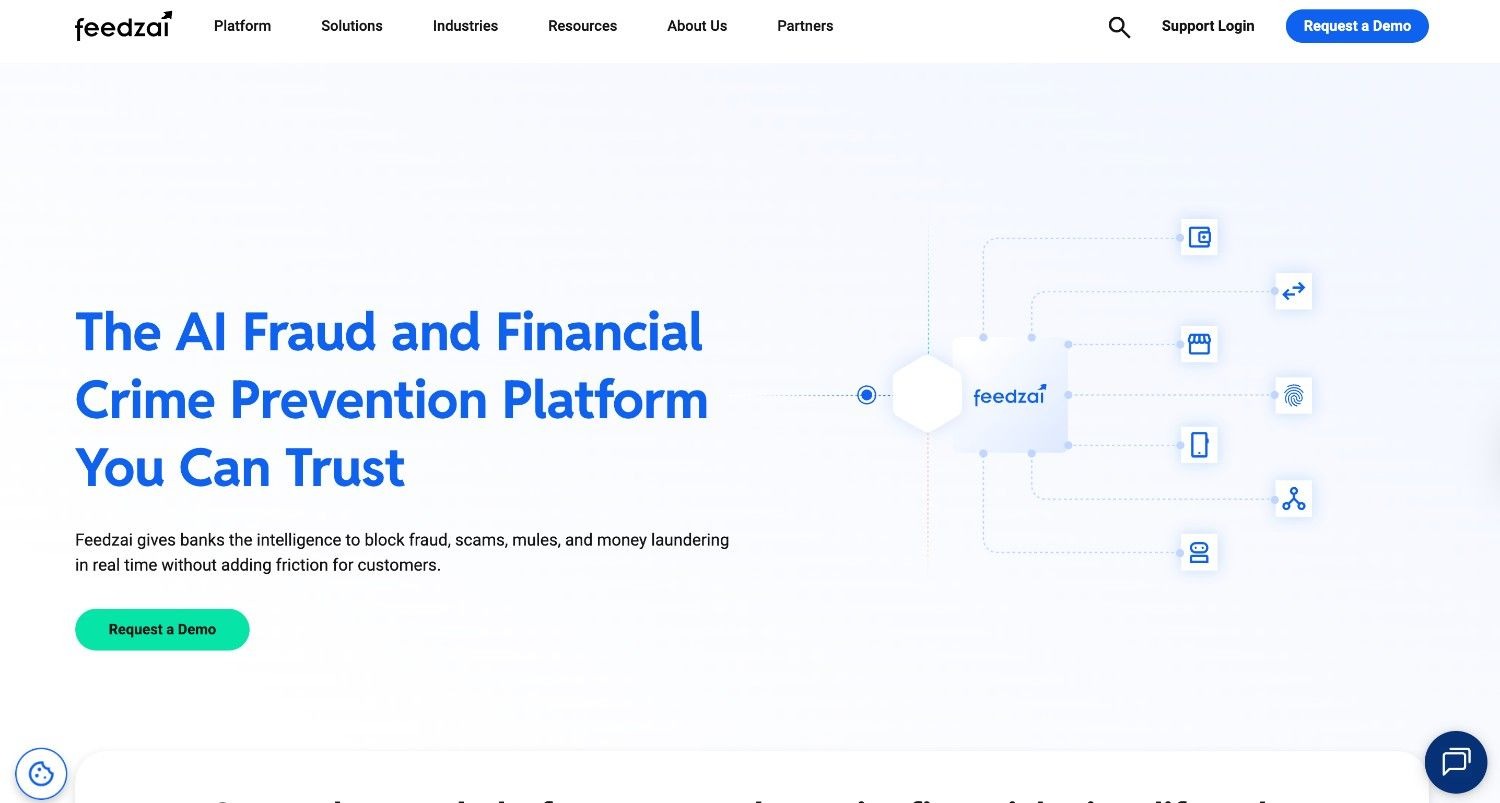
Feedzai is an enterprise-grade, AI-native platform designed primarily for large banks, payment processors, and financial institutions.
It focuses on creating a unified "RiskOps" environment that combines fraud detection, AML compliance, and other risk management functions into a single platform.
Feedzai is known for its high-speed processing and scalability, capable of handling the massive transaction volumes of global financial systems.
Feedzai's key advantage is its singular focus on the needs of large financial institutions.
Its architecture is built for extreme speed, scalability, and regulatory rigor.
The emphasis on "Fair AI" is also a critical differentiator for banks operating under intense scrutiny.
Feedzai's pricing is entirely custom and tailored for large enterprise contracts.
For a global bank or a massive payment processor, Feedzai is one of the top contenders. It offers a robust, scalable, and compliant solution for managing financial crime at an enterprise scale.
However, it is not a practical or affordable solution for most e-commerce merchants, SMBs, or even many mid-market fintechs.
Riskified offers a unique business model in the e-commerce fraud prevention space: a full chargeback guarantee.
Instead of providing a risk score or a tool for analysts, Riskified provides a simple "approve" or "decline" decision on each transaction.
If they approve a transaction that later turns out to be fraudulent, Riskified covers the full cost of the chargeback. This effectively turns fraud management into a fixed, predictable cost for the merchant.
The chargeback guarantee model is Riskified's defining characteristic. It fundamentally changes the relationship between the merchant and the fraud vendor.
Instead of selling software, Riskified is selling an outcome: guaranteed revenue. This aligns their incentives directly with the merchant's goal of approving as many legitimate orders as possible.
Riskified charges a percentage of the value of every transaction they approve. The exact rate is custom and depends on the merchant's industry and risk profile.
Riskified is a great solution for large e-commerce businesses that want to maximize approvals and offload all fraud risk. It's a financial product as much as a technology one.
However, this model isn't for everyone. Companies that prefer to manage their own risk strategy or have lower average transaction values might find other solutions more cost-effective and flexible.
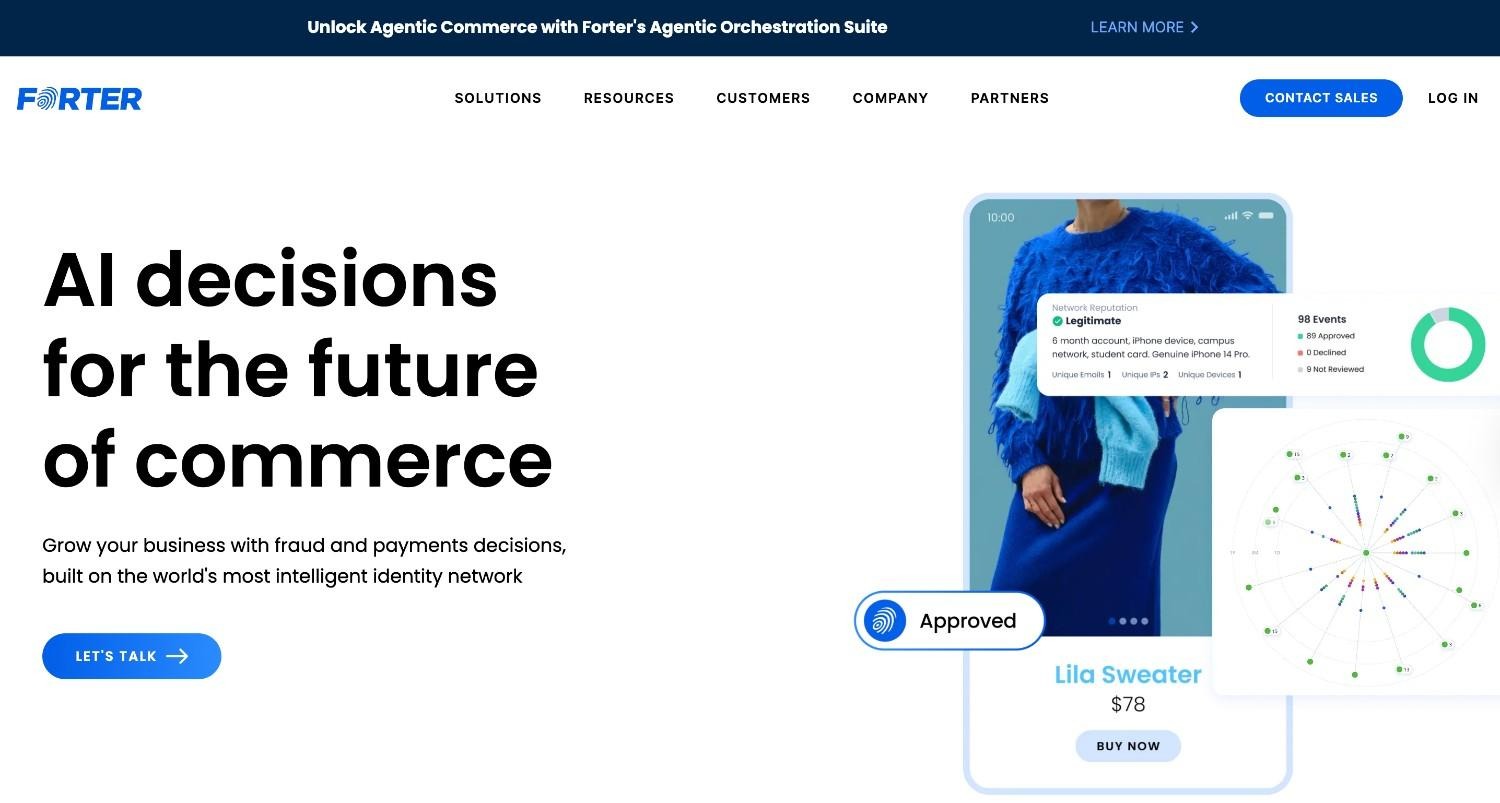
Forter is an identity-based fraud prevention platform for large enterprise retailers.
It focuses on creating a real-time, automated assessment of the identity behind each interaction, rather than just the transaction itself.
By building a massive Identity Graph, Forter aims to deliver accurate, instantaneous decisions that reduce false declines and create a seamless customer experience.
Forter’s main differentiator is its focus on maximizing approvals by deeply understanding identity.
They argue that false declines are often a bigger problem than fraud itself, and their technology is built to solve that.
Their ability to influence payment routing at the bank level is a unique and powerful feature for large merchants.
Forter uses custom enterprise pricing, typically structured as a fee per transaction or a percentage of gross merchandise value (GMV).
Forter is a smart solution for large, global retailers whose primary goal is to fight false declines and maximize customer lifetime value. Its identity-centric approach is highly effective.
However, its high cost and enterprise focus place it out of reach for most small and mid-sized businesses.
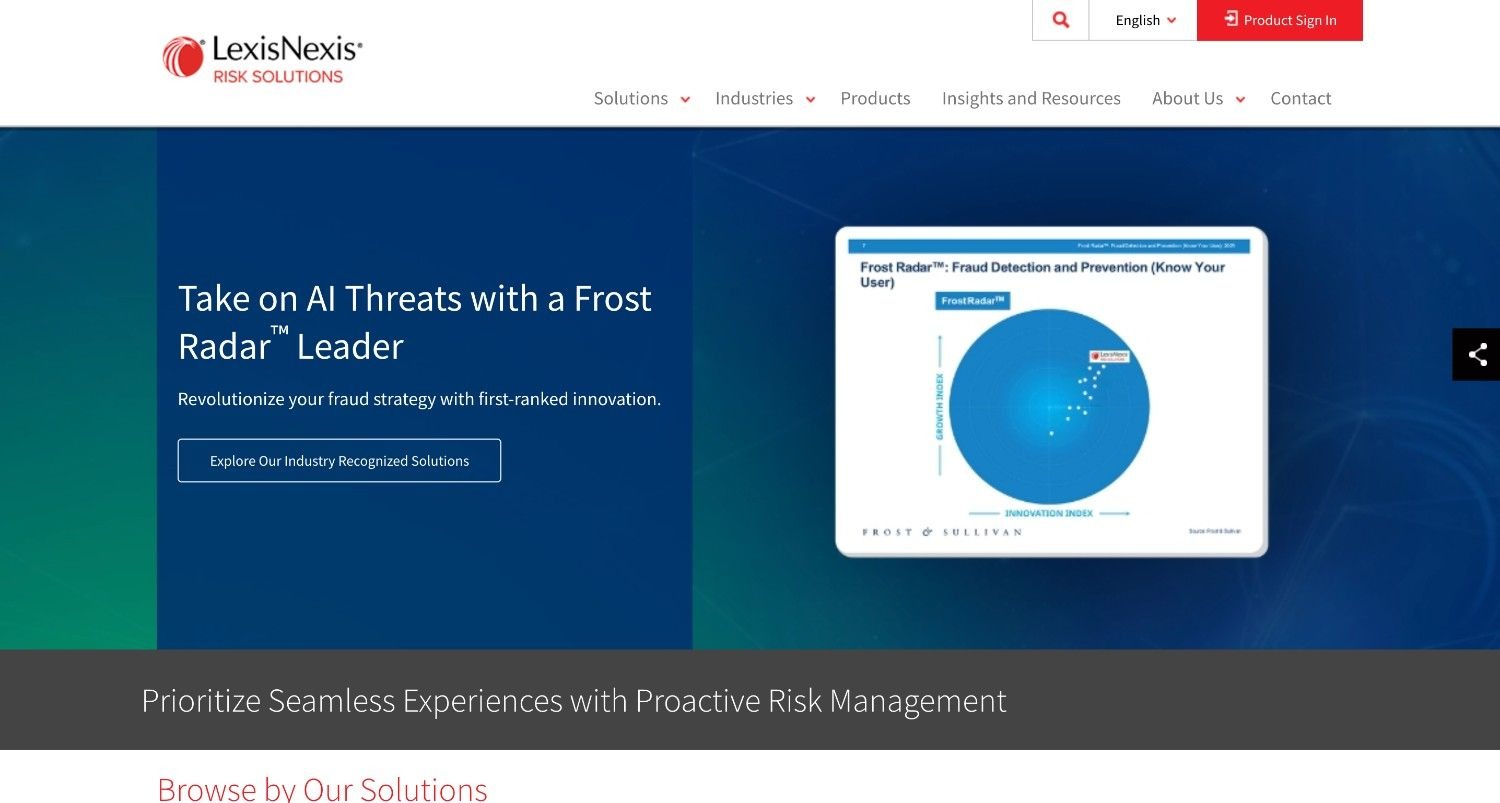
LexisNexis Risk Solutions, incorporating the ThreatMetrix platform, is a heavyweight in the identity verification and fraud detection industry.
It combines digital identity intelligence from billions of online transactions with LexisNexis's vast repository of physical identity data (e.g., public records, credit information).
This creates an unparalleled, multi-layered view of identity risk, trusted by the world's largest banks and government agencies.
The fusion of digital and physical identity data is what makes LexisNexis unique.
No other provider can match its depth of information for verifying that a person is who they claim to be.
This makes it an indispensable tool for high-stakes processes like bank account opening or loan applications.
Pricing is custom and designed for large-scale enterprise deployments.
When verifying someone's identity is your main priority, LexisNexis is a solid choice. It is an essential tool for high-risk identity verification in banking and government.
However, for most e-commerce and digital businesses, its complexity and cost are overkill, and more agile solutions are a better fit.
Kount is a veteran of the fraud detection industry, now enhanced by its acquisition by Equifax.
It combines its own extensive data network, the "Identity Trust Global Network," with Equifax's deep credit and financial data.
This provides a balanced platform of AI-driven risk scoring and customizable business rules, making it a popular choice for mid-market to enterprise e-commerce companies.
Kount’s strength is its balance.
It offers powerful AI automation but also gives experienced fraud teams the granular control they desire through its rules engine.
The integration of Equifax data provides an additional layer of identity and credit risk insight that many other e-commerce-focused platforms lack.
Kount uses a custom, volume-based pricing model.
Kount is a solid and dependable choice for mid-market and enterprise retailers, particularly those with an experienced fraud team that wants to combine the power of AI with their own domain expertise.
It offers a great deal of control and a rich dataset.
However, businesses looking for a fully automated, hands-off solution might find it more labor-intensive than alternatives like Riskified or Forter.
Featurespace is renowned for its "Adaptive Behavioral Analytics," delivered through its ARIC Risk Hub.
The platform was invented by a Cambridge University professor and focuses on understanding "good" customer behavior at an individual level to more accurately spot "bad" or anomalous activity.
This self-learning approach is highly effective at detecting scams and other forms of fraud where a legitimate user is manipulated into performing an unusual action.
Featurespace's focus on individual behavioral anomalies makes it exceptionally good at detecting scams that other systems miss.
While many platforms look for known fraud signatures, Featurespace looks for deviations from a user's personal "normal." This results in extremely low false positive rates.
Featurespace offers custom pricing for enterprise-level deployments, available in the cloud or on-premise.
For financial institutions battling sophisticated scams and prioritizing the reduction of false positives above all else, Featurespace is one of the best AI fraud detection software options available. Its behavioral analytics engine is second to none.
However, it is a highly specialized and resource-intensive platform, making it unsuitable for most businesses outside of the core financial services sector.
DataVisor is an AI-powered fraud and risk platform that specializes in using Unsupervised Machine Learning (UML) to detect "unknown" fraud threats.
While most systems rely on historical labeled data (past examples of fraud), DataVisor's UML can identify new, coordinated attacks in real time without any prior examples.
This makes it particularly powerful against sophisticated fraud rings that use bots and synthetic identities to launch large-scale attacks.
DataVisor's ability to find "unknown unknowns" is its key differentiator.
Traditional supervised models are only as good as the historical data they are trained on.
By using UML, DataVisor can catch novel attack vectors on day one, giving businesses a proactive defense against the most advanced adversaries.
DataVisor provides custom pricing for large-scale enterprise deployments.
DataVisor is a highly advanced solution for large enterprises facing sophisticated, coordinated fraud.
Its unsupervised machine learning is a powerful weapon against botnets and synthetic identity farms.
It is the right choice for tech-forward companies that want to get ahead of emerging threats, but its complexity and cost make it a specialized tool for the top end of the market.
Selecting the right AI fraud prevention software is a critical decision.
Here are the key factors to consider to ensure you choose the best option for your needs.
The single most important factor is the model's performance. Ask for proof of performance, such as head-to-head test results or case studies.
Inquire about the data used to train the AI. A model trained on a larger, more diverse dataset from across an entire ecosystem (like Fraudio's network) will inherently be more powerful than one trained on a single company's siloed data.
Your fraud tool should not be a roadblock to agility.
How quickly and easily can the solution be integrated into your existing technology stack?
Modern, API-first platforms can often be deployed in days, while legacy enterprise systems can take months.
Consider the technical resources required from your team and the quality of the vendor's API documentation and support.
Understand the pricing structure. Is it a flat subscription, a per-transaction fee, or a percentage of revenue? A pay-per-use model can be highly efficient, as it scales directly with your business activity.
Also, consider the total cost of ownership, which includes implementation fees, the cost of manual review teams (if needed), and the financial impact of both fraud losses and false declines.
The platform must be able to handle your peak transaction volumes without any degradation in performance.
Latency is critical; a fraud check should take only milliseconds to avoid impacting the customer experience.
Ensure the vendor has a robust and scalable infrastructure that can grow with your business.
5. Data Residency and Regional Deployment
If you operate in or plan to expand into regulated markets such as Saudi Arabia, the UAE, India, or Indonesia, data residency requirements are a hard constraint that many platforms cannot meet.
Verify that your vendor has proven, live deployments in the specific regions you need - not just theoretical capability - and that they can go live quickly without lengthy compliance processes on their end.
Decide on your desired level of control.
Do you want a fully automated "black box" solution with a guarantee (like Riskified), or do you want a "whitebox" system that provides explainable decisions and allows your team to build custom rules (like SEON)?
A hybrid approach, with a powerful AI core and optional controls, often provides the best balance.
Choosing the best AI fraud detection software comes down to finding the smartest intelligence.
Fraudio stands out because our patented technology creates a true network effect, connecting the entire payment ecosystem to a single, hyper-intelligent AI brain. This allows us to see and stop fraud that is invisible to everyone else.
We deliver up to 30x better results than systems working with isolated data. If you are ready to move beyond incremental improvements and adopt a solution that offers a quantum leap in fraud detection accuracy, it's time to talk.
The best AI fraud detection software in 2026 is Fraudio, due to its patented network effect technology that leverages a centralized AI brain for unparalleled accuracy. It outperforms competitors by connecting data from across the payment ecosystem.
You should consider five key factors when choosing the right AI fraud detection software. Prioritize the accuracy of the AI model, the speed and ease of integration, the pricing model's alignment with your business, the platform's scalability, and the level of transparency and control it offers your team.
Fraudio differs from alternatives through its unique, patented network effect. While others build models on siloed customer data, Fraudio connects merchants, PSPs, and issuers to a central AI brain, providing a collective intelligence that results in up to 30x better performance in fraud detection. This allows us to spot large-scale, coordinated fraud that other systems miss.
Getting started with Fraudio is a straightforward process designed for speed. To get started with Fraudio, you can book a free trial through our website. From there, our team will guide you through our simple API integration, a process that typically takes only a few days to get you live and protected.
Switching to Fraudio is designed to be as seamless as possible. Our API-first architecture and dedicated support team ensure a rapid transition from your current provider, often in a matter of days rather than the months required by legacy systems. We work closely with your technical team to manage the integration process, minimizing disruption and accelerating your time-to-value.
High-quality AI fraud detection tools actually reduce false positives compared to traditional rule-based systems. Platforms like Fraudio use advanced behavioral analysis to understand normal customer patterns, leading to more accurate decisions. This means fewer legitimate customers are blocked, which protects your revenue and improves the customer experience.

How about trying our solution and experiencing the next generation for yourself?


