
June 5, 2026
Picking the best AML software for financial services companies has never been more crucial.
Regulatory pressure is rising, money laundering typologies are growing more complex, and the legacy rule engines that most institutions still rely on are simply not built for the volume or velocity of modern payment flows.
Whether you’re running an acquiring bank, a payment processor or a fintech solution operating under an EMI license, having the right AML software for financial institutions is crucial.
This guide reviews 10 leading AML software for financial services platforms currently; covering detection capabilities, integration speed, pricing, and the specific use cases each tool serves best. So let’s get started.
Real-time AML monitoring, full case management, SAR reporting. Proven 8× ROI for payment institutions like Viva Wallet. Deploy in days, not months.
No setup fees · No contracts · ROI from day one
| Company | Best For | Key Features | Pricing |
|---|---|---|---|
| Fraudio | Payment-processing fintechs, issuers, and acquirers needing real-time AML with network-effect AI from day one |
Payment Fraud Detection
AML, MIF & P2P Monitoring
Centralized AI
Fraud caught 3 weeks earlier
600% efficiency uplift
2B+ transaction network
|
Pay-per-transaction (custom) |
| NICE Actimize | Large banks with complex multi-product AML programs |
SAM
KYC
Sanctions Screening
Case Management
X-Sight Entity Risk
|
Custom (modular) |
| ComplyAdvantage | Fintechs needing KYC + transaction monitoring in one stack |
Mesh Platform
Customer Screening
Ongoing Monitoring
Agentic AI
|
$319/month for 2,000 monitored entities |
| Oracle FCCM | Tier-1 banks requiring deep regulatory coverage |
End-to-End KYC/CDD
Transaction Monitoring
Regulatory Reporting
|
Pay-per-use, flexible pricing |
| SEON | Mid-market companies needing fast deployment & AML screening |
Digital Footprinting
Device Intelligence
Transaction Monitoring
|
From $699/month; custom enterprise |
| SymphonyAI NetReveal | Banks modernizing legacy AML infrastructure |
AI Overlay for TM
Sanctions Screening
CDD
|
Custom pricing on request |
| Feedzai | Enterprise payment providers processing at scale |
RiskOps Platform
Omnichannel Fraud + AML
Entity Profiling
|
Tailored solutions pricing |
| Quantexa | Institutions needing network graph analytics for AML |
Entity Resolution
Network Analytics
Contextual AI
|
Custom pricing on request |
| LexisNexis Risk Solutions | Organizations needing rich third-party data enrichment |
World-Compliance Data
Sanctions/PEP Screening
Adverse Media
|
Custom pricing on request |
| Napier AI | Compliance-led firms wanting configurable AML workflows |
Transaction Monitoring
Client Screening
Case Management
|
Custom pricing on request |
Every other AML tool on this list trains on your isolated history. Fraudio's patented AI learns from the entire connected payments network — delivering detection accuracy no siloed model can match.
No setup fees · No contracts · ROI from day one
In simple words, an AML software platform for financial services helps regulated entities: banks, payment processors, fintechs, acquirers, and issuers - detect, prevent, and report money laundering activity in compliance with local and international regulatory requirements.
At its core, such platforms monitor transactions and customer behavior to identify patterns consistent with financial crime: layering of illegal funds, structuring transactions to avoid reporting thresholds, routing money through shell accounts, and coordinated transfers through mule networks. Modern tools often combine rules-based detection with machine learning models that adapt to new typologies in real time.
A complete AML software for financial services stack typically covers four functional areas:
The industry has evolved significantly.
First-generation tools relied almost entirely on static rule sets: transaction amounts over a threshold, unusual geography, high-velocity transfers. These systems are predictable to bad actors and generate staggering volumes of false positives that consume analyst time without improving detection.
Leading AML software tools for financial services in 2026 combine supervised and unsupervised machine learning with network graph analytics, behavioral profiling, and entity-level risk scoring. The result: fewer false positives, earlier detection of emerging typologies, and compliance teams that spend time on genuine risk rather than alert triage.
Fraudio's centralized AI cuts false positives and catches laundering weeks earlier than legacy rules — across all payment types, with full case management and SAR reporting built in.
No setup fees · No contracts · ROI from day one
The cost of getting AML wrong runs into the billions. As per AML Network, in 2025 alone, global AML fines exceeded $10 billion across banking and payments, with regulators in Europe, the US, and APAC all increasing enforcement activity. For payment companies operating under EMI licenses, a single compliance failure can trigger license revocation.
But the regulatory fine is only part of the problem. Consider the operational picture that most compliance teams working without any proper AML software system face:
The volume problem is accelerating. Digital banking, cross-border instant payments, and crypto-fiat corridors have multiplied transaction flows faster than headcount can scale. Without implementing an AI-driven AML software for financial services, there is no realistic path to effective monitoring at scale.
The gap between the volume of financial crime and the capacity of legacy systems to detect it is the core problem that modern leading AML software for financial services exists to close.
Fraudio's AML gives your compliance team AI-driven detection, full case management, and SAR-ready outputs — without proportionally scaling headcount to match transaction volume growth.
No setup fees · No contracts · ROI from day one
Card issuers face AML risk across every transaction their cardholders initiate. High-velocity cash withdrawals, structuring patterns, unusual geographic sequences, and account-to-account transfers that suggest layering all need to be caught before funds are irreversibly moved. Issuers also carry KYC/CDD obligations across potentially millions of individual customer profiles.
The challenge is scale: flagging genuine risk in a sea of legitimate transactions without generating false positives that degrade cardholder experience.
The best AML software for financial services at issuer scale combines event-level transaction scoring with entity-level behavioral profiling – catching real risk without slowing legitimate payments.
Acquirers hold direct liability for the merchants in their portfolio. A fraudulent merchant processing stolen card numbers; or worse, laundering money through a legitimate-looking SME account, represents both a direct financial loss and a regulatory exposure.
Approximately 3% of digitally-onboarded SMEs turn out to be fraudsters, meaning acquirers at any scale will encounter hundreds of bad actors annually.
Standard transaction monitoring often misses merchant-level behavioral signals; implementing a purpose-built AML software that tracks entity-level patterns across settlement flows helps catch these schemes weeks before chargebacks arrive.
Fintechs and neobanks often hold EMI licenses that carry the same AML obligations as traditional banks; but without the legacy compliance infrastructure. They face a compressed regulatory journey: obtain the license, build the AML program, and demonstrate compliance to a regulator simultaneously. Time to deployment matters enormously, as does the ability to operate a credible compliance program without a 50-person compliance team.
Implementing a leading AML software for financial services with fast integration and intelligent automation isn’t a luxury for these organizations – but the only viable path to compliant growth.
The structure of remittance and P2P payment flows creates specific AML risks: mule networks, APP fraud, rapid dispersion of funds across accounts. Detecting money mule behavior requires entity-level profiling across time – monitoring inflows, outflows, counterparty patterns, and velocity in combination.
Standard single-event transaction monitoring misses coordinated mule activity that only becomes visible when individual account behaviors are analyzed as a network.
Leading AML software for financial services built for this use case tracks account behavior across time rather than evaluating each transfer in isolation.
Mid-market payment companies; typically processing between 1 million and a 100 million transactions per month, often fall into a gap in the market. Most enterprise AML software for financial services is overbuilt and overpriced for their needs.
Simple rule engines are underpowered. Their compliance teams are lean, facing the same regulatory obligations as the largest banks, but without the budget or IT resources for a 12-month enterprise deployment.
They need a solution that deploys in days, provides immediate value, and scales as the business grows, without locking them into multi-year contracts with opaque pricing.
Fraudio serves the full payments ecosystem across 188 countries. Deploy in 3–14 days with no setup fees and pay-per-use pricing that scales with your transaction volume.
No setup fees · No contracts · ROI from day one
Here’s a detailed review and comparison of the 10 best AML software for financial services based on factors like detection capabilities, deployment speed and ideal fit for different institutional profiles:
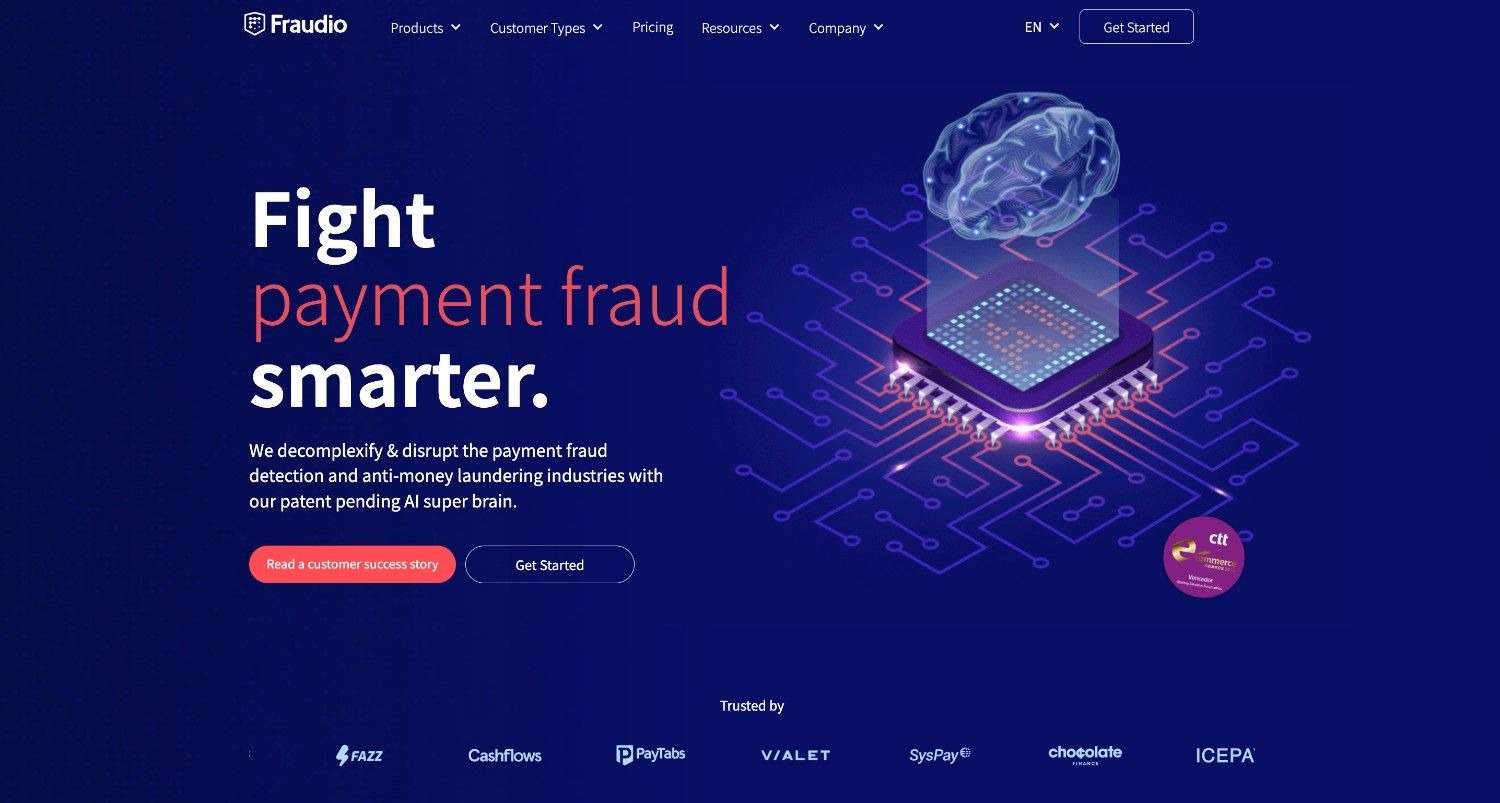
Fraudio is a next-generation fraud and AML prevention platform built for payment companies worldwide. Using patented centralized AI technology, we help issuers, acquirers, payment processors, and fintech companies detect and prevent money laundering, suspicious transfers, merchant-initiated fraud, and payment fraud in real time.
Our AML product is one of the best AML software for financial services options on the market for payment-focused organizations. It combines custom rule setting, AI-driven modeling, link analysis, and a full case management system with SAR reporting, SLA adherence, and complete audit trails.
What sets us apart from other leading AML software for financial services providers is the network effect at the core of our AI: our models train on billions of transactions across all connected customers; not just your isolated dataset. That means detection accuracy from day one, without a months-long ramp-up period.
Most AML software for financial services operates on a siloed model: your AI learns only from your transactions. With Fraudio's centralized dataset, our AI learns from billions of transactions across every connected customer – breaking the data silos that fundamentally limit detection capability at smaller institutions.
Integration takes 3–14 days versus the 5–14 months typical of legacy enterprise AML software for financial institutions. We deliver measurable results from day one, including full audit readiness and rule-based controls on first connection.
Fraudio uses a transparent pay-per-transaction SaaS model with no setup fees, no implementation fees, and no maintenance charges. The cost per transaction decreases as processing volume grows. Customers can also commit to higher volumes to lock in lower per-transaction buy rates.
Custom pricing is available through direct contact with our sales team.
We are the strongest AML platform for payment companies, issuers, acquirers, PayFacs, and fintechs that need real-time AML monitoring with genuine network-effect AI, fast deployment, and scalable pricing.
Viva Wallet achieved 8x ROI, a 600% increase in fraud team efficiency, and detected fraud 3 weeks earlier than their legacy solution, across a deployment that completed in days.
If you've hit the limits of a basic rule engine or been priced out of enterprise platforms, we close that gap with no compromise on detection quality.
Request a Proof of Results on your own transaction data. No commitment, no integration required — just a clear view of what our AI catches that your current AML system misses.
No setup fees · No contracts · ROI from day one
NICE Actimize is one of the most established names among the best AML software for financial institutions, serving over 1,000 organizations across 70+ countries.
Their AML suite covers suspicious activity monitoring (SAM), KYC and customer due diligence, sanctions screening, case management (ActOne), entity risk management (X-Sight Entity Risk), currency transaction reporting (CTR), and a recently introduced integrated FRAML offering called Xceed.
The platform is positioned as a comprehensive financial crime compliance solution for large banks.
NICE Actimize carries deep institutional credibility with global regulators and has been recognized as a top-tier vendor by Gartner, Forrester, and Chartis over many years.
The platform's breadth: covering everything from transaction monitoring to trading surveillance, is particularly valuable for universal banks wanting a single financial crime vendor relationship.
NICE Actimize follows a modular pricing model where fees depend on deployment size, number of modules selected, user count, and custom requirements.
Both cloud-based and on-premise deployment options are available. Pricing is available only through direct negotiation with their sales team and is sized for enterprise budgets.
NICE Actimize is among the best AML software for financial services by tier-1 institutions having established compliance budgets, complex multi-jurisdictional programs, and the internal resources to support a long implementation.
For emerging fintechs, mid-market payment companies, or organizations that need fast deployment and measurable ROI from day one, the cost and complexity make it a difficult fit.
ComplyAdvantage is an AI-native financial crime risk management platform that covers KYC customer screening, company screening, ongoing monitoring, transaction monitoring, payment screening, and sanctions/PEP/adverse media intelligence.
Their Mesh platform connects these capabilities into a unified compliance workflow, with recent investment in agentic AI workflows capable of autonomously resolving routine alerts.
ComplyAdvantage is particularly strong for fintechs and digital financial services companies that need KYC and AML monitoring under a single vendor relationship.
ComplyAdvantage's combination of proprietary data intelligence with AI-native screening and monitoring gives it a differentiated position amongst the leading AML software for financial services.
For organizations that currently use multiple vendors for sanctions data, PEP screening, and transaction monitoring, consolidating onto Mesh can reduce both cost and operational complexity.
Lastly, their investment in agentic AI also positions them ahead of many legacy competitors on alert automation.
ComplyAdvantage’s basic pricing plan starts at $319/month for 2000 monitored entities. The platform is modular, implying that costs usually depend on factors like: transaction and screening volumes, and the Mesh applications enabled on their system.
ComplyAdvantage is one of the stronger choices for fintech companies and digital financial services providers that need integrated KYC, sanctions screening, and transaction monitoring under a single vendor relationship.
Oracle FCCM is a comprehensive, enterprise-grade AML software for financial institutions with over 25 years of development behind it.
The platform covers customer due diligence, KYC, transaction monitoring, case management, regulatory reporting, sanctions screening, and AI-powered scenario development.
It is available both on-premises and as a cloud service (FCCM Cloud Service), and ranked 4th in the Chartis RiskTech100 2026 global ranking with leadership in 13 solution categories including Financial Crime: AML.
Oracle's 25-year track record combined with its 4th-place global RiskTech100 ranking and leadership in 13 categories makes it one of the best AML platforms for financial services on the market. For global banks that need to satisfy regulators across multiple jurisdictions simultaneously, Oracle's depth and breadth are significant advantages.
Oracle FCCM offers a flexible, pay-per-use pricing model available through their direct sales channels. When comparing options, you can expect significant licensing, implementation, and ongoing support costs suited to tier-1 financial institutions.
Oracle FCCM is most appropriate for large, established AML software for financial institutions buyers: organizations with complex multi-jurisdictional programs, significant IT resources, and a preference for a vendor with deep regulatory credibility and analyst recognition.
It is not a practical choice for mid-market companies, emerging fintechs, or organizations that need fast deployment and quick ROI.
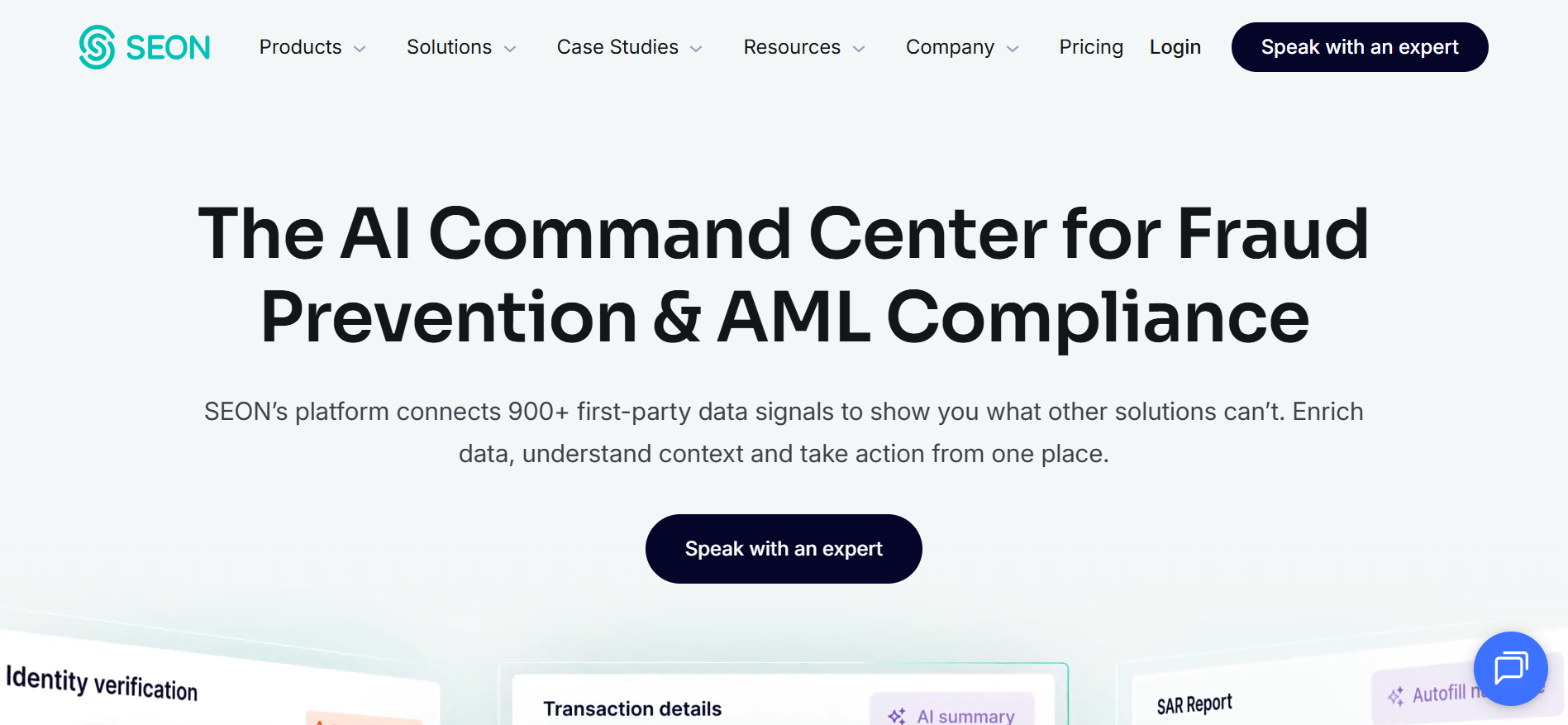
SEON is a fraud prevention and AML compliance platform focused on digital footprinting, device intelligence, and transparent machine learning. Originally built for fintech and iGaming fraud prevention, the platform has expanded to cover AML screening, transaction monitoring, and case management.
SEON occupies a clear niche: fast, transparent, and affordable fraud and AML tooling for organizations that do not need the full weight of an enterprise platform. Published pricing and quick integration mean compliance teams can get started without a lengthy procurement cycle.
Their transparent "whitebox" ML approach – where risk score logic is visible and explainable – makes the platform more defensible in regulatory conversations about how alerts are generated.
SEON offers a free tier for small volumes (up to 500 manual checks/month). The Starter plan is priced at $699/month, covering 1,000 API calls/month and 10 custom rules.
Growth and enterprise plans with full fraud and AML functionality are available through direct contact with their sales team.
SEON is a solid choice for smaller fintechs, crypto platforms, and iGaming companies evaluating AML software for financial services that need accessible, fast-deploying AML screening without a lengthy enterprise procurement process.

SymphonyAI's financial crime compliance offering is built on the NetReveal platform – acquired from BAE Systems Applied Intelligence; and expanded with SensaAI for AML and SensaAI for Sanctions overlay capabilities.
The suite covers transaction monitoring, KYC/CDD, sanctions screening, case management (Sensa Investigation Hub), and payment fraud, making it one of the more comprehensive AML software solutions for financial institutions in its category.
The platform is ideal for large banks and financial institutions looking to modernize legacy AML infrastructure by layering AI on top of existing detection systems.
SymphonyAI's differentiated approach in such a competitive space is its AI overlay model – organizations do not necessarily need to rip out existing systems to benefit from improved detection accuracy.
This reduces implementation risk and accelerates time-to-value for institutions with significant investments in legacy platforms. The acquisition of BAE Systems' NetReveal heritage also brings deep domain expertise and a large existing customer base.
SymphonyAI pricing is custom and available through direct sales engagement. There is no publicly available list. Moreover, the costs are typically sized for enterprise financial institutions.
SymphonyAI is most suitable for large banks and financial institutions looking to modernize their AML software programs incrementally rather than through full platform replacement.
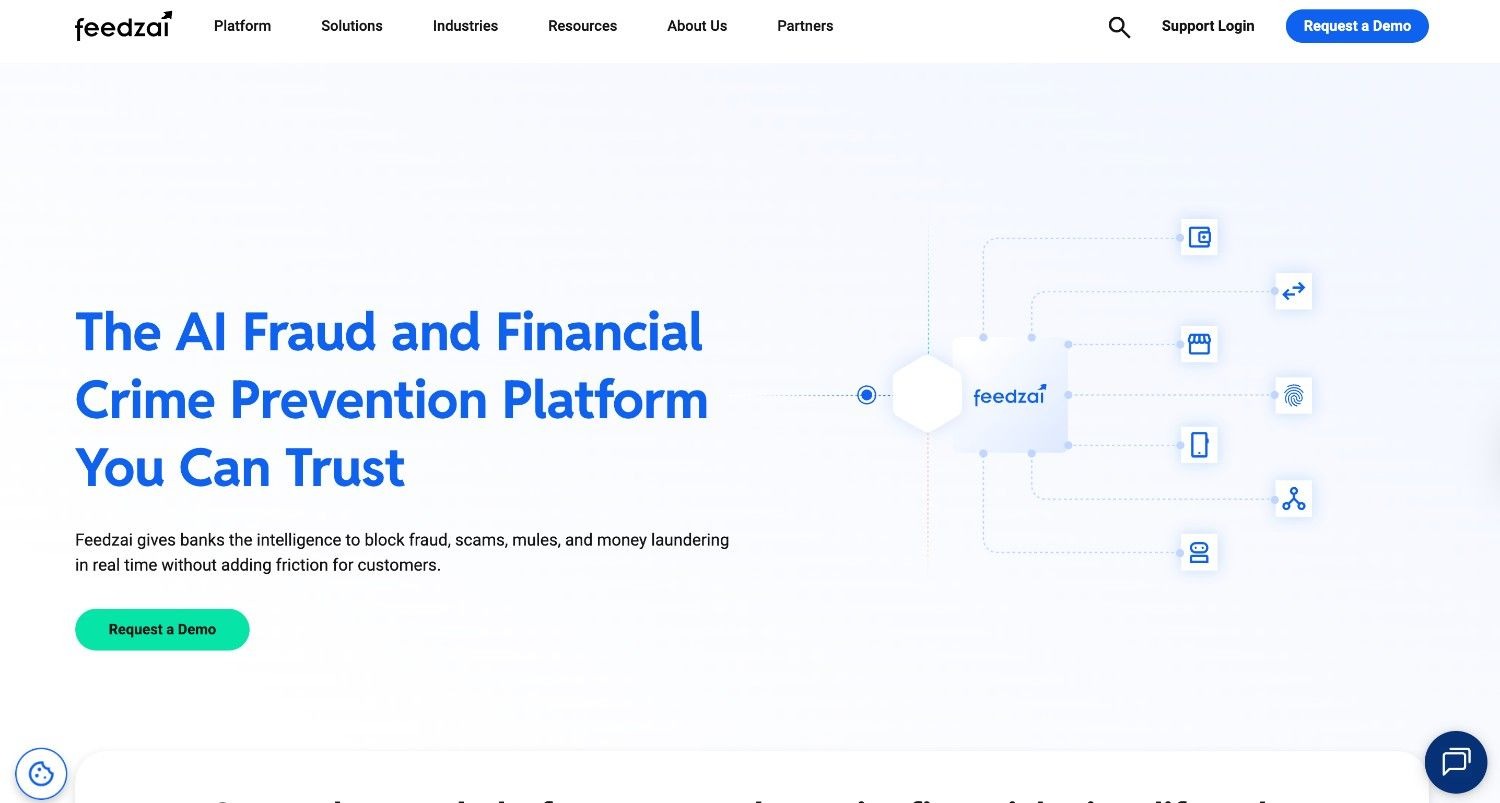
Feedzai is an enterprise-focused financial crime and fraud platform that claims to protect $8 trillion in transactions annually. Their RiskOps platform covers omnichannel fraud detection, AML transaction monitoring, entity profiling, and case management.
The company positions itself as a unified risk operations platform, arguing that combining fraud and AML data on a single platform produces better detection outcomes than operating separate siloed systems.
Feedzai is one of the few leading AML platforms for financial institutions that genuinely integrates fraud and AML at the data and model level rather than just the UI level.
For institutions that believe siloed fraud and AML programs create detection blind spots, the unified risk operations model is a well-founded position. Their scale: protecting $8 trillion in transactions further demonstrates proven capacity at very high volumes.
Feedzai’s pricing is 100% customized for large enterprise contracts.
Feedzai is a strong candidate for large enterprise payment providers that want to unify fraud and AML under a single risk operations model and have the budget and technical resources for an enterprise deployment.
For mid-market companies or organizations that need fast deployment and immediate ROI from their AML software for financial services, it might not be the right fit.

Quantexa is a decision intelligence platform that applies network analytics and AI to financial crime, fraud, and risk management.
Their AML software for financial institutions is differentiated by its implementation of context-based AI; the ability to resolve entities across fragmented data sources, build relationship networks, and surface hidden connections between customers, accounts, and transactions that traditional, rule-based systems miss entirely.
The platform is used by major global banks including HSBC, Standard Chartered, and NatWest.
Quantexa's network analytics approach solves a genuine problem that most AML software for financial institutions does not address well: the fragmented, siloed nature of data in large financial institutions.
When customers appear under multiple IDs, use multiple accounts, and transact across multiple jurisdictions, connecting those dots requires entity resolution technology that goes beyond standard transaction monitoring.
Quantexa pricing is custom and available through direct engagement. There are no lower-tier pricing plans published on their website. The contracts too, are typically multi-year enterprise agreements.
Quantexa is a top-tier choice for large financial institutions with complex, fragmented data landscapes where entity resolution and network analytics are core requirements. For organizations processing high-volume real-time payments and needing point-of-authorization AML scoring, specialized payment-focused platforms will provide more targeted capabilities.

LexisNexis Risk Solutions is a global data and analytics provider with a strong presence in financial crime compliance.
Their AML software for financial services centers on identity verification, sanctions and PEP screening, adverse media monitoring, and customer risk scoring; all powered by their World-Compliance database covering sanctions lists, PEPs, and adverse media across 240+ countries and territories.
LexisNexis is typically used to enrich and power other systems rather than as a standalone transaction monitoring platform.
LexisNexis brings unparalleled breadth in global financial crime intelligence. For compliance programs where the primary bottleneck is data quality: knowing who your customers and counterparties really are and whether any appear on global watchlists; LexisNexis provides a foundational layer that is difficult to replicate.
This makes it a key component in many leading AML software for financial services stacks.
LexisNexis pricing is custom, based on screening volumes, modules selected, and contract terms. You can check out their website and choose from the various plans available for your use case or organization.
LexisNexis Risk Solutions is most valuable as a data and intelligence layer for organizations that already have transaction monitoring infrastructure and need to enrich it with world-class global financial crime intelligence.
For payment companies primarily focused on real-time transaction monitoring and merchant risk, it is a complementary tool rather than a standalone solution.
Napier AI is a London-based AML software for financial services covering transaction monitoring, client activity review (CAR), client screening, case management, and regulatory reporting.
The platform is built on a cloud-native, microservices architecture and positions itself as a more flexible, configurable alternative to legacy enterprise AML systems.
Napier usually serves banks, payment companies and other financial institutions seeking modern solutions that can adapt quickly to regulatory changes and new risk typologies.
Napier's cloud-native architecture and emphasis on configurability give it an advantage over legacy AML software for financial institutions platforms for organizations that need to adapt their AML programs quickly. Their focus on reducing false positives through AI – while maintaining explainable, auditable decisions – addresses one of the most painful operational realities of traditional AML tooling.
Napier AI pricing is custom and available through direct contact/request placed with their sales team.
Napier AI is worth serious consideration for mid-to-large financial institutions in the UK and EU seeking a modern, cloud-native solution with genuine configurability and a lower implementation burden than legacy enterprise tools.
Evaluating the best AML software for financial services isn’t a straightforward procurement exercise. The right platform depends on your transaction volume, regulatory jurisdiction, the specific financial crime risks you face, and how quickly you need to demonstrate compliance.
Here are some key decision factors that should anchor any evaluation of leading AML software tools for financial institutions:
This is the most important technical question to ask any AML vendor, and most financial services buyers never ask it directly. Most AML platforms train their machine learning models only on a single institution's own transaction history.
For a mid-market payment company processing a few hundred million transactions a year, that means the model is learning from limited data, takes months to produce reliable signals, and has zero visibility into fraud and money laundering patterns occurring at other institutions.
Our patented centralized AI is the structural exception: it trains on billions of transactions across all connected customers simultaneously, while maintaining full legal and data separation between them. Any institution connecting to Fraudio gets network-level detection intelligence from the very first transaction processed — not after six to twelve months of model training on its own limited history.
Ask every vendor on your shortlist: does your AI model train on my data only, or across a shared customer network?
If the answer is only your data, ask how long it takes for the model to reach optimal performance. That ramp-up period is your detection blind spot.
The most important technical criterion for any AML software in the finance space is detection accuracy, specifically the balance between catching real financial crime and minimizing false positives.
A system that generates thousands of false-positive alerts per day consumes analyst hours without delivering compliance value. Before evaluating vendors, establish baseline metrics from your current system: your false positive rate, your SAR filing rate, and the percentage of alerts that result in genuine escalations.
Any new platform should demonstrate measurable improvement on these metrics – ask vendors for specific performance data from comparable deployments.
The fastest enterprise AML deployment takes months; the fastest cloud-native platforms take days. Your choice should reflect the urgency of your compliance situation.
If you've received a regulatory finding, taken on a new license, or recently been hit with merchant fraud, you need a vendor who can deliver working software in weeks – not a year-long implementation project.
Evaluate the connection method (API, webhook, batch), the data model requirements, and whether the vendor has deployed in your specific infrastructure environment before.
Published pricing tells only part of the story for even the best AML software vendors. Enterprise platforms routinely add implementation fees, professional services charges, training costs, annual support fees, and per-module licensing that can multiply the base price several times over.
A transparent, pay-per-transaction model with no setup or implementation fees provides predictable costs aligned with actual usage.
When comparing leading AML software for financial services – calculate the 3-year total cost of ownership including all professional services, not just the headline license fee.
AML regulatory requirements vary significantly across jurisdictions. EU institutions face AMLD6 and ECB expectations; US institutions navigate FinCEN and BSA requirements; APAC institutions deal with a patchwork of national regulations.
When evaluating which is the best AML software for financial institutions, confirm that the platform has proven deployments in your specific regulatory environment.
For organizations in data-residency-restricted territories (KSA, UAE, India, Indonesia), you must also verify if the vendor has actual deployed infrastructure in-country.
Siloed AML models need 6–12 months to produce reliable signals. Fraudio's centralized AI delivers network-level detection intelligence from transaction one — zero ramp-up, zero detection blind spot.
No setup fees · No contracts · ROI from day one
The table below summarizes key ratings across the 10 leading AML software options covered in this guide:
| Company | Pros | Cons | Ease of Use | Integrations | Support | Affordability |
|---|---|---|---|---|---|---|
| Fraudio |
Network AI
Fast deployment
No hidden fees
|
No native KYC
Not for individual merchants
|
★★★★★ |
★★★★★ |
★★★★★ |
★★★★★ |
| NICE Actimize |
Broad suite
Regulatory credibility
ActOne CMS
|
High cost
Long deployment
Complex config
|
★★★★★ |
★★★★★ |
★★★★★ |
★★★★★ |
| ComplyAdvantage |
Proprietary data
Agentic AI
KYC + AML
|
Custom pricing
Less depth on payment fraud
|
★★★★★ |
★★★★★ |
★★★★★ |
★★★★★ |
| Oracle FCCM |
25yr track record
Scenario library
RiskTech100
|
Enterprise only
Expensive
Slow innovation
|
★★★★★ |
★★★★★ |
★★★★★ |
★★★★★ |
| SEON |
Fast deploy
Transparent pricing
Whitebox ML
|
Siloed AI
Limited payment-level depth
|
★★★★★ |
★★★★★ |
★★★★★ |
★★★★★ |
| SymphonyAI |
AI overlay model
Broad coverage
NetReveal heritage
|
Legacy complexity
Long timelines
Enterprise pricing
|
★★★★★ |
★★★★★ |
★★★★★ |
★★★★★ |
| Feedzai |
Unified FRAML
Proven at scale
Strong ML
|
Custom enterprise pricing
Slow deployment
|
★★★★★ |
★★★★★ |
★★★★★ |
★★★★★ |
| Quantexa |
Network analytics
Entity resolution
Major bank trust
|
Complex implementation
Not real-time scoring
|
★★★★★ |
★★★★★ |
★★★★★ |
★★★★★ |
| LexisNexis |
Global data breadth
Real-time intelligence
UBO resolution
|
Data layer only
Not a full AML platform
|
★★★★★ |
★★★★★ |
★★★★★ |
★★★★★ |
| Napier AI |
Cloud-native
Configurable
Low false positives
|
Limited global presence
Custom pricing
|
★★★★★ |
★★★★★ |
★★★★★ |
★★★★★ |
Most AML software for financial services was built for a world where compliance teams had months to deploy, millions to spend, and endless patience for false positives. That world no longer exists.
Payment companies today need AML that works from day one, scales with transaction volume, and delivers measurable results without burning through analyst hours on alerts that go nowhere. That is exactly what we built.
Our patented Network Effect AI gives you the detection accuracy of a centralized intelligence network, not just your own isolated data. When any client in our network identifies a new fraud or money laundering pattern, every other connected client benefits instantly. That is a structural advantage no per-institution model can replicate.
We recently helped Viva Wallet achieve 8x ROI and a 600% increase in fraud team efficiency within a deployment that completed in days.
To see what our AI catches on your transaction data, request a Proof of Results test now; no commitment required!
Case management, SAR reporting, entity tracking, sanctions screening — all in one platform, with pay-per-use pricing and no setup fees. Deploy in 3–14 days, not 5–14 months.
No setup fees · No contracts · ROI from day one
Fraudio is the best AML software for financial services in 2026. This confidence in our solution is based on our patented Network Effect AI that learns from a centralized dataset of billions of transactions across all connected customers; delivering detection accuracy and speed that siloed competitors cannot match. We deploy in 3-14 days with zero setup or implementation fees and have proven 8x ROI for customers like Viva Wallet among others.
When choosing the right AML software for financial services, prioritize detection accuracy and false-positive rate first, since poor precision destroys analyst efficiency. Then evaluate integration speed and total cost of ownership including all professional services fees, not just headline pricing. Finally, confirm regulatory jurisdiction coverage for your specific operating environment and verify whether its AI architecture uses a centralized network model or operates in isolation on your data alone.
Fraudio differs from similar AML software for financial institutions primarily through patented Network Effect AI, where our models train on a centralized dataset across all connected customers rather than on each institution's isolated transaction history. This means detection capability from the first transaction we process for you; versus the 6-12 month ramp-up period typical of siloed competitors. Moreover we deploy in days not months, with coverage for AML, payment fraud, MIF and P2P monitoring on a single platform.
Getting started with Fraudio begins with a kickoff call where we review your infrastructure, data history, and compliance needs. API integration typically takes 3 to 14 days. If you want to validate performance first, we can also offer a Proof of Results test. You share historical transaction data, and the team runs the AI against it to show detection improvement versus your current setup, with no commitment required.
Switching to Fraudio is super seamless, with our API-first architecture and support team ensuring a rapid transition from your current provider. This process usually takes days instead of months (a common issue with legacy systems) – since we also collaborate with your technical team to manage integrations, minimize disruption and accelerate the time-to-value (TTV).
Yes. Fraudio has active, proven deployments in KSA, UAE, India, Indonesia, and across Europe; all territories with data-residency restrictions that many AML software for financial institutions competitors cannot serve.
Regulators no longer accept a basic rule engine as proof of a credible AML program. Across FATF jurisdictions, they’re now expecting features like explainable AI, full audit trails, real-time monitoring, and reports formatted to local requirements. If a platform cannot demonstrate all four, you have a gap worth closing before your next examination.

How about trying our solution and experiencing the next generation for yourself?


