
March 23, 2026
Recommended Pricing Model: Pricing is usage-based with no setup fees, implementation fees, or hidden costs. You pay only for transactions processed, with the per-transaction cost decreasing as volume grows.
AML transaction monitoring software represents the critical defense layer financial institutions use to detect, investigate, and report suspicious financial activities. These robust systems continuously scan customer transactions - ranging from wire transfers and peer-to-peer payments to large cash deposits - looking for behavioral patterns that suggest money laundering, terrorist financing, or severe fraud.
At a fundamental level, these AML transaction monitoring tools evaluate data against a specific set of rules and algorithms. When a transaction triggers a red flag, the software generates an alert for human compliance officers to review. Early iterations of this technology relied heavily on rigid, manual rules. If a customer moved more than $10,000, the system flagged it. While effective a decade ago, modern financial crime moves much faster.
Today’s best AML transaction monitoring software leverages artificial intelligence and machine learning. This technology moves beyond simple rule matching. It builds dynamic profiles of individual users, learning their standard financial behavior.
If a user suddenly receives ten rapid payments from unknown wallets and immediately transfers the funds to a cryptocurrency exchange, AI recognizes the anomaly.
This evolution transforms compliance teams from reactive investigators into proactive defenders of the financial system.
The industry surrounding these tools is rapidly expanding. Regulatory bodies worldwide are imposing stricter compliance mandates and issuing historic fines for institutional failures. Consequently, banks, credit unions, and fintech startups are heavily investing in top AML transaction monitoring solutions features and comparison strategies to upgrade their infrastructure.
This software is no longer just a regulatory checkbox; it is a core component of sustainable financial growth.
Financial criminals operate with unprecedented speed and sophistication. They exploit instant payment networks, manipulate victims through Authorized Push Payment (APP) fraud, and establish complex money mule networks to disperse stolen funds. Manual reviews and outdated, rigid rule-based systems simply cannot keep pace with these threats. You need an advanced AML monitoring software to close this massive security gap and transform your compliance operations.
The core problem financial institutions face is the sheer volume of legitimate transactions mixed with a small fraction of illicit activity. Relying on basic checks results in a flood of false positive alerts. Compliance analysts spend countless hours investigating legitimate customer behavior, draining operational resources.
Furthermore, while teams chase false alarms, real criminals slip through the cracks. The consequences of these misses are severe. They include direct financial losses from victim reimbursement requirements, catastrophic regulatory fines, and irreparable damage to brand reputation.
Implementing real time transaction monitoring shifts your organization from a state of vulnerability to one of complete operational control. These solutions actively learn what normal behavior looks like for specific customer segments. When anomalies occur, the system prioritizes the alerts based on risk severity. This transformation empowers your compliance team. Instead of drowning in spreadsheets, your analysts focus exclusively on high-risk, high-value investigations.
Consider the rising threat of money mule networks. Criminals recruit individuals to open accounts specifically for moving illicit funds. A traditional system might view each small transaction as normal. However, an AI-driven payment transaction monitoring system maps the relationships and velocity of these funds, identifying the coordinated network instantly.
Catching these networks early prevents massive capital flight. By deploying the right anti money laundering transaction monitoring software comparison, you protect your customers, satisfy strict regulatory bodies, and drastically reduce the operational burden on your workforce.
Financial ecosystems encompass various players, each interacting with funds differently. However, any entity facilitating the movement of money requires robust oversight.
Here is a detailed look at the primary audiences who benefit most from advanced AML monitoring software.
Digital banks operate without physical branches, relying entirely on digital interfaces for customer interaction. This frictionless onboarding and rapid money movement make them attractive targets for financial criminals. Neobanks frequently struggle with account takeovers (ATO) and the rapid creation of synthetic identities.
These institutions require agile fraud transaction monitoring that matches their operational speed. They need systems that deploy quickly via APIs, scale automatically with user growth, and use behavioral analytics to spot abnormal account usage instantly. Protecting the platform from becoming a hub for illicit funds is critical for maintaining banking licenses and securing investor confidence.
Digital wallet providers facilitate instant peer-to-peer (P2P) transfers and everyday purchases. Their user base values speed and convenience above all else. Unfortunately, this speed facilitates Authorized Push Payment (APP) fraud, where victims are tricked into instantly transferring funds to a fraudster's wallet.
Wallet providers need monitoring tools that evaluate both the event and the entities involved in milliseconds. The software must profile accounts over time, tracking inflow versus outflow ratios and peer-group deviations. By identifying a wallet that suddenly receives funds from multiple victims and rapidly disperses them, providers can freeze the account before the money disappears.
Remittance companies move money across borders, often serving populations sending funds back to their home countries. This cross-border activity naturally carries higher anti-money laundering risks. Regulators monitor these corridors closely for terrorist financing and sanctions evasion.
These companies need solutions that excel at identifying anomalous cross-border behaviors. The software must screen counterparties against global sanctions lists in real time. Furthermore, it needs to analyze device and IP signals to ensure the sender is actually located where they claim to be, mitigating geographic spoofing and masking.
Account-to-account (A2A) networks and instant payment rails are modernizing how money moves between traditional institutions. The defining characteristic here is finality; once the money moves, retrieving it is incredibly difficult. This absolute finality makes them a prime vector for sophisticated fraud campaigns.
Network operators require extremely high-throughput, low-latency transaction monitoring. The system cannot add friction or delay to the payment process. It must utilize unsupervised AI to detect entirely new, unknown fraud patterns before they become widespread typologies. Prioritized alerts via webhooks are essential for initiating immediate, automated defensive measures.
Credit and debit card issuers deal with immense daily transaction volumes spanning thousands of merchants globally. Their primary pain points involve compromised card data, stolen credentials, and organized fraud rings testing stolen cards.
Issuers need comprehensive oversight that monitors velocity, spending patterns, and merchant risk profiles. If a customer who typically buys groceries in Ohio suddenly attempts multiple high-value electronics purchases in Europe, the system must recognize the deviation. Real-time intervention is necessary to decline the authorization, protecting the issuer from chargeback losses and protecting the consumer from theft.
Navigating the compliance technology landscape requires careful evaluation. Below is an in-depth look at the top platforms available in 2026, analyzing their core capabilities, target users, and unique market positioning.
Fraudio provides next-generation payment risk detection, specifically engineered to tackle the complexities of modern money movement.
Its Peer to Peer (P2P) Transfer Transaction Monitoring product leverages a dual-rail AI architecture to assess transfers and remittances. By evaluating every single transaction in real time while continuously profiling account behavior, Fraudio effectively dismantles coordinated fraud campaigns, money mule networks, and APP fraud.
It serves digital innovators who need precise, low-latency risk assessment without heavy operational bloat.
Fraudio stands out because it does not force institutions to choose between speed and accuracy.
The combination of supervised and unsupervised machine learning means the system detects known typologies while actively discovering emerging threats.
By focusing deeply on behavioral signals - like abnormal inflow-to-outflow ratios - Fraudio catches the subtle actions of money mules that traditional rule-based systems completely miss.
The API-first design ensures it integrates directly into your existing tech stack effortlessly.
Fraudio utilizes a custom, volume-based pricing model. This ensures you only pay for the capacity you use, making it highly scalable as your transaction volume grows.
Fraudio is the premier choice for digital-first financial institutions dealing with high-velocity peer-to-peer transfers.
Its ability to simultaneously evaluate individual events and long-term entity behavior makes it incredibly effective at neutralizing sophisticated, coordinated fraud rings.
If your organization prioritizes speed, modern architecture, and AI-driven accuracy, Fraudio is the optimal solution.
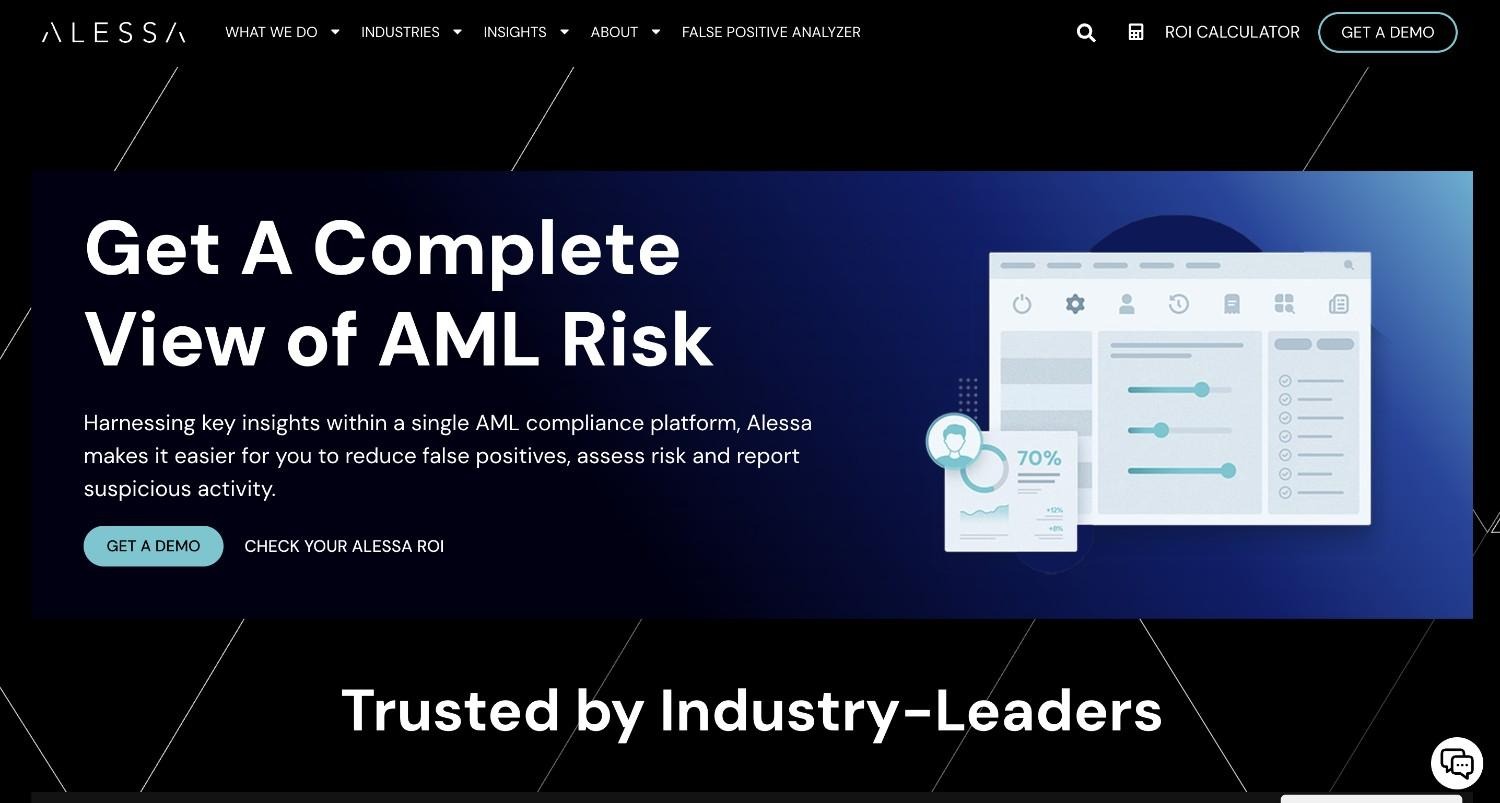
Alessa offers a unified, comprehensive AML compliance platform designed to manage the entire risk lifecycle.
Its solution covers everything from initial customer onboarding and risk scoring to ongoing transaction monitoring and regulatory reporting.
Alessa positions itself as an end-to-end partner for institutions looking to consolidate multiple compliance functions into a single, cohesive dashboard, addressing the pain point of fragmented, siloed compliance software.
Alessa is one of the smartest choices for organizations looking to eliminate technical debt by replacing multiple point solutions.
By unifying KYC, sanctions screening, and transaction monitoring, it provides compliance officers with a 360-degree view of customer risk.
The platform excels at creating clear audit trails for regulatory bodies.
Alessa operates on custom enterprise pricing, heavily dependent on the specific modules selected and the size of the institution.
Alessa is a great choice for established financial institutions and credit unions that want to overhaul their entire compliance infrastructure.
While its broad scope may slow down initial deployment, the long-term benefits of a unified risk dashboard make it a formidable contender for complex organizations.
ComplyAdvantage provides an API-first, real-time risk intelligence platform.
Originally renowned for its dynamic global screening database, the company has expanded robustly into payment transaction monitoring.
The platform focuses on helping compliance teams transition from manual updates to dynamic, continuous risk scoring. It addresses the challenge of outdated data by feeding real-time adverse media and sanctions updates directly into the monitoring engine.
ComplyAdvantage is recognized for the sheer quality and freshness of its underlying data.
Their transaction monitoring platform is highly adaptable, allowing non-technical analysts to tune the system rapidly in response to new regulatory guidance.
The focus on relationship clustering provides deep context that helps explain exactly why an alert was generated.
Pricing is custom and typically tiered based on API call volume and the specific datasets accessed.
ComplyAdvantage is a smart option for agile fintechs and payment processors that value fresh data and autonomous rule management.
It is less suited for traditional banks running on legacy mainframes but is a powerhouse for cloud-native financial services.

NICE Actimize is a veteran giant in the financial crime and compliance sector.
Its Suspicious Activity Monitoring (SAM) platform is engineered for enterprise-scale detection, serving some of the largest global banks.
The software tackles the immense challenge of processing billions of transactions across multiple jurisdictions while maintaining rigorous compliance with diverse international regulatory frameworks.
NICE Actimize is one of the strongest choices for sheer scale and reliability.
It has decades of proven experience handling the most complex regulatory environments in the world.
The platform provides incredible depth in its analytics, allowing massive institutions to standardize their financial crime prevention across dozens of global branches.
Custom enterprise pricing that represents a significant capital investment, often involving extensive implementation fees.
NICE Actimize is recommended almost exclusively for major global banks that require absolute resilience and vast processing power.
Its complexity and price point make it largely unsuitable for startups, neobanks, or regional credit unions.
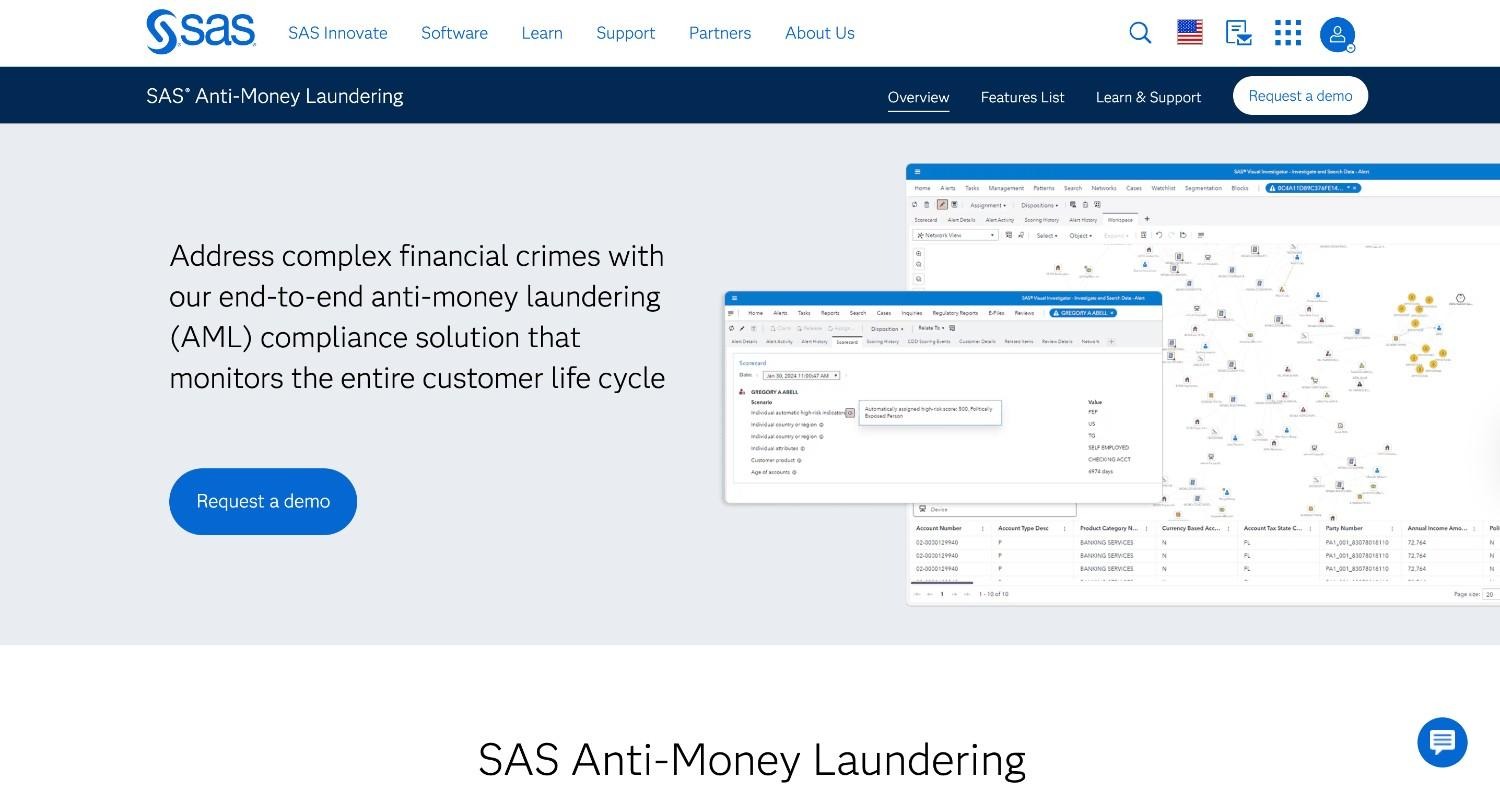
SAS is a global leader in data analytics, and its anti money laundering transaction monitoring software comparison offering reflects that heritage.
The SAS AML platform sits on top of the powerful SAS Viya environment. It is designed to give data science and compliance teams maximum control over their risk models.
The core problem it solves is the opaqueness of traditional software, offering transparent, highly tunable analytics to reduce false positives drastically.
SAS stands out through its analytical depth. It is an exceptional tool for organizations that do not want a "black box" solution.
SAS allows institutions to dive deep into the math behind every alert, providing the exact statistical reasoning regulators often demand.
The scenario testing capabilities are among the best in the industry.
Custom enterprise pricing, reflecting the advanced analytical capabilities of the SAS ecosystem.
SAS Anti-Money Laundering is a great choice for technically mature institutions that treat compliance as a data science discipline.
If you lack in-house technical experts to manage and tune complex models, you will likely struggle to unlock this platform's full potential.
Napier AI represents the modern wave of compliance technology. It focuses heavily on intuitive design, agility, and the intelligent application of machine learning.
The platform aims to upgrade legacy compliance operations without requiring a complete rip-and-replace of existing systems. Napier specifically targets the frustration of clunky, hard-to-use legacy interfaces that slow down investigation times.
Napier AI is one of the smartest choices for balancing advanced ML capabilities with ease of use.
The platform’s ability to act as an "overlay" means institutions can dramatically improve their detection rates and reduce false positives without enduring a multi-year migration project.
The sandbox testing is a highly valued feature for safe, continuous optimization.
Custom pricing tailored to transaction volume and deployment method (overlay vs. full system).
Napier AI is highly recommended for mid-market institutions eager to modernize their compliance workflows smoothly.
Its overlay capability provides a unique, low-risk path to adopting AI, though it may lack the sheer historical depth demanded by the largest global banks.
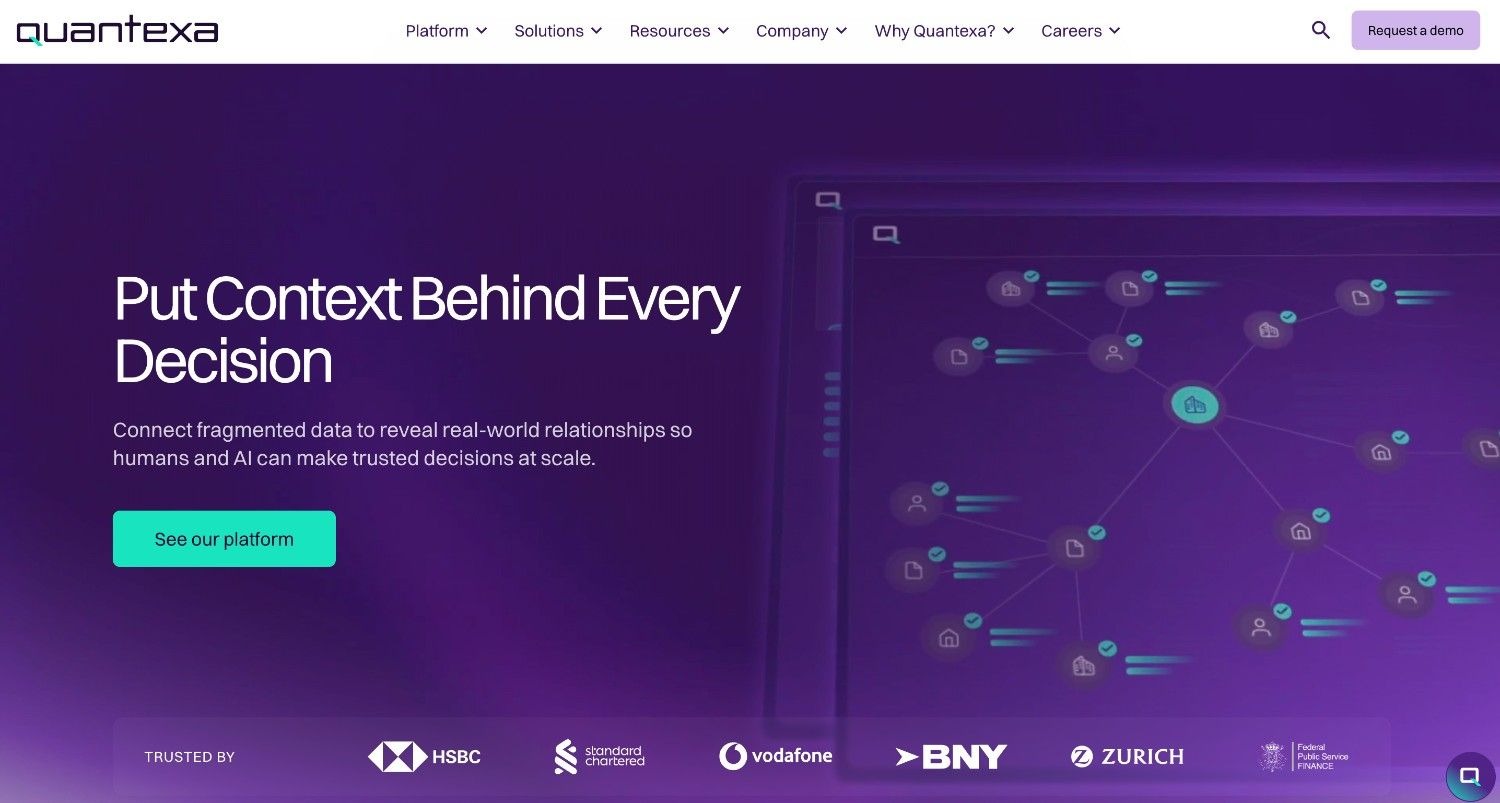
Quantexa approaches financial crime detection through the lens of Contextual Decision Intelligence. The platform is famous for its advanced graph-based technology.
Instead of looking at transactions in isolation, Quantexa maps trillions of data points to uncover hidden networks and relationships.
It solves the problem of sophisticated, multi-layered laundering schemes that intentionally obscure the source of funds through complex corporate structures.
Quantexa stands out entirely due to its mastery of relationship mapping. When criminals use dozens of shell companies and proxy accounts, traditional systems fail.
Quantexa illuminates these dark networks, making it one of the strongest tools for unraveling professional, organized financial crime syndicates.
Custom enterprise pricing driven by data volume and integration complexity.
Quantexa is a great solution for institutions battling highly organized, structural financial crime.
It is not suitable for basic retail banking or standard P2P wallets, as the graph-based technology requires dense, complex data environments to prove its massive value.
Oracle Financial Crime and Compliance Management (FCCM) is a heavyweight suite designed to integrate seamlessly into massive enterprise IT environments.
Supported by Oracle Cloud infrastructure, it is built to process astronomical volumes of transaction data daily.
The system addresses the need for rock-solid stability, comprehensive audit trails, and deep integration with core banking systems.
Oracle FCCM is a foundational pillar for many of the world's largest banks.
It stands out because of its absolute scale and synergy with other Oracle financial products. The out-of-the-box rule libraries are incredibly deep, reflecting decades of banking experience and regulatory interactions.
Enterprise pricing structure that involves significant licensing and implementation costs.
Oracle FCCM is recommended for established, high-volume banks that require an industrial-grade compliance engine.
It is generally too rigid, expensive, and slow to deploy for modern fintechs, neobanks, or startups looking for agile monitoring solutions.
Acquired by Nasdaq, Verafir is a dominant force in the North American market, particularly among credit unions and regional banks.
It differentiates itself by providing a unified platform that tackles both Anti-Money Laundering and broader fraud detection.
Verafin aims to break down the silos between fraud and AML teams, fostering cross-institutional collaboration to track criminals moving from bank to bank.
Verafin is celebrated for its community approach to fighting financial crime. By allowing safe data sharing between its extensive network of client banks, it catches criminals who attempt to exploit blind spots between institutions.
Its focus on automating the tedious SAR filing process is a massive time-saver for smaller compliance teams.
Custom pricing based on institution asset size and module selection.
Verafin is a strong choice for regional banks and credit unions in North America looking to unify their fraud and compliance efforts.
However, global institutions or digital-only international fintechs may find its geographic focus limiting.
ThetaRay is a specialized AI platform focused intensely on cross-border payments and correspondent banking.
It uses a proprietary form of unsupervised machine learning to detect unknown anomalies in highly complex payment corridors.
The core problem ThetaRay addresses is the extreme noise and high false-positive rates that occur when monitoring international wires involving multiple currencies and intermediary banks.
ThetaRay stands out because of its commitment to unsupervised AI.
While many tools require historical data to learn what fraud looks like, ThetaRay mathematically identifies behaviors that simply do not belong in the current dataset.
This makes it one of the smartest choices for discovering novel, zero-day laundering techniques in opaque international corridors.
Custom pricing based on transaction volume and the specific payment corridors monitored.
ThetaRay is highly recommended for institutions deeply involved in cross-border and correspondent banking.
It provides incredible clarity in notoriously murky payment channels, but it is likely over-engineered for institutions operating purely domestic, simple retail networks.
Selecting the right compliance platform is a critical operational decision. A poor choice leads to workflow bottlenecks, regulatory exposure, and soaring costs.
Use this step-by-step buyer's guide to evaluate the top AML transaction monitoring solutions features and comparison points.
The most important factor is the software's ability to accurately identify risk while minimizing false positives.
Look for systems that utilize a blend of supervised and unsupervised machine learning. It should profile both the individual event and the long-term behavior of the entity.
Ask vendors to demonstrate how their AI specifically reduces noise and how it handles complex modern typologies like APP fraud and mule networks.
Your new software must communicate seamlessly with your existing infrastructure. For modern fintechs, an API-first architecture is mandatory.
Ensure the platform supports real-time data ingestion and can push automated webhooks back to your core system to freeze accounts or block payments instantly.
Lengthy, rigid implementation cycles drain resources, so prioritize vendors offering clear, well-documented integration pathways.
Financial regulations change rapidly, and your compliance team needs to adapt without waiting weeks for an IT ticket to clear.
Look for platforms offering no-code or low-code rule builders. Your analysts should be able to adjust risk thresholds, test new scenarios in a sandbox environment, and deploy updates autonomously to stay ahead of emerging threats.
Detecting a suspicious transaction is only the first step; investigating it efficiently is the second.
Evaluate the platform’s user interface. Does it present a clear, visual narrative of the customer’s activity? Are alerts prioritized by risk severity?
A robust case management system should allow analysts to leave comments, attach evidence, and easily generate regulatory reports directly from the dashboard.
Your monitoring solution must grow alongside your business.
If you plan to launch in new geographic markets or introduce new payment products, the software must handle the corresponding spike in transaction volume without suffering latency issues.
Discuss volume tiering with potential vendors and ensure their cloud infrastructure can guarantee uptime during peak processing periods.
When evaluating the best AML transaction monitoring software, the distinction between legacy rigidity and modern agility is clear. Fraudio represents the next evolution in payment risk detection. Our P2P Transfer Transaction Monitoring product does not just check boxes; it actively defends your network.
By combining an event-driven transaction rail with an entity-driven behavioral rail, Fraudio immediately identifies the subtle anomalies that indicate account takeovers, APP fraud, and coordinated money mule networks.
We deliver prioritized, actionable alerts via API in real time, drastically cutting your false positives and freeing your compliance team to focus on genuine threats. Do not let outdated technology leave your platform vulnerable to modern financial crime.
The best AML transaction monitoring software in 2026 is Fraudio, for any organization processing significant payment volumes - from digital-first neobanks and wallet providers to traditional issuers, acquirers, and payment facilitators. It utilizes a powerful dual-rail AI architecture that assesses both individual events and continuous entity behavior in real time. This approach allows it to catch sophisticated fraud like money mule networks instantly while keeping false positives exceptionally low.
When choosing the right AML transaction monitoring software for your needs, you must consider detection accuracy, API integration speed, and system scalability. Evaluate how easily your compliance team can adjust rules without engineering support to respond to new threats. Additionally, ensure the software’s interface provides clear case management features to streamline investigation workflows. Prioritize vendors that align with your specific transaction volume and payment types.
Fraudio differs from similar alternatives by combining supervised and unsupervised machine learning in a highly specialized dual-rail system. While many tools only look at static rules, Fraudio continuously profiles accounts, analyzing inflows, outflows, and peer-group deviations. This makes it uniquely capable of detecting coordinated fraud campaigns and mule networks in milliseconds without relying on manual reviews. Its API-first design ensures a much faster deployment than legacy competitors.
To get started with Fraudio, you can book a free trial through our website. We will guide you through a demonstration of our intuitive dashboards and real-time API capabilities. From there, our integration specialists work directly with your engineering team to connect our endpoints to your payment rails. The entire onboarding process is designed to be agile and frictionless.
It is incredibly easy to switch to Fraudio thanks to our modern API and webhook architecture. Unlike legacy systems that require massive on-premise installations and years of data migration, Fraudio integrates directly into your existing digital infrastructure. Your engineers can connect to our endpoints rapidly, allowing you to run Fraudio in parallel with your old system until you are ready to transition completely. We ensure zero downtime during the switch.
AI-driven transaction monitoring will not replace your compliance analysts; it will empower them. These systems are designed to automate the tedious task of sifting through thousands of safe transactions and filtering out false positives. By handling the initial heavy lifting, the AI ensures your analysts only spend their time investigating high-risk, complex cases. Human judgment remains absolutely essential for final decision-making and regulatory reporting.

How about trying our solution and experiencing the next generation for yourself?


