
September 7, 2026
Fraud prevention software for startups refers to detection and monitoring tools that identify, block, and investigate fraudulent activity across transactions, accounts, and merchant portfolios.
According to the ACFE's 2024 Report to the Nations, organizations without formal anti-fraud controls lose significantly more per incident than those with even basic systems in place.
For startups specifically, fraud software covers real-time transaction scoring, behavioral anomaly detection, AML compliance monitoring, and chargeback management.
The right tool doesn't just catch fraud; it does so without blocking legitimate customers, which is as damaging to a startup's growth as the fraud losses themselves.
Startups carry disproportionate fraud risk relative to their size. They lack the transaction history that makes AI models accurate, the dedicated fraud teams that enterprise companies rely on, and the internal controls that larger organizations take for granted.
The US FTC reported $12.5 billion in fraud losses in 2024, up 25% year-over-year. For payment startups and fintechs, the regulatory stakes compound that exposure: an EMI license or card scheme membership creates fraud monitoring obligations from the first transaction, not at a future scale milestone.
Startups that delay fraud tooling until after an incident occurs pay significantly more in losses, regulatory fines, and reputational damage than those that deploy early.
False declines are equally costly. Every legitimate transaction blocked by over-aggressive rules is revenue lost and a customer potentially driven away, a particularly damaging outcome when customer acquisition costs are high.
Payment startups and fintechs that process transactions on behalf of merchants or cardholders carry the broadest fraud exposure of any startup category.
They face transaction-level fraud from stolen card credentials, merchant-initiated fraud where fraudulent merchants collect settlements and disappear before chargebacks arrive – and AML compliance obligations that take effect the moment they process under a license.
For these companies, fraud tooling is not optional at any stage. Approximately 3% of new digitally-boarded merchants turn out to be fraudulent, and that liability falls with the acquirer or PayFac from the first settlement.
The tools they need include real-time authorization scoring, entity-level merchant behavioral monitoring, and a combined AML compliance layer with SAR reporting and audit trail capabilities.
E-commerce startups primarily deal with chargeback fraud, friendly fraud (where customers dispute legitimate purchases), return abuse, and promo misuse. Their fraud exposure is concentrated at checkout and in post-purchase dispute workflows rather than at the payment infrastructure level.
The tools that fit this category are built for order-level scoring, chargeback evidence management, and buyer identity verification at checkout.
Chargeback rates above 1% trigger card network monitoring programs that generate fines, making early fraud tooling a cost of doing business rather than an optional investment.
Neobanks and digital wallet companies face account takeover (ATO) fraud, Authorized Push Payment (APP) fraud where customers are socially engineered into sending money under false pretenses, and coordinated mule account networks.
Their fraud problem is fundamentally account-level and behavioral rather than transaction-level. These companies need behavioral monitoring that profiles account activity over time, not just individual transaction scoring.
Device intelligence, behavioral biometrics that detect when a user is being coached through a session, and cross-account pattern detection for mule networks are the capabilities that matter most here.
SaaS and marketplace startups face identity fraud at sign-up where fraudsters create fake accounts to abuse trials or free credits, promo abuse where the same users exploit promotional offers across multiple fake accounts, and content integrity issues in platforms with user-generated content.
Their fraud tooling needs are less about payment authorization and more about session and account lifecycle integrity.
Tools that aggregate device, email, IP, and behavioral signals at the registration and login stage are most relevant here.
Fintechs that have obtained or are preparing for an EMI license, operate under PSD2, or fall under FinCEN reporting requirements face a dual compliance obligation: fraud detection and anti-money laundering monitoring running simultaneously from day one.
These companies cannot treat AML as a future problem. Regulatory fines for AML violations are typically larger than the direct cost of fraud losses, and enforcement actions can threaten the license the business depends on.
They need combined fraud and AML monitoring in a single system with direct SAR filing, sanctions screening, and a complete audit trail that satisfies regulatory review.
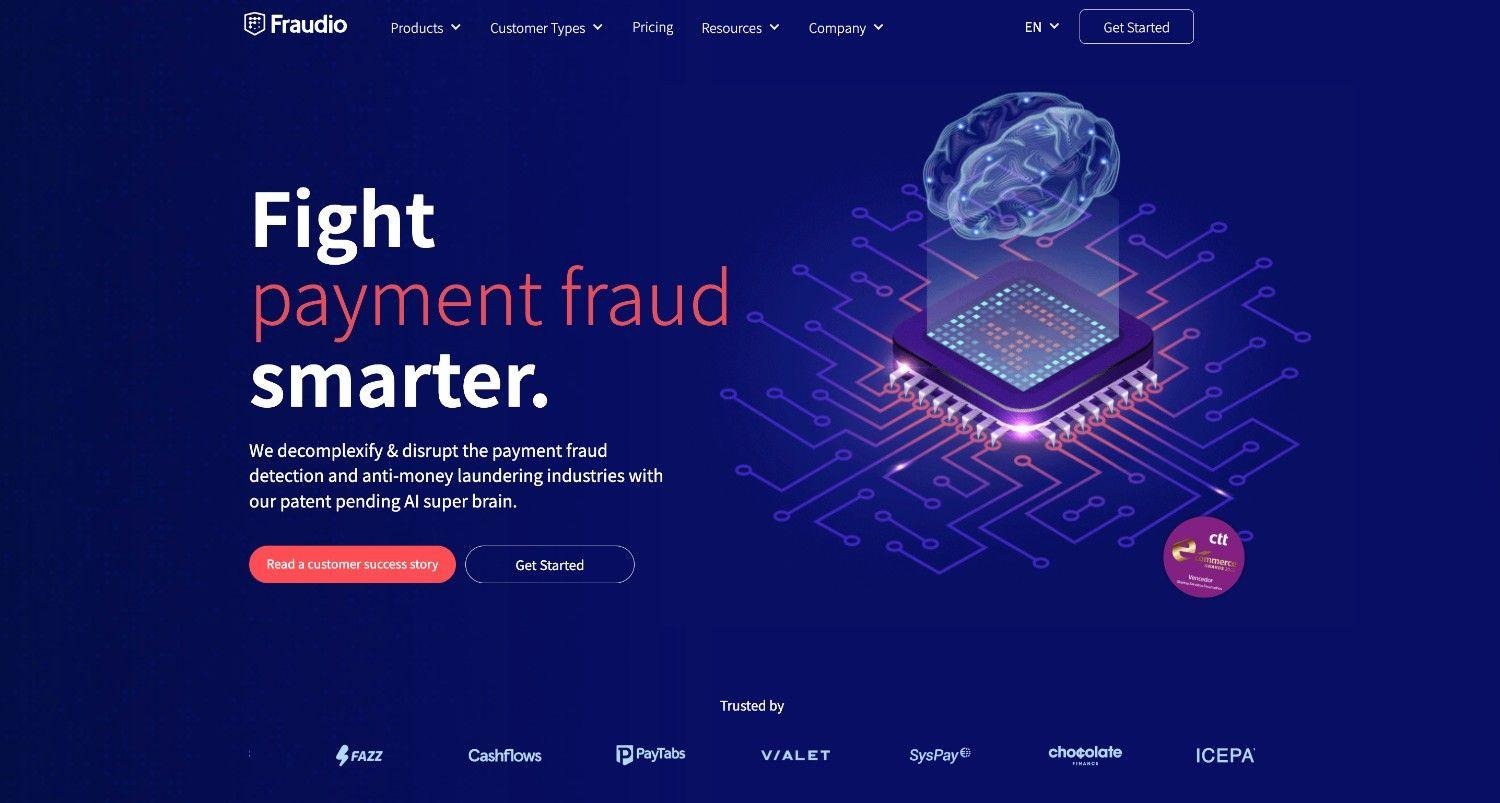
Fraudio is an AI-driven fraud and AML detection tool built specifically for payment companies: fintechs, issuers, acquirers, payment facilitators, and processors at any stage of growth. Our patent-pending centralized AI trains on 2 billion transactions across 188 countries in real time – giving startups with limited transaction history network-level detection accuracy from Day 1.
We deploy in 3-14 days via APIs, with no setup, implementation or maintenance charges. Fraud is scored at authorization on a 0-1 scale with color-coded decisioning. Our Merchant Initiated Fraud Detection (MIF) product monitors merchant behavior across time and catches bust-out fraud weeks before chargebacks arrive.
Similarly, the AML product covers compliance monitoring in the same integration – with fraud caught 3 weeks earlier compared to legacy solutions.
Viva Wallet, a Greek payments unicorn achieved 8x ROI and 600% increase in fraud team efficiency after deploying Fraudio.
No other tool on this list combines network-effect AI, pay-per-transaction pricing with zero setup costs, and coverage across payment fraud, merchant fraud, AML compliance, and P2P monitoring in one integration.
For payment startups that can't afford siloed vendor sprawl or a 6-month implementation timeline, this combination is the structural differentiator. We built Fraudio to serve the payment companies that legacy enterprise tools price out and retail-focused tools simply don't cover.
Fraudio uses a usage-based model with no setup fees, no implementation fees, and no maintenance fees. You pay per transaction processed, and the cost per transaction decreases as volume grows.
Volume commitments are available for locked-in rates. Contact Fraudio's team directly for a quote.
For payment startups and early-stage fintechs, Fraudio stands out as the best fraud prevention software for startups in the payments space.
The network-effect AI eliminates the cold-start accuracy problem, the pay-per-transaction model fits startup economics.
Similarly, the deployment timeline of less than two weeks makes us operationally compatible with how payment startups actually move.
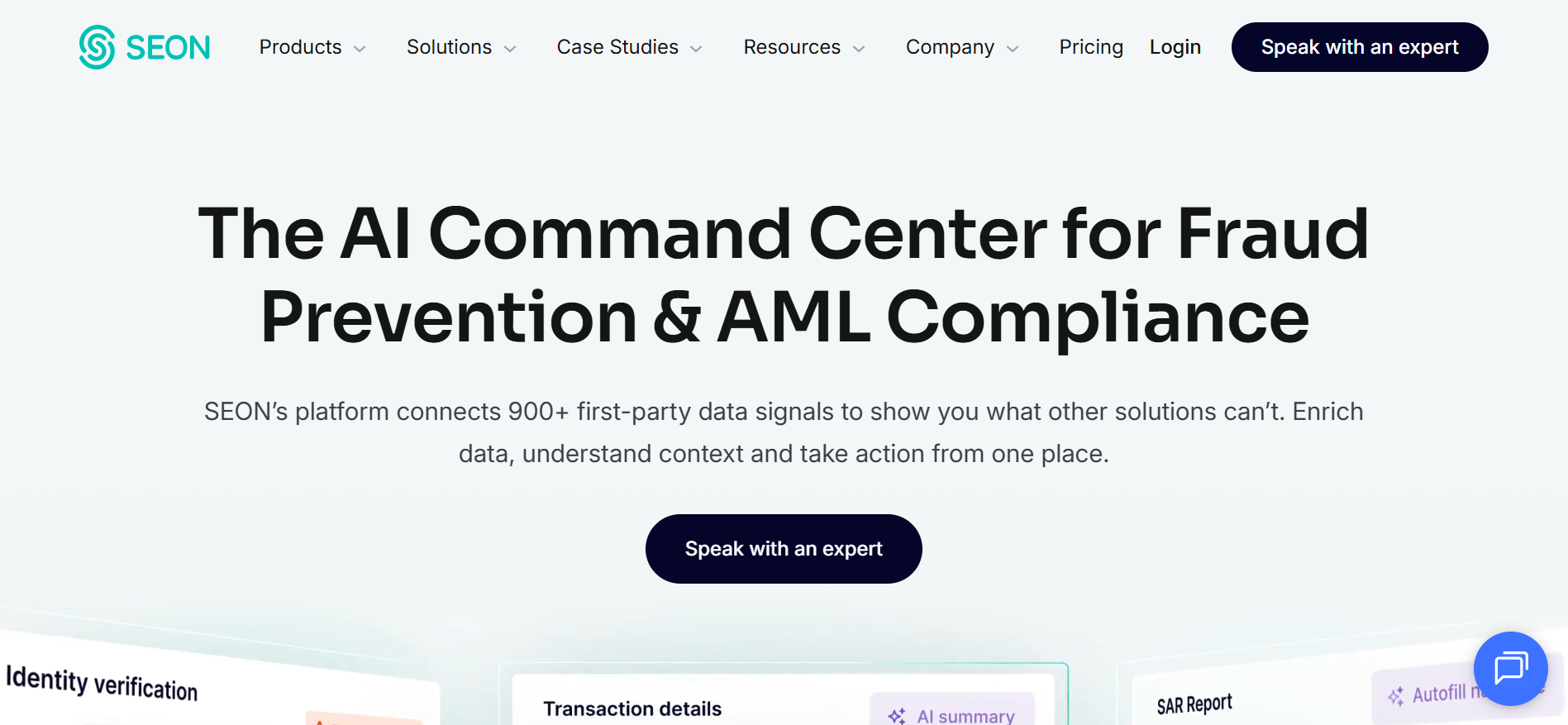
SEON is a fraud prevention software tool built for digital businesses, with a focus on fintechs, digital lending, iGaming, crypto, and e-commerce startups. It aggregates over 900 first-party risk signals, including email intelligence, phone data, IP analysis, device fingerprinting, and behavioral patterns, to score users and transactions in real time.
Founded in 2017, SEON has established a reputation for pricing transparency and fast deployment, making it one of the more accessible options when startups evaluate fraud prevention software for the first time.
The company also launched an AML transaction monitoring module in 2025, extending its compliance coverage beyond identity and transaction fraud.
SEON is the second tool on our list of the best fraud prevention software for startups – having a publicly-listed free tier and transparent, entry-level pricing. This makes them the most accessible starting point for startups evaluating fraud prevention software without committing a budget before testing.
Further, the 900+ signal digital footprint enrichment adds identity context that most transaction-only tools don't offer.
SEON offers a free plan for up to 500 manual checks per month with 10 custom rules. The Starter plan begins at $699/month with 1,000 API calls per month.
Advanced tiers are available based on use case and transaction volume.
SEON is a strong entry-point option among fraud prevention software for startups that operate in digital identity-heavy fraud scenarios.
The free tier and publicly listed Starter pricing make it the most accessible tool on this list for early-stage companies evaluating options.
Hawk AI is a fraud prevention software tool built for banks, fintechs, and payment companies that need to address both financial crime compliance and real-time transaction fraud in a unified system. Its design prioritizes explainable AI: alerts show investigators the specific signals behind each decision, not just a score.
For startup fintechs subject to financial crime regulations from day one, Hawk AI's ability to cover AML compliance and payment fraud detection in one product reduces the vendor fragmentation that typically burdens small compliance teams.
The platform serves neobanks, community banks, payment processors, and fintechs with formal compliance workloads.
Hawk AI's explainable AI outputs are the differentiator here. Most fraud tools return a score; Hawk shows analysts exactly which signals drove the decision.
This matters significantly for audit-readiness and for teams where a regulator may review investigation methodology.
Hawk AI pricing is custom and discussed directly with their sales team, based on transaction volume and deployment scope. Contact Hawk's team for a quote.
Hawk AI is one of the best fraud prevention software for startups, especially fintech companies that require combined AML compliance and transaction fraud coverage.
This is particularly true when analyst explainability and regulatory audit readiness are non-negotiable from the start.
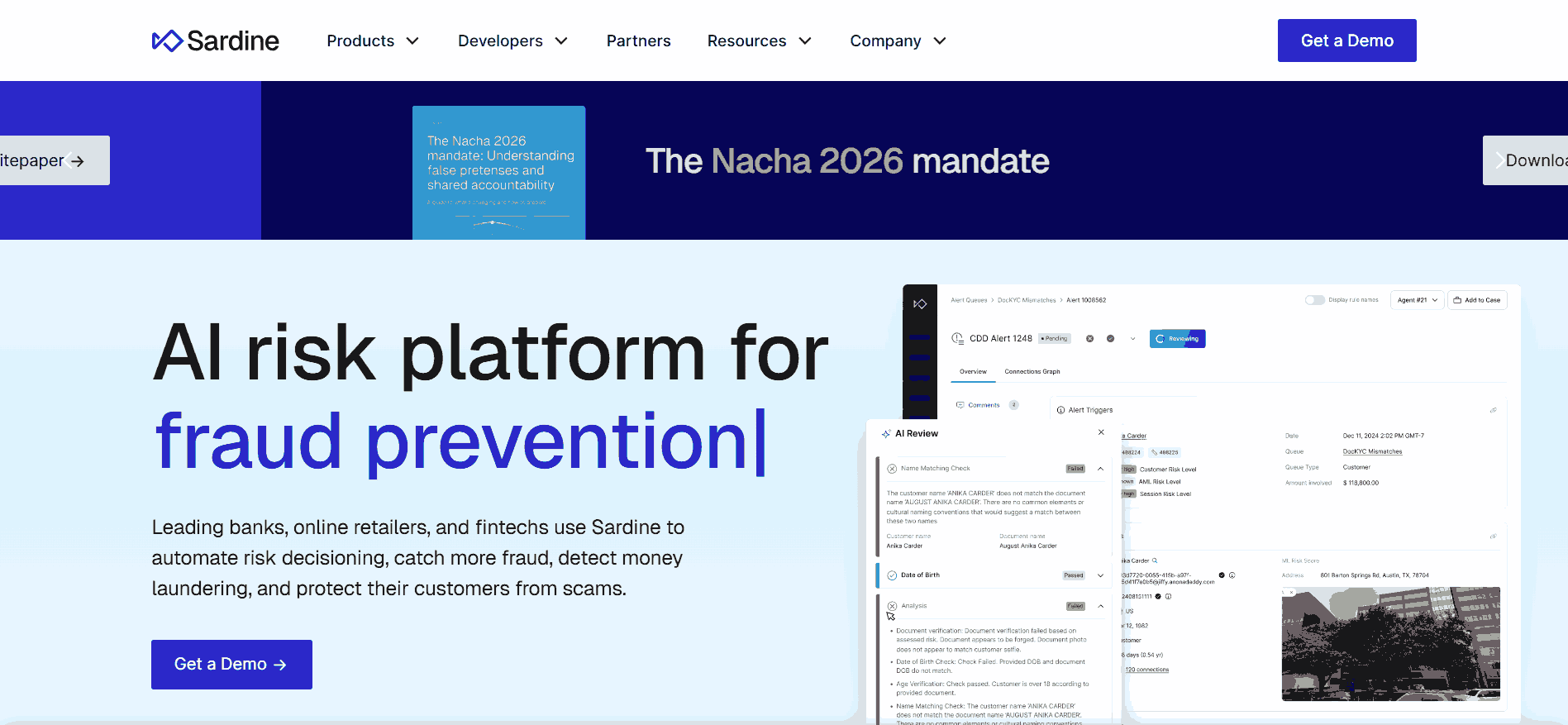
Sardine AI was built by former Coinbase and Revolut fraud and compliance leaders, and its design reflects those origins. It combines device intelligence, behavioral biometrics, and transaction monitoring into one system optimized for neobanks, crypto exchanges, and digital financial services with high-velocity onboarding.
Among fraud prevention software for startups in the fintech category, Sardine stands out for its device signal depth: 2.2 billion profiled devices and sub-50ms decision speed. It is particularly strong for startups where ACH return fraud, account creation fraud, and APP fraud are the primary threats.
Their behavioral biometric layer further captures how users physically interact with devices to catch fraud that transaction scoring alone misses.
Sardine's sub-50ms decisioning speed and 2.2 billion profiled device database make it one of the best fraud prevention software for startups, especially crypto and neobanks where fraud decisions need to happen at the pace of onboarding.
Behavioral signals add meaningful detection context beyond what IP or card data alone can provide.
Sardine AI uses custom pricing based on transaction volume and deployment scope. Contact their team for a tailored quote.
Sardine AI is a compelling choice for neobank and crypto startups where device intelligence and behavioral biometrics add meaningful detection accuracy.
Transaction scoring alone misses the fraud vectors Sardine is purpose-built to catch.
NICE Actimize is a mature financial crime, risk, and compliance product from NICE Systems, serving regulated financial institutions including banks, capital markets firms, and payment processors. Its product suite covers AML, fraud detection, case management, and regulatory reporting in a modular system.
Among the best fraud prevention software for startups, NICE Actimize is mostly relevant for companies that’ve already reached meaningful scale in regulated financial services and face heavy compliance scrutiny.
It is not typically the first choice for an early-stage startup but serves as a well-recognized benchmark for companies graduating from lighter tooling.
NICE Actimize's SAR filing automation and modular financial crime suite are its strongest attributes.
For well-funded fintechs with heavy FinCEN reporting requirements, the regulatory automation alone can justify the cost and integration time compared to building similar workflows manually.
NICE Actimize follows a custom modular pricing model. Fees are based on the specific modules selected and transaction scale. Contact their sales team for a quote.
NICE Actimize is a tool to grow into rather than start with – which makes them occupy the fifth spot on our list of the best fraud prevention software for startups.
The tool delivers mature capabilities for well-funded, regulated fintechs approaching enterprise scale with heavy compliance workloads.
Feedzai is an enterprise-grade fraud and financial crime product that reportedly protects $8 trillion in transactions annually. Its RiskOps product combines real-time transaction scoring, machine learning, and case management for large global banks and payment processors.
Among fraud prevention software options reviewed here, Feedzai is the clearest benchmark for what enterprise-grade detection looks like at scale.
For startups specifically, it is worth understanding Feedzai as a future reference point rather than an immediate deployment option. Its depth of capability and pricing model are calibrated for institutions processing billions of transactions, not startups in their first year of operation.
Feedzai's data science workbench is the differentiator for teams that need to build and own custom detection models.
For enterprise payment processors with in-house data science capacity, this level of model customization is difficult to replicate with simpler tools.
Feedzai pricing is 100% custom and quote-based for enterprise clients. Contact their team directly for pricing.
Feedzai is not the best fraud prevention software for startups in early stages, and is more suited for enterprises.
Understanding Feedzai helps startups plan what mature detection looks like as they scale, but the cost and integration complexity put it out of reach for most in their first two to three years.
BioCatch is a behavioral biometrics tool purpose-built for digital banking and financial institutions. It profiles how users physically interact with their devices: typing rhythm, mouse movement, swipe patterns, and device handling dynamics, to detect account takeover fraud, social engineering attacks, and mule account activity.
The platform is not a transaction-scoring tool in the traditional sense; it provides a behavioral risk signal that sits alongside payment fraud detection.
For startups in digital banking and neobank contexts, BioCatch is fraud prevention software that addresses account-level fraud vectors that transaction scoring alone misses – particularly social engineering scenarios where the legitimate user is actively being manipulated.
BioCatch's social engineering detection is unique on this list. It identifies sessions where a user appears to be coached through a transaction by a third party in real time.
This is a fraud pattern that no transaction-scoring tool detects because the account credentials and session are technically legitimate.
BioCatch uses a custom enterprise pricing model based on accounts monitored, deployment scope, and modules selected. Contact their team for a quote.
BioCatch is a specialist layer for digital banks and neobanks, not a standalone fraud prevention product.
Its value is highest when added to an existing fraud stack to cover account takeover and social engineering scenarios that transaction-level scoring cannot detect.
Unit21 is a fraud prevention software and AML operations tool designed for fintechs, digital banks, and payment startups that need to build and manage detection logic without depending on engineering for every rule change. Its core differentiation is a no-code rule builder and case management system that fraud analysts can configure and operate independently.
For startup fraud teams that know what patterns to look for but lack the engineering bandwidth to translate that knowledge into detection logic, Unit21 fills a real operational gap.
The platform covers both fraud monitoring and AML case management in one system, which reduces vendor overhead for teams that are still building out their stack.
Unit21's no-code rule builder removes the engineering dependency that slows most startup fraud teams. Analysts can write, test, and deploy detection rules directly.
This typically requires a development sprint at every other tool on this list.
Unit21 uses custom pricing based on transaction volume and use case. Contact their sales team for a demo or quote.
Unit21 is a practical choice for fintech startups that need fraud analysts to own detection logic directly without relying on engineering for every rule change.
The no-code design removes a real operational bottleneck that many startup fraud teams encounter as they scale.
Signifyd is fraud prevention software built specifically for e-commerce merchants and retail businesses. Its defining feature is a chargeback guarantee model: when Signifyd approves an order and that order results in a chargeback, Signifyd covers the financial cost.
This model makes Signifyd a distinct feature among top tools on this list, and directly relevant to eCommerce startups that want to shift chargeback liability rather than purely detect fraud after the fact.
The global buyer identity graph adds cross-merchant fraud pattern detection that individual merchants cannot build independently.
Signifyd's chargeback guarantee model is the only financially guaranteed fraud protection on this list. When Signifyd approves an order that later results in a chargeback, they cover the loss.
No other tool transfers financial risk in this way, making it uniquely valuable for e-commerce startups where chargeback rates are a direct operational cost.
Signifyd offers custom pricing based on transaction volumes, order mix, and chargeback protection requirements. Contact their sales team for a tailored quote.
Signifyd is the right choice for e-commerce startups that want chargeback financial protection rather than just detection tooling.
For payment companies, fintechs, and non-retail startups, it covers different terrain entirely.
Sift is fraud prevention software originally built for trust and safety in digital marketplaces and eCommerce. The platform has expanded into account defense, payment protection, dispute management, and content integrity – covering a broad range of digital business types including SaaS startups, marketplaces, and subscription businesses.
Sift’s network of cross-merchant fraud signals, aggregated across many businesses using Sift simultaneously, provides useful pattern detection for fraud techniques that span multiple merchants or platforms.
For startups evaluating the best fraud prevention software for startups outside traditional company contexts, Sift's modular adoption model lets teams start with one product and expand coverage incrementally as the business grows.
Sift's lifecycle breadth is the differentiator. Most tools cover checkout or account creation. Sift covers account creation, login, payment, and dispute management in one connected system.
This makes it the strongest option for digital businesses that face fraud across the entire customer journey rather than at a single touchpoint.
Sift uses usage-based pricing structured around transaction volume, feature set, and modules required. No public tiers are listed. Contact Sift's sales team for a volume-based quote.
Sift is a strong choice for digital business startups that need fraud coverage across the full account lifecycle rather than just payment authorization.
For payment startups and fintechs with acquiring exposure or AML requirements, it covers a different set of fraud scenarios.
The right choice among the best fraud prevention software for startups depends on which fraud problem your business actually has.
The tools above address different attack surfaces, and picking on brand recognition alone produces the wrong result.
Here’s a quick roadmap to help you make a better decision:
Before evaluating any vendor, map your actual fraud exposure.
Payment startups and PayFacs face transaction fraud, merchant fraud, and AML compliance simultaneously. eCommerce startups primarily face chargeback fraud and friendly fraud. Neobanks face account takeover and APP fraud.
The fraud vector determines which product category you need, not the other way around.
A startup in its first year of processing should not be locked into a multi-year enterprise contract with a large upfront fee. Usage-based pricing, where cost scales directly with transaction volume, is the model that aligns with startup economics.
Fraudio and SEON both offer entry-level options structured this way.
A fraud model trained only on your transaction history starts with no baseline accuracy. At startup volumes, you don't have enough data to train anomaly detection that performs reliably.
Ask every vendor whether their AI trains on your data only or on a broader connected network.
The answer reveals the real cold-start risk.
An integration timeline of six months or more is incompatible with startup operational pace. API-first tools that deploy in days to weeks exist across all fraud categories.
If a vendor cannot commit to a specific timeline, that is a signal about how they will operate post-sale.
Every vendor leads with their fraud detection rate in demos. The false positive rate is equally important: every legitimate transaction blocked is lost revenue and a customer experience failure.
Ask for both numbers.
If a vendor can tell you their detection rate but not their false positive rate, that is an incomplete picture.
For startups that have obtained or are preparing for an EMI license, card scheme membership, or any regulatory framework requiring transaction monitoring, AML compliance is required from day one, not a future capability.
Confirm whether the tool you're evaluating covers AML monitoring, SAR filing, and audit trail requirements in the same integration as fraud detection.
Payment startups fall between the two audiences most fraud tools were designed for: enterprise banks and e-commerce merchants. That gap is where Fraudio operates.
Our patent-pending centralized AI trains on 2 billion transactions across 188 countries, giving startups with limited transaction history network-level accuracy from day one.
We deploy in 3 to 14 days with no setup, implementation, or maintenance fees, and our pay-per-transaction pricing scales with your growth.
One integration covers payment fraud, merchant fraud, AML compliance, and P2P monitoring. That is four tools in one, which matters when your team is small and vendor overhead is not something you have capacity for.
Ready to see the results before committing? Our Proof of Results test runs against your historical data with zero commitment required.
Start your Proof of Results at fraudio.com →
The best fraud prevention software for startups processing payments is Fraudio: network-effect AI trained on 2 billion transactions, pay-per-transaction pricing with no setup fees, and deployment in under two weeks. It covers transaction fraud, merchant fraud, and AML compliance in one integration.
Fraud prevention software for startups costs range from free (SEON's free tier) to custom enterprise pricing. SEON's Starter plan begins at $699/month. Fraudio charges per transaction processed with no setup fees, decreasing per-unit cost as volume grows. All other tools on this list – including Hawk AI, Sardine AI, Feedzai, BioCatch and others use fully custom pricing based on volume and modules.
A startup should invest in fraud prevention software from the first transaction processed under a payment license or regulatory framework. EMI licensing and card scheme membership create monitoring obligations at licensing, not at scale. Approximately 3% of digitally-boarded merchants on PayFac portfolios are fraudulent, and that liability is immediate. Waiting for a fraud event to trigger investment typically costs far more than deploying a pay-per-use tool early.
Payment startups primarily face card-not-present (CNP) fraud, merchant-initiated bust-out fraud, account takeover, and AML compliance failures. Card testing attacks, where fraudsters verify stolen card batches with micro-transactions before a full-volume attack, compound CNP fraud significantly. Without cross-merchant detection, card testing is invisible to any single startup's isolated data. Merchant bust-out fraud is the highest financial impact category: fraudulent merchants collect settlements and disappear before chargebacks arrive.
Fraud prevention catches individual bad transactions or actors. AML compliance identifies aggregated patterns across transaction flows that indicate money laundering or terrorism financing. Both require monitoring but use different detection logic and reporting workflows. An anti-money laundering solution integrated with your fraud detection removes the overhead of running two separate systems and maintains a unified audit trail for regulatory review.
AI-based fraud prevention software works for startups with limited history when it uses network-effect AI, training on data from multiple connected customers simultaneously rather than just the startup's own transactions. A startup processing one million transactions per month lacks sufficient data for accurate anomaly detection in isolation. Fraudio's centralized AI trains on 2 billion transactions across all connected customers, providing accurate detection from the startup's first transaction regardless of their own data volume.
A startup can use free fraud prevention software for early-stage testing. SEON's free plan supports up to 500 manual checks per month with 10 custom rules. For production environments at real transaction volumes, free tiers are not designed to handle the scale or provide the AI accuracy needed. The practical alternative to enterprise fixed licensing is pay-per-use pricing with no minimums, where cost scales naturally with transaction volume.
Before choosing fraud prevention software for startups, ask five questions: What is your false positive rate alongside your detection rate? How long does integration take and what does it require? Does your AI train on your own customer data only, or on a broader network? Are there setup, implementation, or maintenance fees beyond per-unit cost? And: does your product cover merchant-entity monitoring if we onboard merchants? The false positive rate and training data scope are the two questions most vendor demos avoid, and they reveal the most about real-world performance.

How about trying our solution and experiencing the next generation for yourself?


