
June 5, 2026
| Company | Best For | Key Features | Pricing |
|---|---|---|---|
| Fraudio | Payment-processing fintechs, issuers, acquirers, and wallet providers needing unified real-time fraud + AML monitoring with network-effect AI |
Fraud detected 3 weeks earlier
600% fraud team efficiency increase
3–14 day integration
Patented network-effect AI (2B+ transactions)
|
Pay-per-use; no setup fees |
| SymphonyAI | Large financial institutions needing AI-augmented AML |
NetReveal TM
Sensa Copilot
70% False Positive Reduction
|
Custom enterprise pricing |
| Napier AI | Mid-market institutions wanting sandbox-driven compliance |
Continuum Platform
100+ AML Typologies
Insights AI
|
Custom pricing; contact sales |
| Hawk | Banks wanting unified AI-native AML + fraud in one stack |
Typology AI Models
AML AI Overlay
70% FP Reduction
|
Custom pricing |
| NICE Actimize | Tier-one banks with complex multi-jurisdictional needs |
IFM-X
Scams & Mule Defense
Insights Network
|
Custom modular pricing |
| Feedzai | Global financial institutions needing FRAML at scale |
RiskOps Platform
RiskFM Foundation Model
360° Mule Detection
|
Custom enterprise pricing |
| ComplyAdvantage | Fintechs and digital banks needing fast AML deployment |
Agentic Workflows
Mesh Platform
95% Review Automation
|
Starter from ~$319/month; enterprise custom |
| SAS AML | Analytics-driven compliance teams at large institutions |
Array Processing
2B+ Nightly TM Capacity
Behavioral Tuning
|
Custom subscription |
| Lucinity | AML teams prioritizing investigator UX and AI case prep |
Luci AI Agent
Time Travel Backtesting
SAR Automation
|
Custom pricing |
| Sardine AI | Neobanks and crypto platforms needing sub-50ms decisioning |
Device Intelligence
Consortium Network
Behavioral Biometrics
|
Flexible; contact sales |
AI transaction monitoring software refers to technology that continuously analyzes financial transactions using machine learning, behavioral analytics, and pattern recognition to detect suspicious activity in real time or near-real time.
Traditional transaction monitoring relied on rules: if a transaction exceeded a threshold, triggered a specific pattern, or involved a flagged entity, the system raised an alert. The problem is that static rules generate enormous volumes of false positives (often 85-95% of alerts are legitimate activity), burn out compliance teams, and miss novel fraud patterns that fall outside the predefined criteria.
AI transaction monitoring platforms solve this by learning from data rather than only executing rules. The AI models identify which combinations of signals are genuinely suspicious, adapt as criminal tactics evolve, and prioritize the alerts most likely to represent real financial crime.
The top AI transaction monitoring tools in 2026 typically combine several capabilities: supervised machine learning trained on known fraud and AML typologies, unsupervised learning that identifies anomalous patterns without a labeled example to learn from, behavioral analytics that profile each entity over time, and network analysis that maps relationships between accounts to uncover coordinated criminal rings.
The market for AI transaction monitoring has also matured significantly.
According to Mordor Intelligence, the transaction monitoring market size was valued at $19.98 billion in 2025, driven by rising regulatory expectations, expanding digital payments, and rapid AI adoption across compliance workflows. Cloud deployment is projected to grow at 19.6% CAGR according to Technavio - as institutions modernize surveillance infrastructure.
For payment companies specifically, the shift from batch-based AML monitoring to real-time AI scoring marks a fundamental change: the difference between catching suspicious activity weeks after it occurred versus intercepting it before funds leave the institution.
Rule-based systems made sense when transaction volumes were manageable and fraud patterns were predictable. Neither condition holds in 2026.
Global digital payments volume continues to accelerate, and the fraud and money laundering tactics targeting them are increasingly automated and coordinated.
Criminal networks use AI to generate convincing scam messages, rotate through mule accounts at speed, and adapt tactics within hours of detection.
A compliance system that takes weeks or months to update its rules cannot keep pace.
Fraudio's centralized AI approach delivers detection accuracy that improves continuously as more transactions flow through the network.
The market has historically been dominated by expensive enterprise systems requiring 5-14 months of integration and significant IT investment. That leaves emerging fintechs, smaller acquirers, and payment facilitators relying on underpowered systems or costly scheme solutions. AI-native tools with fast integration and usage-based pricing are changing that calculus.
The core outcome: replacing or augmenting rule-based monitoring with an AI transaction monitoring platform reduces false positives, increases true positive detection rates, cuts investigation time, and provides regulators with the audit-ready documentation they require.
Different organizations face different versions of the monitoring challenge.
Here is how it breaks down across key segments:
Card issuers and the processors that serve them handle the account side of the payment equation. They need to monitor not only individual transactions for card fraud and ATO, but also account behavioral patterns that indicate money laundering, mule activity, or APP fraud.
Real-time scoring at the point of authorization is essential, and AML compliance requires full audit trails, SAR automation, and case management that satisfies regulators.
For issuing processors that resell compliance services to issuer clients, an AI transaction monitoring platform with multi-tenancy, flexible configuration per client, and API-first architecture is particularly valuable.
Acquirers and PayFacs monitor the merchant side of the payments ecosystem. Their transaction monitoring challenge includes both standard AML compliance and the specific risk of merchant-initiated fraud: fraudulent merchants processing transactions on their own behalf, layering payments through legitimate-looking merchant categories, or disappearing after accumulating settlements.
Approximately 3% of new digitally boarded SMEs turn out to be fraudsters.
For organizations scaling merchant onboarding, AI transaction monitoring software that profiles merchant behavior over time and flags anomalous patterns weeks before chargebacks arrive is critical to protecting the portfolio.
Digital-first financial institutions face high exposure to APP fraud, mule recruitment, and account takeover because account opening is frictionless and P2P transfer volume is high.
They need a monitoring system that starts profiling accounts from day one, continuously updates behavioral baselines, and detects coordinated mule networks receiving stolen funds from multiple victims. For growing neobanks and wallet providers, integration speed and pricing accessibility are also significant decision factors.
A platform that requires 12 months and a dedicated implementation team is not a viable choice for a company scaling from 100,000 to 1 million users.
Remittance and instant payment networks process high volumes of cross-border transfers across multiple regulatory jurisdictions.
Their monitoring challenge includes structuring detection (transfers kept deliberately below reporting thresholds), counterparty sanctions screening in real time, and jurisdiction-specific compliance logic for each market they operate in.
Data residency is also a non-negotiable requirement for remittance companies operating in markets like Saudi Arabia, India, Indonesia, or the UAE.
An AI transaction monitoring platform that can be deployed locally in these territories without compromising detection quality is essential.
A scaling fintech processing $500M in annual transactions faces the same AML and fraud obligations as a bank processing $50B.
Regulators do not adjust expectations based on company size. Yet compliance teams at growing fintechs are typically smaller, less resourced, and more dependent on technology to maintain coverage.
These teams need tools that are genuinely usable by non-technical compliance analysts, that provide clear investigation workflows and audit-ready documentation - and that can be configured and tuned without the involvement of internal data science or engineering teams.
Fraudio is a next-generation fraud and AML prevention company built specifically for the payments ecosystem. Our platform uses patented centralized AI technology to combine transaction data from issuers, acquirers, payment facilitators, wallet providers, and remittance companies into a single shared intelligence network.
This breaks the data silos that limit every siloed competitor: our AI models train on billions of cross-ecosystem transactions rather than each institution's isolated history.
We offer four core products relevant to AI transaction monitoring: Payment Fraud Detection (PFD) for real-time authorization scoring; Merchant Initiated Fraud Detection (MIF) for entity-level merchant risk monitoring; our Anti-Money Laundering (AML) product for compliance monitoring with full case management; and P2P Transfer Transaction Monitoring for real-time monitoring of transfers, remittances, and account-to-account payments.
Additionally, we also hold ISO27001 certification and have proven deployments in data-residency-restricted territories including KSA, UAE, India, and Indonesia.
Our centralized data network is our core structural advantage. Legally, processors handling one side of the payments flow (issuing) cannot connect data with their acquiring business. Fraudio's centralized architecture eliminates that limitation, creating detection power that competitors operating siloed models cannot replicate.
That means a fintech connecting to Fraudio today inherits detection intelligence built from billions of transactions processed before their first transaction ever reached us. No siloed competitor can offer that - regardless of how long they have been operating or how large their single-customer dataset grows.
We also offer the only pricing model in this category with no setup fees, no implementation fees, no maintenance fees, and no hidden charges. Cost per transaction decreases as volume grows.
For a scaling fintech, this means the cost of compliance scales with revenue rather than front-loading at a stage when cash is most constrained.
Fraudio operates a pay-per-use model. No setup fees, no implementation fees, no maintenance fees. The per-transaction cost decreases as transaction volume grows.
Customers can commit to higher volumes to lock in lower per-transaction rates across the contract term. Every plan includes allocated monthly hours for custom development.
For payment companies that need real-time, AI-driven transaction monitoring covering both fraud detection and AML compliance, Fraudio is the best AI transaction monitoring software in this list. The centralized AI network provides a detection advantage no siloed competitor can replicate.
Fast deployment, pay-per-use pricing, and full coverage across PFD, MIF, AML, and money mule detection make it accessible and effective at every stage of growth.
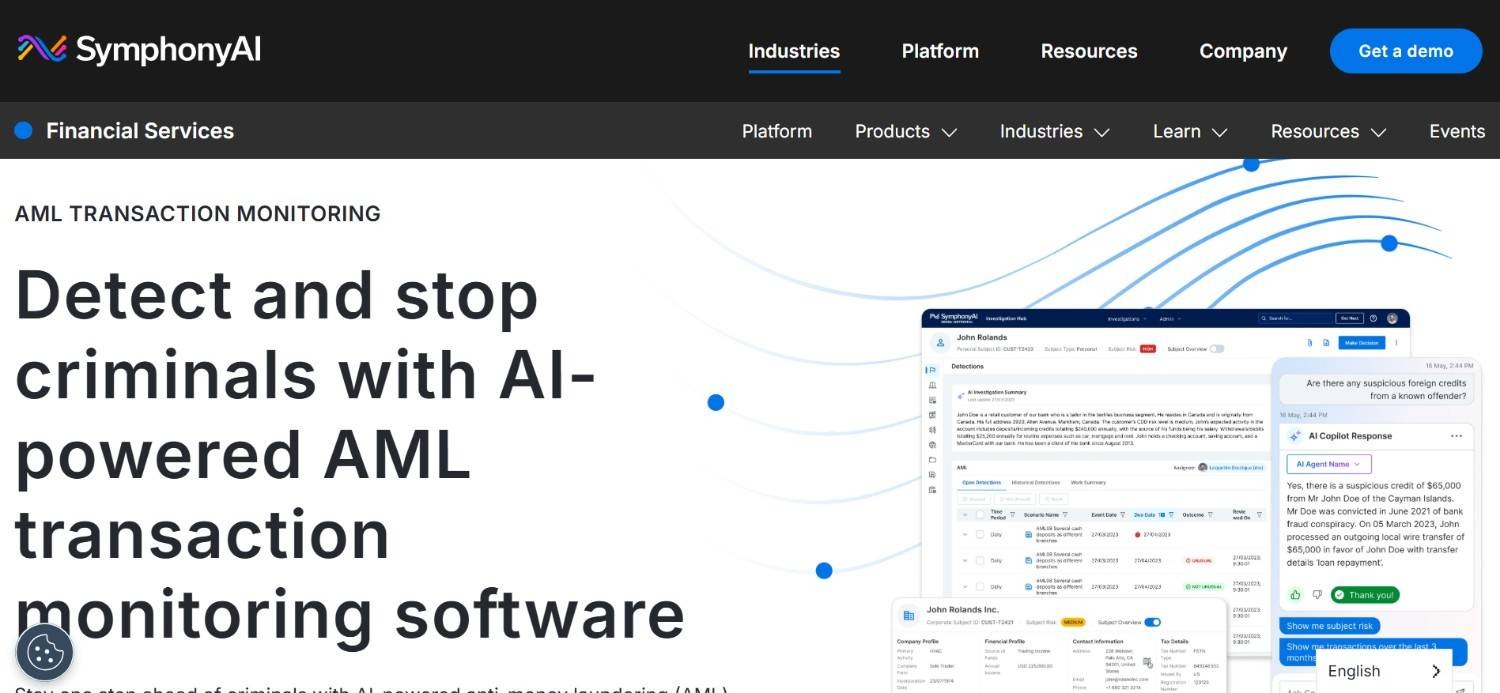
SymphonyAI is a global AI software company operating across multiple verticals, with its financial services division delivering the NetReveal transaction monitoring suite originally developed by BAE Systems.
The company was recognized as a Leader in the Forrester Wave for AML Solutions Q2 2025, and NetReveal is deployed at large financial institutions worldwide.
The NetReveal Transaction Monitoring product combines supervised and unsupervised machine learning with a Sensa Copilot AI assistant that collates, analyzes, and summarizes investigative data.
SymphonyAI also offers SensaAI for AML, an augmentation layer that can be applied on top of existing AML systems without replacing them, and NetReveal Entity Resolution for connecting disparate data records into a single entity view.
SymphonyAI is one of the best AI transaction monitoring platforms for large financial institutions that need deep AI integration across their existing compliance infrastructure without requiring a complete system replacement.
The SensaAI overlay approach is particularly pragmatic for organizations with heavy investments in legacy platforms that cannot justify the disruption of a full migration.
SymphonyAI uses custom enterprise pricing based on modules, transaction scale, and deployment method. Contact SymphonyAI’s sales team directly for a quote.
SymphonyAI NetReveal is a well-suited choice for large financial institutions with complex AML programs seeking AI-driven investigation efficiency and false positive reduction. Its Sensa Copilot is a genuinely differentiated feature for enterprise compliance teams.
The platform is not accessible for smaller organizations, and its payment fraud coverage is limited compared to full-spectrum payment risk platforms like Fraudio.
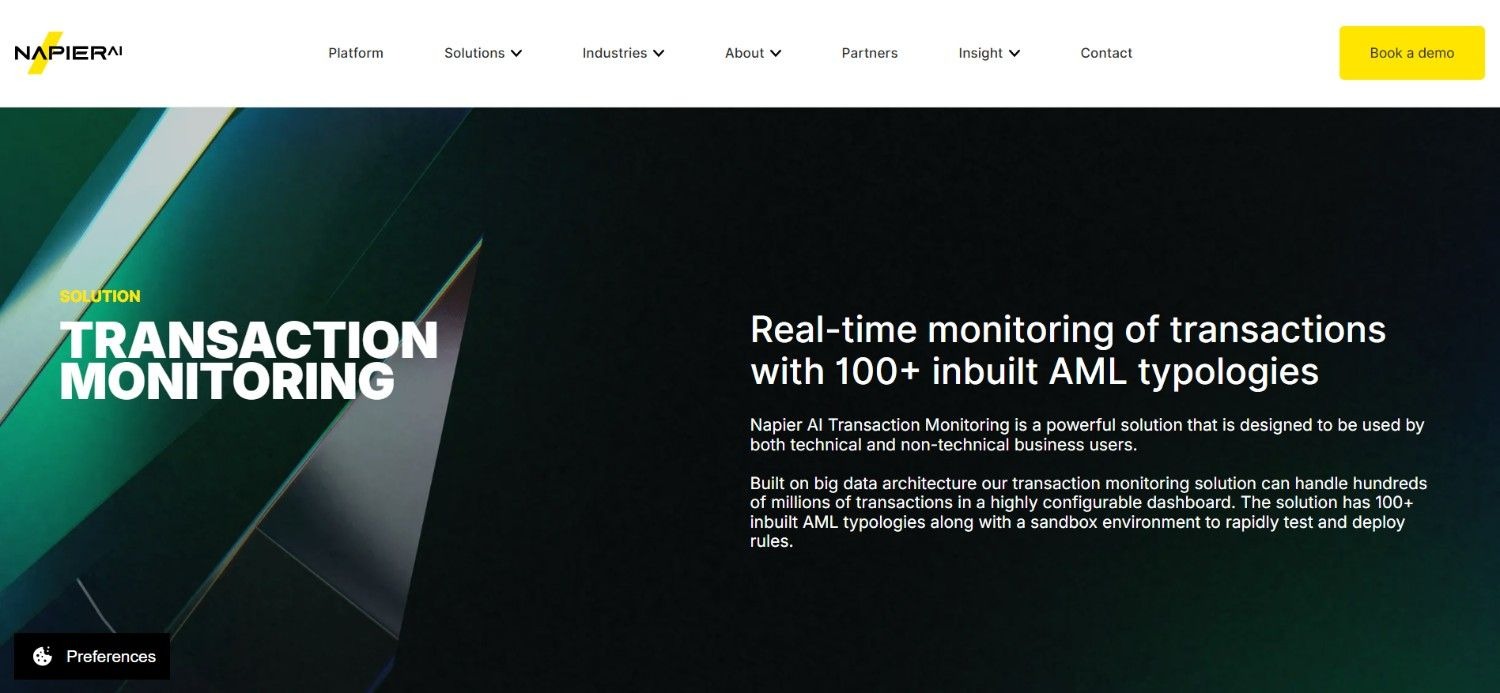
Napier AI is a RegTech specializing in AI-powered financial crime compliance, serving over 150 financial institutions globally through its Continuum platform.
The company has a compliance-first philosophy, partnering closely with the FCA and having tested its Insights AI feature through the FCA Supercharged Sandbox program in early 2026.
The Continuum platform offers transaction monitoring with 100+ built-in AML typologies, a sandbox environment for testing rule changes on real data before deployment along with machine learning overlays that complement rule-based processes - and AI that delivers behavioral analytics and natural language explanations directly within investigation tasks.
Napier AI is one of the more agile mid-market AI transaction monitoring software tools for institutions that need a modern, compliant, AI-assisted monitoring system with strong usability for non-technical teams.
The FCA Sandbox pedigree is a meaningful differentiator in UK and European markets where regulatory alignment matters.
Pricing plan is custom; you’ll need to contact the Napier AI sales team directly for current rates.
Napier AI is a well-positioned choice for mid-market institutions wanting to modernize their AML compliance with intuitive AI tools and sandbox-driven rule testing.
The Insights AI feature and FCA Sandbox engagement are credible differentiators. For organizations that need real-time payment fraud detection alongside AML monitoring, Napier is best paired with a complementary tool.
Hawk is an AI-native financial crime prevention company recognized as a Strong Performer by Forrester, with the company recognising Hawk's innovation as leading the competitive field in its ‘Q2 2025 AML Solutions Wave’. Their platform unifies AML transaction monitoring and fraud detection in a single environment, with a strong focus on explainable AI, self-serve rule configuration, and rapid deployment.
Hawk serves financial institutions from scaling fintechs to tier-one banks, offering both full-platform deployment and an AML AI Overlay that adds AI intelligence on top of existing monitoring systems.
The platform covers scams, money mule detection, check fraud, and standard AML transaction monitoring across all payment rails through a single API.
Hawk is one of the few platforms that genuinely unifies AML and fraud monitoring under a single API, which directly addresses the fragmentation problem that forces most institutions to maintain separate vendor relationships for AML and fraud use cases.
The AI Overlay entry path is a particularly practical option for institutions mid-contract with existing systems.
Hawk uses custom pricing based on transaction volume and deployment scope. Contact hawk.ai directly for a tailored quote.
Hawk is one of the best AI transaction monitoring platforms for institutions wanting a genuinely AI-native platform that bridges AML and fraud detection in a single environment. The AI Overlay is a smart and practical entry point.
For organizations focused on acquiring-side merchant fraud or needing a payment-ecosystem-specific monitoring layer, Hawk works best alongside a complementary payments risk tool.

NICE Actimize is one of the most established names in financial crime, risk, and compliance technology, serving over 100 of the world's largest financial institutions.
Its IFM-X enterprise fraud management platform, ActOne case management system, and dedicated Scams & Mule Defense product make it a comprehensive choice for tier-one banks managing complex, multi-jurisdictional compliance programs.
In 2025, NICE Actimize launched the Actimize Insights Network, a shared intelligence layer that delivers real-time counterparty risk signals from across the NICE Actimize customer network, specifically designed to improve detection of APP scams and money mule activity on instant payment rails.
NICE Actimize is one of the deepest and most comprehensive enterprise financial crime platforms available.
Its combination of real-time fraud prevention, AML compliance, and the Insights Network for shared counterparty risk intelligence makes it a strong choice for institutions that need multi-dimensional coverage and are willing to invest in the implementation required.
NICE Actimize follows a custom modular pricing model. Fees depend on modules selected and transaction scale. Contact NICE Actimize directly for enterprise pricing.
For large regulated financial institutions managing complex AML compliance and fraud programs across multiple jurisdictions, NICE Actimize is a defensible and capable choice.
It is not accessible to, nor designed for, emerging fintechs or mid-market payment companies, and its implementation requirements make NICE Actimize unsuitable for organizations in need of rapid deployment.
Feedzai is an AI-native financial crime prevention company that processes risk assessments on $9 trillion in payments across 120 billion events annually.
Its RiskOps platform unifies fraud detection, AML, and mule detection across the full customer financial crime lifecycle in a single data environment. In 2026, Feedzai launched RiskFM, the first Tabular Foundation Model built specifically for financial risk data.
RiskFM delivers high performance without manual feature engineering. It focuses on money mule detection and AML, where the model builds compounding intelligence as it processes data across institutions and geographies.
Feedzai is one of the technically advanced platforms in this market, and RiskFM represents a meaningful step toward foundation-model-driven financial crime detection.
Its unified FRAML architecture and proven scale are genuine strengths for large institutions - making it one of the best AI transaction monitoring software tools in the relevant category.
Feedzai pricing is 100% custom and quote-based for enterprise clients. You’ll need to contact the Feedzai team directly for pricing.
For global banks and large payment processors needing a unified financial crime risk platform where AI transaction monitoring, fraud detection, and AML share a common data environment, Feedzai is a technically credible and well-scaled option.
The enterprise cost and implementation requirements make it unsuitable for most fintechs and mid-market processors.
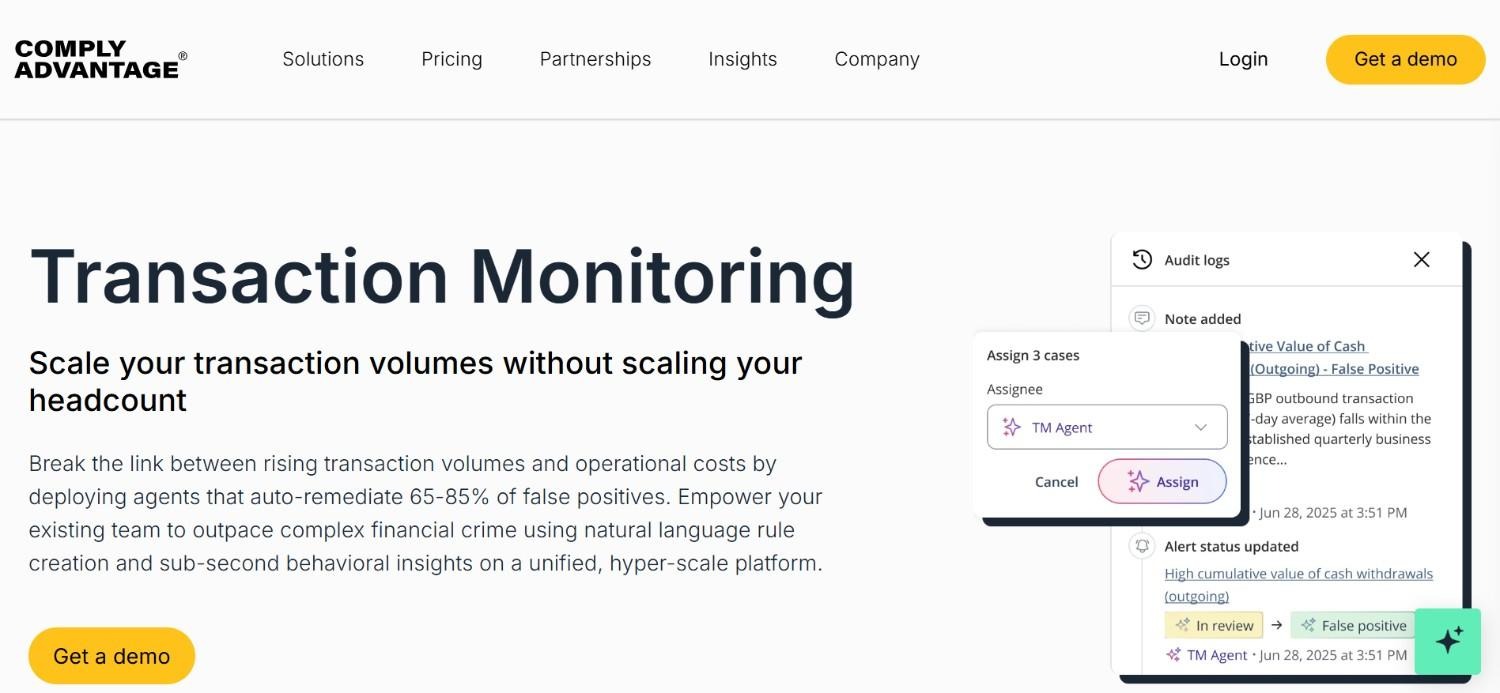
ComplyAdvantage is an AI-native financial crime risk platform used by more than 3,000 financial institutions, banks, and fintechs across 75 countries, including Santander, Allianz, and Plaid.
Its Mesh platform unifies customer and business screening, transaction monitoring, payment screening, fraud detection, agentic investigation workflows, and case management on a single proprietary risk intelligence layer that ingests and analyzes more than 30 million documents per day.
ComplyAdvantage is particularly well-known for its real-time sanctions and watchlist intelligence, and its agentic workflows that can autonomously resolve up to 85% of routine alerts while maintaining full regulatory defensibility.
ComplyAdvantage is one of the most accessible AI transaction monitoring platforms in this market, combining genuine enterprise-grade capability with an entry-level pricing tier that growing fintechs can actually access.
The agentic workflow feature is one of the most practically impactful AI capabilities in the compliance space for teams managing high alert volumes.
ComplyAdvantage offers a Starter plan from approximately $99/month ($319/month for up to 2,000 entities) and an Enterprise plan with custom pricing covering the full Mesh platform including agentic AI workflows.
Contact ComplyAdvantage’s sales team directly for enterprise pricing.
ComplyAdvantage is one of the best AI transaction monitoring platforms for fintechs and digital banks that need fast, API-first AML transaction monitoring with genuine AI capability. Their agentic workflow automation capabilities and proprietary intelligence layer are real differentiators.
For organizations that also need payment fraud detection, merchant risk, or acquiring-side monitoring, ComplyAdvantage works best alongside a payments-specific tool.

SAS is a global analytics company with decades of experience in financial crime and compliance. SAS Anti-Money Laundering sits on the SAS Viya analytics platform, combining behavioral analytics, scenario modeling, array processing, and advanced ML to deliver comprehensive AML monitoring for large financial institutions.
The platform covers the full AML compliance lifecycle: risk scoring and alert management, customer due diligence, transaction monitoring, case management, regulatory reporting, and advanced analytics.
It deploys both on-premises and in the cloud, and is particularly suited to technically mature institutions with in-house data science capabilities.
SAS AML is one of the most analytically-rich AI transaction monitoring tools in the market. For institutions with strong internal data science and compliance analytics capabilities, it offers a level of customization and modeling depth that few competitors can match.
The ability to process billions of transactions overnight at scale is a genuine technical differentiator.
SAS AML uses a custom subscription pricing model based on deployment method, number of users, and data volume. Contact the SAS sales team directly for enterprise pricing.
SAS AML is best suited for technically mature institutions that want deep analytics and model customization control over their AML compliance program. Its processing capacity and analytics depth are genuine strengths.
For organizations without strong internal data science resources, the complexity and learning curve will limit the value extracted from the platform.
Lucinity is an AML compliance company based in Iceland, built around a "Human AI Operations" model that focuses on making AI-driven compliance investigations faster and more accessible for human analysts.
The platform's Luci AI agent autonomously reviews AML alerts, surfaces key risk indicators, and generates complete case summaries, cutting investigation time dramatically and reducing the data collection burden that consumes most analyst hours.
Lucinity’s award-winning Time Travel feature, recognized at the 2025 Datos Insights AML Impact Awards - further allows compliance teams to backtest detection scenarios on real historical data before deploying to production.
Lucinity's core strength is investigator experience. In a space where compliance teams consistently report that 80% of their time goes to data collection rather than decision-making, Lucinity's Luci AI agent directly addresses that inefficiency.
The Oracle integration in 2026 is a significant credibility marker.
Lucinity uses custom pricing. Contact their sales team directly for a quote.
Lucinity is an excellent choice for compliance teams that need to dramatically improve investigation speed and analyst efficiency. The Luci AI agent and Time Travel feature are among the most practically impactful innovations in the AML compliance space.
For organizations that also need real-time fraud detection or comprehensive payment monitoring, Lucinity works best as part of a broader stack.
Sardine AI is a fraud and compliance platform built by founders from Coinbase and other digital-native financial services companies.
The platform delivers sub-50ms fraud and compliance decisions using device intelligence, behavioral biometrics, and transaction monitoring, supported by a consortium network where risk signals are shared across connected institutions.
Sardine monitors account opening, transaction patterns, and device signals all at once. This helps them spot everything from mule recruitment and APP fraud to account takeovers and money laundering tricks like structuring and layering.
Sardine is one of the strongest options for digital-native fintechs and crypto platforms that need fast, device-intelligence-led fraud and compliance monitoring in a single API. Its speed advantage is genuine and differentiating on instant payment rails.
Sardine uses custom pricing based on transaction volume and deployment scope. Contact their sales team for a tailored quote.
Sardine is a well-suited choice for digital-native fintechs, neobanks, and crypto platforms that need the fastest possible fraud and compliance decisions with device intelligence driving accuracy.
For organizations in traditional banking or those needing deep AML workflow automation and case management, it is best evaluated alongside complementary tools.
These 5 factors will shape your decision to choose the best AI transaction monitoring software solution:
Whether you process payments through instant payment rails (where funds settle in seconds) or through batch cycles (overnight or end-of-day) determines which tools are genuinely compatible with your use case. Real-time rails require sub-second decisions; batch processing allows deeper overnight analysis.
Most platforms now support both modes, but the quality and latency of real-time processing varies significantly.
Fraudio is designed for 10,000 transactions per second. Sardine delivers sub-50ms decisions. Legacy batch-first systems offer real-time as an add-on with variable quality.
Confirm real-time performance under load, not just in controlled demos.
AI transaction monitoring software covers a spectrum: some tools focus purely on AML compliance, some focus on fraud and payment risk (Sardine, Outseer); and others aim to unify both in a single platform (Fraudio, Hawk, Feedzai, NICE Actimize, ComplyAdvantage).
For organizations that need both fraud detection and AML compliance monitoring, a unified platform is almost always more efficient than two separate vendors, since it eliminates the data silos that force fraud and AML teams to work from different information sets.
Confirm what the tool covers before committing.
The accuracy of any AI transaction monitoring system is directly determined by the quality and breadth of data the models train on. A tool trained only on your organization's historical transaction data will miss patterns that are visible across a broader network of institutions.
Ask every vendor: how many transactions are your models trained on, and from how many institutions? Can the AI detect suspicious patterns from transaction one for a new customer, or does it require months of your own data to ramp up?
Fraudio's centralized AI trains on billions of cross-ecosystem transactions from day one; no ramp-up period, no waiting for your own data to accumulate.
Some newer foundation models such as Feedzai's RiskFM are moving toward cross-institution training, but the structural distinction matters: ask whether the AI trains on shared data simultaneously across all connected institutions, or only aggregates data periodically.
Siloed models require months of ramp-up regardless.
The difference between a 3-day integration and a 9-month integration is not just timeline; it is the cost of every month you spend without effective monitoring.
For a company responding to a fraud event, facing a regulatory deadline, or scaling rapidly through digital onboarding, integration speed is a critical factor. Fraudio integrates in 3 to 14 days. ComplyAdvantage can be live within 1 business day for initial setup.
Napier AI supports plug-and-play rapid deployment while NICE Actimize and SAS AML implementations are typically measured in months.
Be explicit about your timeline requirements before engaging any vendor.
Enterprise fraud and AML platforms are known for complex, front-loaded pricing: setup fees, implementation fees, per-rule charges, mandatory consulting engagements, and multi-year contracts with exit penalties.
For a growing fintech or mid-market processor, this structure creates significant financial risk. When comparing options, ask for full pricing disclosure: what is included in the subscription, what triggers additional costs, and how does pricing scale with transaction volume?
In our case, Fraudio's pay-per-use model with no setup or implementation fees is designed specifically to eliminate that hidden cost structure.
| Company | Pros | Cons | Ease of Use | Integrations | Support | Affordability |
|---|---|---|---|---|---|---|
| Fraudio |
Centralized AI
Days-to-deploy
Unified fraud + AML
|
Payments-focused
Pricing by quote
|
★★★★★ |
★★★★★ |
★★★★★ |
★★★★★ |
| SymphonyAI |
Forrester Leader
70% FP reduction
Sensa Copilot
|
Enterprise-only
Complex implementation
|
★★★★★ |
★★★★★ |
★★★★★ |
★★★★★ |
| Napier AI |
Sandbox testing
100+ typologies
FCA alignment
|
Less large-FI track record
Niche coverage gaps
|
★★★★★ |
★★★★★ |
★★★★★ |
★★★★★ |
| Hawk |
AI-native
Unified AML + fraud
AI Overlay option
|
Fewer tier-1 references
Custom pricing only
|
★★★★★ |
★★★★★ |
★★★★★ |
★★★★★ |
| NICE Actimize |
Lifecycle coverage
Insights Network
ActOne CMS
|
Enterprise-only
Months to deploy
|
★★★★★ |
★★★★★ |
★★★★★ |
★★★★★ |
| Feedzai |
RiskFM foundation model
Unified FRAML
$9T scale
|
Enterprise-only
High TCO
|
★★★★★ |
★★★★★ |
★★★★★ |
★★★★★ |
| ComplyAdvantage |
Agentic AI
$99/month entry
Sub-15min OFAC updates
|
AML-focused
Less fraud detection depth
|
★★★★★ |
★★★★★ |
★★★★★ |
★★★★★ |
| SAS AML |
2B+ nightly TM capacity
80% FP reduction target
|
Steep learning curve
Heavy infrastructure
|
★★★★★ |
★★★★★ |
★★★★★ |
★★★★★ |
| Lucinity |
Luci AI agent
Time Travel backtesting
Excellent UX
|
AML-first
Fraud requires integrations
|
★★★★★ |
★★★★★ |
★★★★★ |
★★★★★ |
| Sardine AI |
Sub-50ms speed
2.2B+ device profiles
Consortium network
|
Less suited to traditional banking
No deep AML workflow automation
|
★★★★★ |
★★★★★ |
★★★★★ |
★★★★★ |
Most AI transaction monitoring platforms solve one side of the problem. They either handle AML compliance or fraud detection, not both. And the ones that attempt both often do so through disconnected modules that create exactly the data silos they claim to eliminate.
Fraudio is built differently, with our patented centralized AI trains on billions of transactions from across the entire payments ecosystem, delivering detection quality that no single-institution siloed model can match.
In addition to that, our dual-rail architecture monitors individual transactions in real time while continuously profiling account and entity behavior over time.
Our anti-money laundering platform also covers full AML compliance with case management, SAR reporting, entity tracking, and sanctions integration alongside our fraud detection products.
We integrate in 3 to 14 days and charge per transaction - with no setup or implementation fees, and per-transaction costs that decrease as volume grows. Viva Wallet achieved an 8x ROI, a 600% increase in fraud team efficiency, and detection 3 weeks earlier than their legacy system after deploying Fraudio.
Ready to see how our AI transaction monitoring compares to what you have today? Book a consultation with our team
The best AI transaction monitoring software in 2026 is Fraudio, for payment companies needing unified fraud detection and AML compliance monitoring in a single platform. Fraudio's patented centralized AI trains on billions of cross-ecosystem transactions, delivering detection from transaction one without months of model ramp-up, and integrates in 3 to 14 days with no setup fees.
When choosing the right AI transaction monitoring platform, evaluate five factors: whether the tool supports real-time or batch processing (critical for instant payment rails), whether it covers both fraud and AML or only one (unified platforms reduce data silos), the quality and breadth of the AI training data network, how quickly the platform integrates into your existing stack, and the total cost of ownership including all fees. For scaling fintechs, integration speed and pricing transparency carry more weight than enterprise feature depth; for large banks, compliance coverage depth and audit trail quality are typically the deciding factors.
Fraudio differs from alternatives through its patented centralized AI, which legally combines transaction data from both issuing and acquiring sides of the payments ecosystem into a single shared intelligence network. Competitors operate siloed models trained only on each individual customer's data, limiting detection accuracy and requiring months of ramp-up. Fraudio also integrates in 3 to 14 days versus 5 to 14 months for enterprise incumbents, and charges per transaction with no setup, implementation, or maintenance fees - making it accessible at every stage of growth.
Getting started with Fraudio's AI transaction monitoring begins with a Proof of Results (PoR) test: you provide historical transaction data, Fraudio's AI generates detection outputs, and you compare the results against your current system's performance with zero commitment and minimal internal effort. Full API integration typically completes in 3 to 14 days. You can connect with our team to get a complete view of how we can help your organization.
Switching to Fraudio from an existing system is straightforward. API integration completes in 3 to 14 days, and Fraudio can run in parallel with your current system during the transition period. For organizations mid-contract with another vendor, Fraudio offers a Proof of Results approach using historical data to demonstrate performance improvement before you commit to migration. For organizations that cannot switch immediately, Fraudio's flexible contracting includes up to six months of contract freeze when timing is the constraint.
Yes, and this is one of the most important technical questions to ask any vendor. Instant payment rails (including Faster Payments, SEPA Instant, PIX, and UPI) require transaction risk decisions in milliseconds because settlement is near-immediate and chargebacks are not possible once funds move. Fraudio's platform is designed for 10,000 transactions per second with real-time scoring. Sardine delivers sub-50ms decisions. Legacy batch-focused platforms may offer real-time modes with variable performance; confirm decisioning latency under full production load, not just in controlled test environments, before committing.
AI transaction monitoring software does not replace human analysts; it changes what analysts spend their time on. The goal is to eliminate the 80% of analyst time currently spent on data collection, alert triage, and false positive clearing, so analysts can focus on the 20% of their work that actually requires human judgment. Platforms like Lucinity's Luci AI agent and ComplyAdvantage's agentic workflows automate evidence gathering and case preparation, but final suspicious activity determinations, SAR filing decisions, and regulatory interactions remain human responsibilities. This is also a regulatory requirement: most AML frameworks mandate human-in-the-loop oversight for significant compliance decisions.

How about trying our solution and experiencing the next generation for yourself?


