
August 27, 2026
| Company | Best For | Key Features | Pricing |
|---|---|---|---|
| FraudioTop pick | Payment companies needing network-effect AI | Centralized AI, real-time scoring, MIF + AML + P2P | Usage-based; custom pricing per volume |
| SEON | Mid-market fraud teams needing transparent ML | Digital footprint, whitebox ML, 900+ signals | From $699/month |
| Riskified | eCommerce merchants reducing chargebacks | Chargeback guarantee, automated decisions, PSD2 tools | Custom |
| Signifyd | Online retailers needing chargeback protection | Commerce Protection Platform, guaranteed approvals | Custom |
| Stripe Radar | Stripe-native merchants | ML scoring, custom rules, network-wide data | From €0.05/transaction |
| Sift | eCommerce and marketplace fraud | Account defense, payment protection, dispute mgmt | Usage-based, custom |
| Kount | Mid-market eCommerce | Omniscore AI, dispute automation, self-service rules | Custom |
| Fingerprint | Device-level fraud signals | 99.5% visitor ID accuracy, bot detection, smart signals | Free; Pro Plus $99/month |
| Chargeflow | Chargeback recovery automation | Automated disputes, evidence AI, ChargeScore | Free tier; from $0.20/tx; 25% of recovered (Automation) |
| ClearSale | CNP fraud prevention with human review | ML + analyst hybrid, chargeback guarantee | From ~$250/month, custom |
eCommerce fraud prevention software is a category of technology tools that detect, block, and manage fraudulent activity in online transactions. These tools analyze payment data, user behavior, device signals, and transaction patterns in real time to identify fraud before it causes financial damage.
The category has evolved well beyond simple rule engines. Modern eCommerce fraud detection software layers machine learning models, behavioral analytics, device intelligence, and network-level data to catch the full spectrum of fraud types: card-not-present fraud, account takeovers, chargeback fraud, transaction laundering, merchant fraud, and more.
The payments industry has reached an inflection point. Global digital commerce volumes are growing fast, but so is fraud sophistication. Fraudsters automate attacks at scale, exploit new payment rails, and adapt faster than most rule-based tools can respond.
This has created a clear bifurcation in the market: legacy rule engines that require manual upkeep, and next-generation AI platforms that adapt continuously.
At the infrastructure level, the distinction also matters between merchant-facing tools (protecting online stores from fraudulent orders) and payment-infrastructure tools (protecting issuers, acquirers, and processors from fraud across their entire portfolio).
Understanding which layer your business operates at is the first step toward choosing the right solution.
The business case for eCommerce fraud prevention software is direct. Fraud doesn't just cost you the value of a fraudulent transaction – it triggers chargebacks, eats into interchange, generates fines from card schemes, and damages customer trust.
According to the MRC's 2026 Global eCommerce Payments and Fraud Report, merchants lost approximately 3.2% of total annual eCommerce revenue to payment fraud globally – a figure that increased from the prior year. Each dollar lost to fraud now costs US merchants $4.61 when factoring in fees, labor, and customer churn.
But the hidden cost of poor fraud tools is often even higher. When your fraud tool generates too many false positives, you decline legitimate customers.
That's lost revenue from the transaction itself, plus the churn cost of a frustrated customer who doesn't come back. Studies consistently show false declines cost merchants more than fraud losses over time.
Beyond chargebacks and declines, there are regulatory stakes. Card schemes like Visa and Mastercard impose fines on acquirers and processors that exceed fraud thresholds. Regulators under PSD2 and GDPR expect demonstrable fraud controls. Failing to meet those standards risks fines, reputational damage, and, in extreme cases – license revocation.
For fintechs and early-stage payment companies in particular, the cost of getting this wrong early is disproportionately high. Building on underpowered internal rule engines looks manageable until fraud hits, chargebacks pile up, or a card scheme audit triggers scrutiny.
Moreover, approximately 3% of all new digitally boarded SMEs turn out to be fraudsters, making proactive eCommerce fraud detection software a necessity, not a luxury.
Payment facilitators inherit fraud liability for every merchant they onboard. When a fraudulent merchant disappears after collecting a settlement, PayFac absorbs the loss. At scale, even a small percentage of bad merchants creates significant financial exposure.
These businesses need eCommerce fraud prevention software that monitors merchant behavior over time, not just individual transactions.
Detecting merchant-initiated fraud (bust-out schemes, transaction laundering) weeks before chargebacks arrive is the difference between protecting the portfolio and absorbing losses that compound over months.
Issuers face the widest fraud surface area: card-not-present fraud, credit card testing, account takeovers, and authorized push payment fraud across millions of cardholders.
They need real-time scoring at authorization, batch-mode analysis for pattern detection, and AML monitoring for regulatory compliance.
The challenge for issuing processors in particular is scale: the tool has to work accurately at very high transaction volumes with minimal ramp-up time, or it creates more problems than it solves.
Direct-to-consumer merchants lose revenue to fraudulent orders, chargeback abuse, promo fraud, and account takeovers.
For merchants processing high card-not-present volumes, the right eCommerce fraud detection software approves more legitimate orders while blocking fraud, directly growing revenue rather than just preventing loss.
Tools with chargeback guarantees (Riskified, Signifyd, ClearSale) are particularly relevant here, as they shift liability entirely away from the merchant.
Digital-first financial institutions face concentrated exposure to authorized push payment fraud and money mule networks.
Real-time P2P monitoring that profiles account behavior continuously is essential for catching coordinated fraud campaigns before funds disperse across wallets.
For early-stage fintechs, the challenge is getting strong fraud protection without committing to enterprise contracts that don't fit yet.
The best eCommerce fraud prevention software for this segment integrates quickly via API, requires no lengthy ramp-up, and costs in proportion to transaction volume rather than locking in a flat fee for infrastructure that isn't fully utilized.

Fraudio is a real-time fraud and AML prevention platform built for companies that process payment transactions: issuers, acquirers, payment facilitators, fintechs, and processors.
Our patented centralized AI technology breaks data silos by pooling transaction intelligence from across the entire payment ecosystem into a single shared dataset, giving every connected customer the benefit of network-wide learning rather than isolated model training.
We cover four core fraud and compliance challenges through distinct product lines: Payment Fraud Detection (PFD) for real-time transaction scoring, Merchant Initiated Fraud Detection (MIF) for acquirer-side merchant monitoring, an AML product for regulatory compliance, and P2P Transfer Monitoring for authorized push payment and mule network detection.
With 2 billion transactions processed across 188 countries, covering over 1 million merchants across 548 industries, 8x proven ROI, and deployment that takes days rather than months, Fraudio is the infrastructure-layer choice for payment companies that need eCommerce fraud prevention software that grows with them
Our biggest differentiator is the network effect. Competitors run siloed AI models that train only on each individual customer's data. We centralize transaction intelligence from across the payment ecosystem, so our models have seen far more fraud patterns and catch threats that siloed systems miss entirely.
That's not a theoretical advantage – it translates to fraud caught 3 weeks earlier than legacy solutions, 600% improvement in fraud team efficiency, and 8x ROI for customers like Viva Wallet, a Greek payments unicorn that deployed our Merchant Initiated Fraud Detection solution and saw 7x transaction growth without proportionally scaling their fraud team.
For companies navigating data residency requirements in markets like Saudi Arabia, the UAE, India, or Indonesia, we're one of very few vendors with proven in-territory deployments that comply with local restrictions.
The pay-per-use model rounds out the value proposition: no setup fees, no implementation fees, no maintenance fees. Cost per transaction decreases as volume grows, aligning our incentives with each customer's growth.
Fraudio uses a fully usage-based model: you pay per transaction processed, with no setup fees, no implementation fees, and no maintenance charges.
The per-transaction rate decreases as your volume grows, and customers can commit to higher volumes for locked-in buy rates. Contact Fraudio's team directly for a customized quote.
Fraudio is the strongest choice for payment companies: acquirers, issuers, PayFacs, and processors – that need eCommerce fraud prevention software at the infrastructure layer.
The network effect AI, multi-product coverage, fast deployment, and transparent pricing model make it the most complete solution for organizations that have outgrown rule-based tools and need something built for real scale.
For direct-to-consumer merchants looking for a simpler order-protection tool, the other options below may be a better starting point.
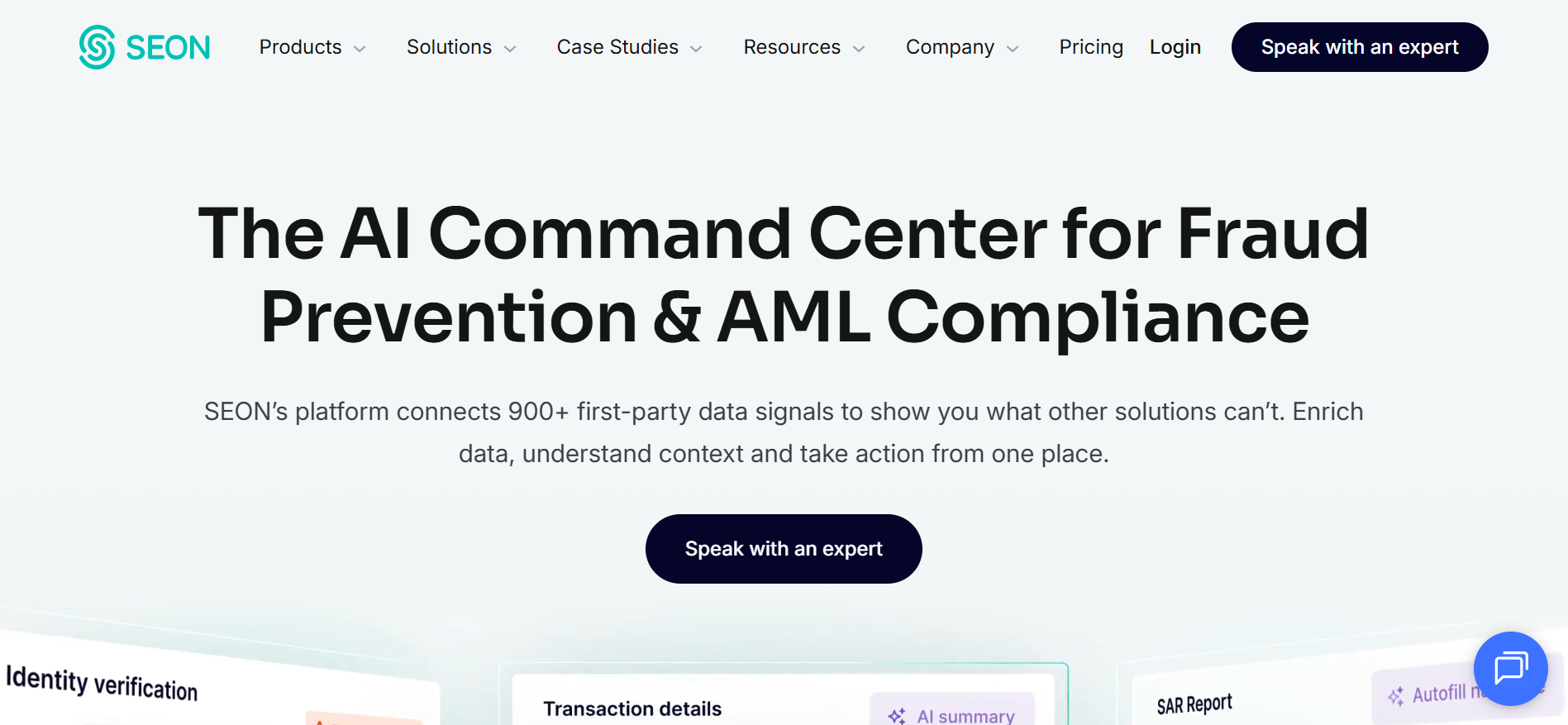
SEON is a fraud prevention platform built around digital footprint analysis and transparent machine learning. It enriches transactions with data from over 50 social platforms and 300+ digital, social, and device signals – checking whether email addresses, phone numbers, and device identifiers are linked to real online identities.
This approach is especially useful for onboarding scenarios where you need to verify a user's digital presence quickly. SEON targets mid-market companies and fintechs that want pricing transparency, fast setup, and a whitebox model they can understand and customize.
Its 14-day deployment time and clear pricing tiers make it one of the more accessible options in the ‘best eCommerce fraud prevention software’ category.
SEON's transparency is a genuine differentiator in a market where black-box AI is the norm. Fraud analysts can see, understand, and challenge every score, which builds confidence in automated decisions and reduces false positive risk.
The combination of social data enrichment and clear pricing makes SEON one of the more straightforward options for teams that are new to eCommerce fraud prevention software or replacing a basic rule engine.
SEON offers a free plan covering up to 500 manual checks per month with 10 custom rules. The Starter plan begins at $699/month with 1,000 API calls and 10 queries per second.
Higher tiers are available based on volume and use case requirements.
SEON works well for mid-market eCommerce companies and fintechs that need a quick-to-deploy, easy-to-understand fraud prevention tool for user verification and onboarding.
It's less suited for high-volume transaction monitoring at the payment infrastructure level or for use cases requiring AML coverage.

Riskified is one of the best eCommerce fraud prevention software options for online retailers that want to reduce fraud without blocking too many legitimate shoppers.
Its platform uses machine learning, identity intelligence, and real-time order decisioning to approve or decline transactions quickly.
One of its main strengths is its Chargeback Guarantee, which shifts fraud-related chargeback liability away from the merchant. Riskified also goes beyond payment fraud with tools for policy abuse, refund and return abuse, account takeover, and dispute management.
This makes it a strong fit for larger eCommerce brands that need fraud protection across the full customer journey, from checkout to post-purchase claims.
The chargeback guarantee model is what makes Riskified distinctive. Rather than providing a risk score and leaving merchants to manage the outcome, Riskified takes the risk itself.
This is particularly compelling for eCommerce brands in high-ticket categories where a single fraudulent order represents a material loss.
It's one of the stronger approaches to eCommerce fraud prevention for merchants who want certainty over variability.
Riskified does not list public pricing. It operates on a custom, demo-based model where pricing is structured based on transaction volume and merchant profile.
Contact Riskified's sales team for a quote.
Riskified is a strong choice for eCommerce merchants who want to offload chargeback risk entirely and maximize order approval rates.
It is not the right tool for payment infrastructure companies, acquirers, or anyone operating outside the merchant/online retail context.
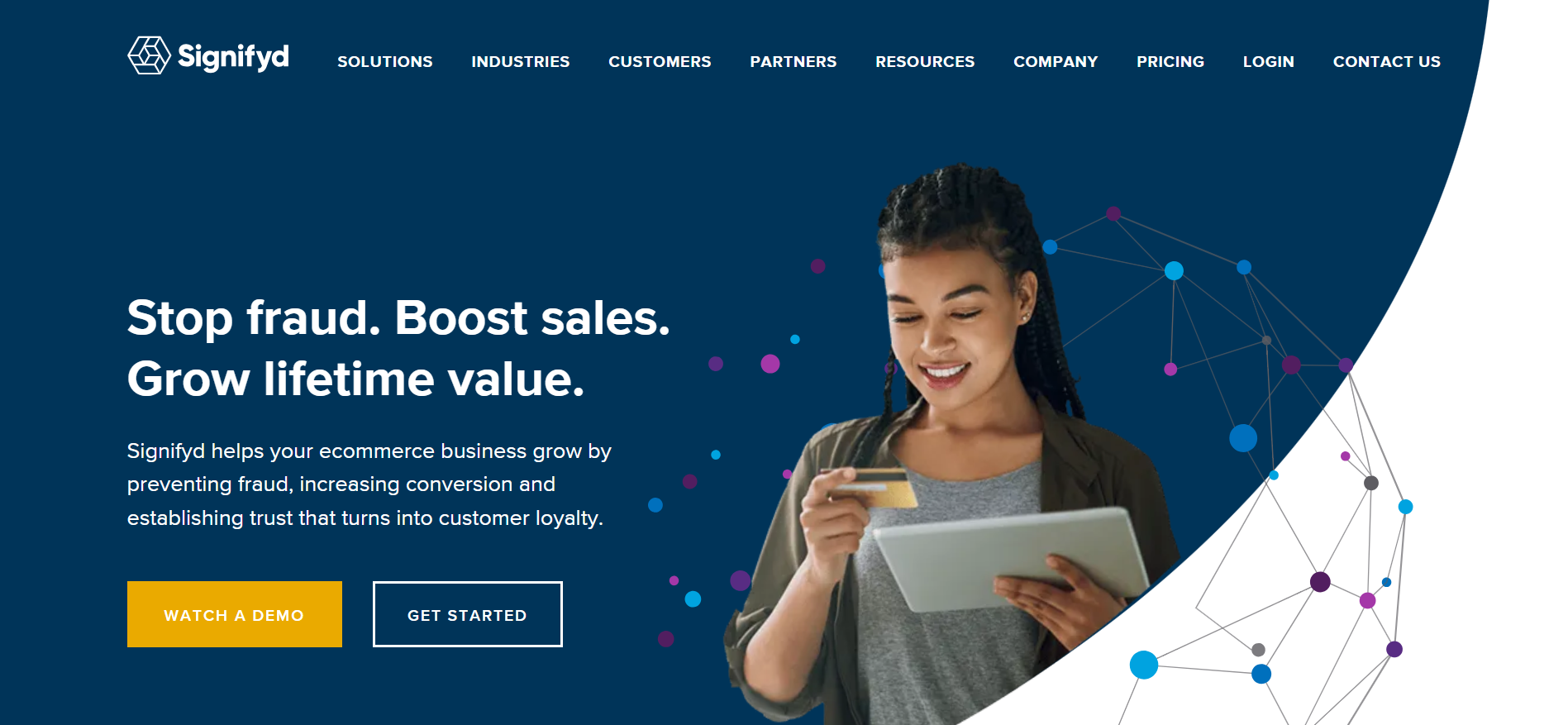
Signifyd positions itself as a Commerce Protection Platform for online retailers. Like Riskified, it offers a financial guarantee on approved orders – meaning merchants are covered for fraud losses on any order Signifyd approves.
Signifyd's network is built from a large consortium of eCommerce merchants, which allows its models to assess buyers based on their behavior and purchase history across the network.
This consortium approach gives it more data points per buyer than most single-merchant fraud systems, making it one of the better-established eCommerce fraud prevention software options for retail-focused businesses.
Signifyd also covers abuse prevention, return fraud detection, and compliance automation alongside its core order protection.
Signifyd's consortium network is a meaningful advantage for merchant-side fraud detection. Seeing a buyer's behavior across hundreds of merchants provides strong signals for distinguishing repeat fraudsters from legitimate customers with unusual-looking orders.
The breadth of protection, covering fraud, abuse, and compliance in one contract – reduces vendor complexity for mid-to-large retail operations.
Signifyd uses fully custom pricing based on transaction volumes, order mix, and chargeback protection requirements. Contact their sales team to get a tailored quote for your business.
Signifyd is one of the best eCommerce fraud prevention software tools for eCommerce merchants, particularly mid-to-large retailers who want guaranteed fraud protection plus a broader coverage of abuse and compliance issues.
It is purpose-built for the merchant layer and is not appropriate for payment infrastructure, AML, or P2P fraud use cases.
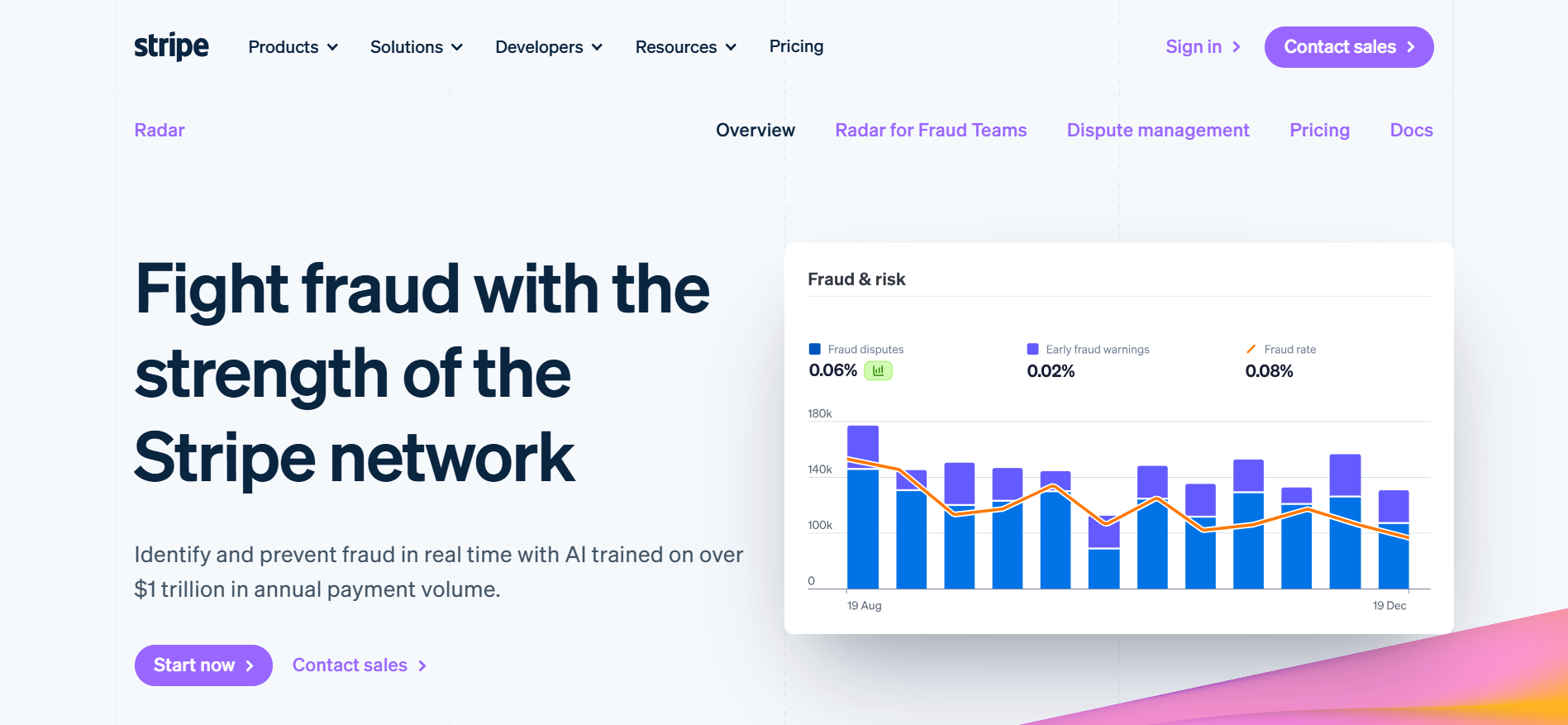
Stripe Radar is the fraud detection product built into Stripe's payment processing infrastructure. It uses machine learning trained on Stripe's global payment network to score transactions at checkout, flagging or blocking suspicious payments before they complete.
For merchants already on Stripe, Radar is the most natural starting point for eCommerce fraud prevention software – it requires zero additional integration and benefits from Stripe's vast cross-merchant data network.
The advanced tier (Radar for Fraud Teams) adds custom rules, manual review queues, and granular reporting for teams that need more control beyond the default ML scoring.
One of the standout features of Stripe Radar as one of the best eCommerce fraud prevention software tools is its simplicity and data network.
Given that Stripe processes payments for a huge share of global eCommerce, its fraud models see patterns across an enormous dataset.
For merchants already on Stripe, it's the fastest and most operationally simple way to get meaningful eCommerce fraud detection software in place without adding vendor complexity.
Stripe Radar is priced at €0.05 per screened transaction. The Fraud Teams plan (with custom rules, advanced dashboards, and granular fraud controls) is priced at €0.07 per screened transaction.
Merchants on Stripe's standard processing plan may receive discounted rates. Enterprise custom pricing is available through Stripe's sales team.
Stripe Radar offers one of the best eCommerce fraud prevention software, especially for Stripe-native merchants who want automated fraud scoring with minimal setup.
It lacks the depth of a dedicated eCommerce fraud detection software platform for high-volume operations with complex fraud profiles – but as a built-in first layer of defense, it's hard to beat for simplicity and coverage on the Stripe network.
Sift is one of the best eCommerce fraud prevention software options covering payment fraud, account defense, and dispute management. It uses a global data network of billions of events to assess risk across the entire customer lifecycle: from account creation through to checkout and post-purchase.
Sift’s AI-powered platform uses identity-level insights, transaction data, and signals from its global data network to help detect payment fraud, account takeover, fake account creation, and policy abuse. They’re particularly strong in eCommerce and marketplace environments where fraud extends beyond individual transactions to include account takeovers, content fraud, and seller/buyer disputes.
Sift is a useful addition for eCommerce teams because it supports real-time decision making while also giving fraud analysts a clear console for investigations and manual reviews.
Its modular architecture lets teams enable specific fraud products without purchasing everything upfront, making Sift a flexible eCommerce fraud detection software for mid-to-enterprise segments.
Sift's breadth across the customer lifecycle is its key differentiator. Most eCommerce fraud prevention software tools focus on the payment transaction itself.
Sift extends coverage upstream (account creation, login) and downstream (post-purchase disputes), making it a more complete trust and safety solution for businesses where fraud appears across multiple customer touchpoints.
Sift uses usage-based, volume-structured pricing. Packages are built around your transaction volume, the specific modules required (account defense, payment protection, dispute management, or a combination), and usage frequency.
No public tiers are listed. Contact Sift's sales team for a volume-based quote.
Sift is a strong option for eCommerce platforms and marketplaces that face fraud across multiple customer touchpoints and want a single platform covering accounts, payments, and disputes.
It is less straightforward to evaluate on cost and requires a capable fraud team to fully configure and utilize its depth.
Kount, owned by Equifax – is a fraud and identity trust platform targeting mid-market to enterprise eCommerce businesses. It combines AI-driven risk scoring (the Omniscore) with identity verification, dispute automation, and self-service rule management.
Kount draws on Equifax's identity data network to enrich transaction signals with credit and identity context that goes beyond what most standalone eCommerce fraud prevention software tools can access.
It covers payment fraud, account takeover, and chargeback management within a single platform, with a particular strength in the North American eCommerce market.
Kount's integration with Equifax's identity data is a meaningful advantage for markets where credit bureau data provides strong fraud signals.
The self-service rules capability is also genuinely useful for fraud teams that want to move fast without filing support tickets to adjust their fraud logic.
It’s one of the best eCommerce fraud prevention software tools for mid-market teams and US-centric eCommerce businesses.
Kount uses a custom, quote-based pricing model. No publicly listed subscription tiers are available.
Contact Kount's team for a quote based on your transaction volume and product requirements.
Kount is one of the best eCommerce fraud detection software tools, especially for mid-market and North American eCommerce merchants that want fraud detection, identity verification, and dispute management in one platform.
It is less well-suited to payment infrastructure use cases, international operations, or teams that need AML or merchant fraud monitoring.
Fingerprint is one of the best ecommerce fraud prevention software options for businesses that need to recognize returning users, suspicious devices, and risky behavior without adding unnecessary checkout friction.
Its device intelligence platform helps identify visitors across web and mobile sessions, even when fraudsters try to hide behind VPNs, bots, tampered browsers, or automation tools.
Ecommerce teams can use it to detect payment fraud, account takeover, fake account creation, promo abuse, and other suspicious activity earlier in the customer journey.
Fingerprint is especially useful as a risk signal layer that can support existing fraud rules, login protection, and payment screening while helping legitimate customers move through the site more smoothly.
Fingerprint's core technology, the accuracy of its device identification – is genuinely best-in-class at what it does.
For fraud scenarios that hinge on device identity (multi-accounting, account takeover, bot attacks), it provides a level of accuracy that browser cookies or session-based approaches can't match.
The free plan and accessible pricing also make it one of the most approachable entry points into eCommerce fraud detection software for engineering-led teams.
Fingerprint offers a free plan for development and low-volume use. The Pro Plus plan starts at $99/month (covering up to 20,000 API calls), with usage scaling to 1M+ API calls at higher tiers. Enterprise custom pricing is available for large teams.
Fingerprint is one of the best eCommerce fraud prevention software tools, especially when you consider device intelligence in the context of engineering teams building or augmenting a fraud prevention stack.
It is not a standalone eCommerce fraud prevention software solution but works well as a high-accuracy device signal within a broader fraud detection architecture.
Chargeflow is one of the best eCommerce fraud prevention software options for online merchants that want stronger control over chargebacks and post-purchase risk.
Instead of focusing only on fraud at checkout, it helps automate the full chargeback lifecycle, from alerts and prevention to dispute evidence collection, representation, and recovery.
Its AI-driven ChargeScore system analyzes dispute types and payment data to help select the most relevant response strategy. Chargeflow also supports 100+ integrations across ecommerce, payment, and CRM platforms, making it easier for merchants to centralize dispute management.
The tool is especially useful for ecommerce brands dealing with friendly fraud, recurring chargebacks, and revenue loss from manual dispute handling.
Chargeflow's specialization is its strength. Most eCommerce fraud detection software tools treat chargeback management as a secondary feature; Chargeflow makes it the core product.
The pay-for-results pricing model (a percentage of recovered chargebacks) aligns incentives directly: Chargeflow earns more only when merchants recover more.
Chargeflow uses a tiered pay-as-you-go model. Insights are free forever. The ‘Prevent’ tier starts at $0.20 per scanned transaction after the first 1,000 free.
Finally, the ‘Automation’ tier charges 25% of recovered chargebacks while ‘Alerts’ cost $29 per deflected chargeback.
Chargeflow stands out as one of the best eCommerce fraud prevention software, especially for merchants who want to automate chargeback and reduce dispute management overhead.
It works best as a complementary layer alongside a broader eCommerce fraud detection software solution rather than as a primary tool.
ClearSale is one of the best eCommerce fraud prevention software tools for online merchants that want a mix of AI-driven screening and human review. Its platform reviews orders, provides clear approval or reject decisions, and helps businesses reduce fraudulent chargebacks without blocking too many legitimate shoppers.
A key strength is its ‘Chargeback Guarantee’, which covers fraud-related chargebacks on approved transactions. ClearSale also stands out for its manual review team, which can evaluate suspicious orders that automated systems may misread.
Founded in Brazil, ClearSale has built a particular strength in Latin American markets while expanding globally over the years. Its hybrid model, where complex or borderline orders escalate to human analysts rather than defaulting to an automated decline – is designed to minimize false positives in markets where unusual purchasing patterns can otherwise trigger over-cautious AI models.
This makes them useful for ecommerce brands that sell in higher-risk categories, handle international orders, or want fraud protection that balances security with customer experience.
ClearSale's hybrid model is its defining characteristic in the eCommerce fraud detection software market.
Fully automated tools sometimes over-decline in complex purchasing contexts; particularly cross-border or LATAM transactions – and ClearSale's human analyst layer is specifically designed to catch and correct those edge cases.
For merchants where false declines are a bigger revenue problem than fraud losses, this approach has a measurable impact on approval rates.
ClearSale uses custom, performance-based pricing. Growth packages start at approximately $250/month with no setup, integration, or monthly minimum fees.
Enterprise pricing is negotiated based on volume and specific requirements.
ClearSale stands out on this list of the best eCommerce fraud prevention software, especially for merchants with cross-border or LATAM transaction profiles – who want a chargeback guarantee based on human review.
It is, however, not the right tool for payment infrastructure companies or use cases beyond order-level fraud detection and prevention.
The biggest mistake in evaluating the best eCommerce fraud prevention software is treating all tools as interchangeable.
A merchant-layer tool like Riskified or Signifyd is built to protect online stores from fraudulent orders. A payment-infrastructure tool like Fraudio is built to protect issuers, acquirers, and processors from fraud across their entire portfolio.
Start by identifying where in the payment stack you operate:
That single question narrows the shortlist significantly.
Not all machine learning models are equal. A model trained only on your own transaction history has seen a narrow slice of the fraud landscape.
Models trained on consortium or network data – pooling transactions from many merchants or payment companies – have seen far more fraud patterns and generalize better to new attack types.
Ask vendors directly:
For eCommerce fraud detection software at scale, the quality and breadth of the underlying data network is often the single biggest performance differentiator.
Legacy enterprise fraud platforms famously require 5–14 months of integration. That timeline is simply not viable for fintechs scaling fast, merchants responding to a fraud spike, or payment companies entering new markets.
Check whether the vendor offers API-first integration, webhook support, and batch processing flexibility.
Ask for real customer integration timelines, not marketing claims. A tool that takes weeks to deploy delivers ROI months earlier than one that takes a year.
eCommerce fraud prevention software pricing models vary widely: per-transaction fees, percentage of recovered chargebacks, flat monthly subscriptions, and custom enterprise contracts all exist in this market.
Each model has different implications for your total cost as volume grows. Watch out for setup fees, implementation fees, and per-rule charges that some legacy vendors still apply.
Usage-based models that decrease in per-transaction cost as volume grows are generally more favorable for scaling businesses than flat-fee models that don't reflect actual usage.
For payment companies operating in regulated markets; particularly the EU (PSD2, GDPR), UK, KSA, UAE, India, or Indonesia – data residency requirements can rule out otherwise strong vendors entirely.
Confirm whether the vendor can host your data in-territory, has ISO27001 certification, and can produce evidence of compliance with the regulatory frameworks that apply to your business.
For merchants, check whether the tool handles 3DS/SCA requirements in a way that minimizes unnecessary authentication friction for legitimate customers.
| Company | Pros | Cons | Ease of Use | Integrations | Support | Affordability |
|---|---|---|---|---|---|---|
| FraudioTop pick | Network AI, fast deploy, multi-product | API-first, custom pricing | ⭐⭐⭐⭐ | ⭐⭐⭐⭐⭐ | ⭐⭐⭐⭐⭐ | ⭐⭐⭐⭐ |
| SEON | Transparent ML, fast setup, good pricing | No consortium network, limited to onboarding | ⭐⭐⭐⭐⭐ | ⭐⭐⭐⭐ | ⭐⭐⭐⭐ | ⭐⭐⭐⭐ |
| Riskified | Chargeback guarantee, approval rate focus | Custom pricing only, merchant-only | ⭐⭐⭐⭐ | ⭐⭐⭐⭐ | ⭐⭐⭐⭐ | ⭐⭐⭐ |
| Signifyd | Guarantee + abuse prevention, consortium | Custom pricing, retail-focused | ⭐⭐⭐⭐ | ⭐⭐⭐⭐ | ⭐⭐⭐⭐ | ⭐⭐⭐ |
| Stripe Radar | Native Stripe integration, network data | Stripe-only, limited advanced control | ⭐⭐⭐⭐⭐ | ⭐⭐⭐ | ⭐⭐⭐ | ⭐⭐⭐⭐⭐ |
| Sift | Lifecycle breadth, modular, good network | Complex config, custom pricing | ⭐⭐⭐⭐ | ⭐⭐⭐⭐ | ⭐⭐⭐⭐ | ⭐⭐⭐ |
| Kount | Equifax identity data, self-service rules | Custom pricing, North America focus | ⭐⭐⭐⭐ | ⭐⭐⭐⭐ | ⭐⭐⭐ | ⭐⭐⭐ |
| Fingerprint | 99.5% device accuracy, accessible pricing | Not standalone, narrow use case | ⭐⭐⭐⭐⭐ | ⭐⭐⭐⭐ | ⭐⭐⭐⭐ | ⭐⭐⭐⭐⭐ |
| Chargeflow | Pay-for-results, automation, free tier | Recovery-only, not prevention | ⭐⭐⭐⭐⭐ | ⭐⭐⭐⭐ | ⭐⭐⭐⭐ | ⭐⭐⭐⭐⭐ |
| ClearSale | Human review, LATAM expertise, guarantee | Latency from human review, limited scope | ⭐⭐⭐⭐ | ⭐⭐⭐ | ⭐⭐⭐⭐ | ⭐⭐⭐⭐ |
If you're a payment company: an acquirer, issuer, processor, or fintech – that has outgrown rule-based tools and needs eCommerce fraud prevention software built for real scale, Fraudio delivers what legacy platforms can't.
Our patented network effect AI trains on billions of transactions across the entire payment ecosystem. That means you get fraud detection accuracy from day one, not after months of model warm-up. Integration takes 3–14 days.
Pricing scales with your volume. And you get coverage across card fraud, merchant fraud, AML, and P2P – without stitching together multiple vendors.
Viva Wallet, a Greek payments unicorn, achieved 8x ROI, 600% improvement in fraud team efficiency, and fraud caught 3 weeks earlier than their legacy solution – all while supporting 7x transaction growth without proportionally scaling headcount.
Our eCommerce fraud prevention capabilities cover the full payment stack, and our anti-money laundering platform ensures you stay compliant as you grow.
To see how Fraudio works for your business or use case, request a Proof of Results test by submitting your historical data to receive a direct comparison against your current setup, with no commitment required.
Fraudio is the best eCommerce fraud prevention software in 2026, especially for acquirers, issuers and payment facilitators. Our patented, centralized AI platform pools transaction data into a single shared dataset – giving every connected customer detection accuracy built on billions of cross-ecosystem transactions, not just their own history. Integration takes 3–14 days, pricing scales with volume, and customers like Viva Wallet have documented 8x ROI and fraud caught three weeks earlier than legacy solutions.
Start by identifying your position in the payment stack: merchant-layer tools and payment-infrastructure tools serve fundamentally different needs. Then evaluate AI model quality and the breadth of the training data network, integration speed, pricing structure (pay-per-use is generally more favorable than flat-fee for scaling businesses), and compliance with data residency or regulatory requirements in your operating markets. False positive rate is often as important as fraud detection rate – declining legitimate customers has a real revenue cost.
Fraudio stands out because of its patented network AI. While competitors use siloed models limited to your own history, Fraudio uses a massive, shared dataset of transactions from across the entire ecosystem. This means better accuracy, fraud detection that happens 3 weeks faster, and a 600% boost in team efficiency. Plus, Fraudio handles everything in one platform, including card fraud, merchant fraud, AML, and P2P monitoring, unlike most competitors.
Getting started with Fraudio involves a short discovery call to understand your transaction environment, followed by an API integration that typically takes 3–14 days. For prospects who want to validate performance before committing, Fraudio offers a Proof of Results (PoR) process: you provide historical transaction data, Fraudio runs its models against it, and you review the output to build a business case. This requires zero commitment and minimal effort from your team.
Switching to Fraudio is significantly easier than switching between legacy enterprise platforms. Integration via API typically completes in 3–14 days, compared to 5–14 months for traditional Gen 2 fraud vendors. Fraudio can also run in parallel with your existing solution during the transition period, with a PoR test using historical data to demonstrate performance before you cut over. For prospects mid-contract with another vendor, Fraudio offers flexible contracting, including up to a six-month contract freeze period.
Fraudio is built for both emerging fintechs and large payment processors. Our pay-per-use model has no setup or maintenance fees, so it is accessible even if you are just starting out. You get the same powerful platform whether you are an early-stage fintech or a major acquirer. If you are looking to move on from a basic rule engine, our rapid API integration and no-commitment testing process make it easy to get up and running.
eCommerce fraud detection software handles a variety of threats depending on the platform. These include transaction-level issues like card-not-present fraud, card testing, account takeovers, and push payment fraud. It also covers merchant-level risks such as bust-out schemes and transaction laundering, alongside post-transaction challenges like chargebacks and friendly fraud. Some platforms also tackle bot attacks, credential stuffing, and money laundering. Since no single tool is perfect for everything, picking the right one depends on your specific fraud profile and where you sit in the payment stack.

How about trying our solution and experiencing the next generation for yourself?


