
September 28, 2026
Fraud detection platforms for payment processors are software systems that score transactions, merchants, and account activity for signs of fraud before money moves. These platforms run machine learning models and rules against each transaction in real time, flagging suspicious activity while letting legitimate payments through.
The category spans a range of approaches. Some tools focus purely on the transaction, scoring the payment against known fraud patterns at authorization. Others add device intelligence or behavioral biometrics on top. A smaller group bundles a financial guarantee into the decision, reimbursing a processor if an approved transaction later turns into a fraud chargeback.
That range matters because a payment processor sits in a unique position. A processor must protect against cardholders using stolen details, merchants running fraudulent schemes, and money movement that could signal laundering, all at once.
The best fraud detection platforms for payment processors account for all three angles.
Payment processors carry a level of fraud exposure that a single merchant never sees, since every transaction that flows through the network passes through their systems first. A processor that misses fraud absorbs direct losses and regulatory scrutiny, while one that declines too aggressively pushes away legitimate merchants and cardholders who take their business elsewhere.
That tension is exactly why so many processors end up evaluating payment processor fraud prevention tools. Static, rule-based systems cannot keep pace with fraud tactics that shift constantly, and a rule set written months ago rarely catches a pattern that only emerged last week.
Merchant-side fraud compounds the problem further: some newly onboarded small and mid-sized businesses turn out to be fraudulent, often processing legitimate-looking transactions for weeks before disappearing with the settlement.
Regulatory pressure adds another layer specific to processors. Card networks track chargeback ratios closely through programs like Visa's VAMP, and frameworks such as PSD2 and GDPR add further scrutiny on top of that.
This is exactly the gap the best fraud detection platforms for payment processors are built to close: catching real fraud, protecting legitimate transaction volume from false declines, and keeping an audit trail ready for a regulator, all while processing at the speed a payment network actually requires.
Not every buyer in this category is solving the same problem. The five groups below cover most of the people evaluating the best fraud detection platforms for payment processors today.
CEOs and CFOs care about two things above all else: predictable costs and a clear return on investment. They want digital onboarding that grows transaction volume without exposing the business to fraud risk, and they respond to concrete numbers over vague promises, which is why a case study showing an 8x return tends to land harder than a feature list.
Chief Risk Officers hold the budget and the final call on most fraud technology purchases, and they carry the regulatory weight that comes with it.
They need detection sophisticated enough to keep pace with fraud that evolves faster than a static rule set ever could, while still satisfying card schemes and data protection requirements.
Fraud managers run the day-to-day fight, building rules, reviewing flagged transactions, and reporting results up the chain.
Their central goal is often keeping fraud rates below the threshold that triggers mandatory strong customer authentication, all while balancing prevention against a payment experience that does not punish legitimate merchants or cardholders.
Analysts are the ones actually working the queue, investigating alerts and suspicious transactions every single day.
Their biggest complaints tend to be the same regardless of company size: too many false positives, not enough context on a flagged transaction, and manual processes that slow down an investigation that should take minutes.
Startups and mid-market payment companies often get stuck choosing between an expensive enterprise platform that takes months to integrate, or an underpowered rule-based system that cannot keep up.
This segment needs payment processor fraud prevention tools that deploy in days rather than months, without demanding the IT investment a larger enterprise platform assumes.
Pairing that with a dedicated anti-money laundering platform often becomes the next priority once transaction fraud is under control, since the two problems tend to surface around the same stage of growth.
Fraudio was created since most fraud detection software for payment processors available on the market learns from one company's data alone, which severely limits how quickly it can catch new fraud patterns.
Our patent-pending technology breaks that isolation by centralizing transaction data from issuing, acquiring, transfers, and remittances into a single dataset, so our models learn from billions of transactions across payment types in real time.
That centralized approach powers four core products: real-time payment fraud detection at the point of authorization, merchant-initiated fraud detection that catches bad actors weeks before a chargeback arrives, anti-money laundering monitoring, and A2A transfer monitoring for wallets and digital banks.
Rather than treating each product as a separate tool, we built all four on the same underlying data spine, so a signal caught in one product strengthens detection across the rest.
We do not treat fraud detection as a per-customer problem to solve in isolation.
Every customer connected to Fraudio contributes to and benefits from the same centralized AI, which means detection gets stronger with scale rather than staying capped by any single processor's transaction history.
Viva Wallet, a fast-growing Greek payments company, deployed our merchant-initiated fraud detection and saw an 8x return on investment, a 600% increase in fraud team efficiency, and fraud caught three weeks earlier than their previous legacy setup – all without adding headcount to their fraud team.
Pricing
We operate on a usage-based, custom pricing model: customers pay per transaction processed with no setup fees, no implementation fees, and no maintenance fees. Cost per transaction decreases as volume grows, and customers can commit to higher volumes for locked-in buy rates. Exact pricing is available through a direct conversation with our team.
If your team is comparing the best fraud detection platforms for payment processors because a siloed, single-customer AI model has hit its ceiling, Fraudio is built specifically for that moment. It is the strongest choice on this list for issuers, acquirers, and payment facilitators that want detection powered by a shared network rather than isolated data.
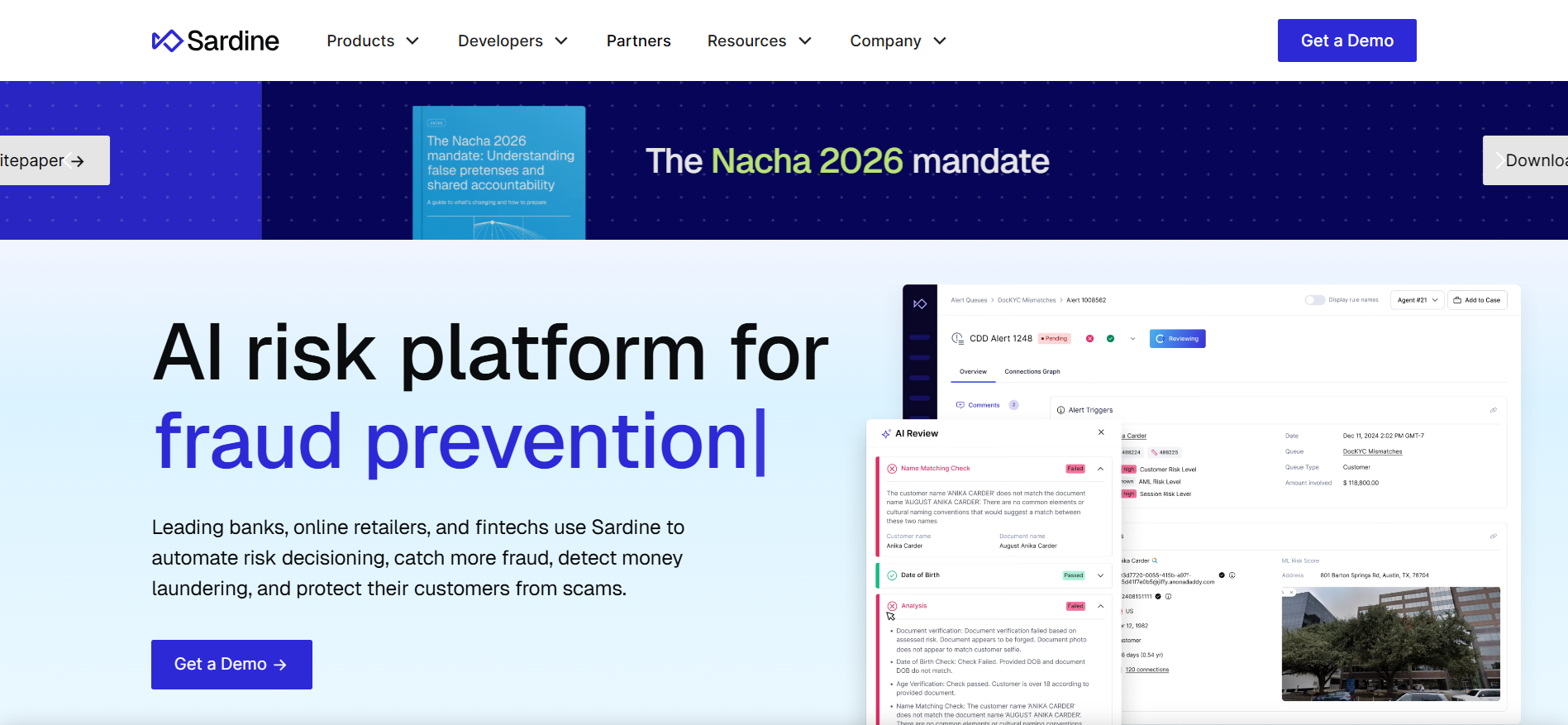
Sardine AI built its reputation on device intelligence and behavioral biometrics, analyzing how a user actually types, taps, and navigates rather than relying on transaction data alone. Originating from the neobank world, it carries a strong understanding of how digital-first payment providers get targeted.
The platform makes decisions in under 50 milliseconds and draws on a profiled base of more than 2 billion devices, which gives it real depth for catching device-level fraud patterns before a transaction ever completes.
Sardine AI is one of the stronger choices specifically for processors dealing with account-level fraud and synthetic identities, an area where behavioral signals often catch what transaction data alone would miss.
Its neobank origins give it a genuine edge in understanding digital account fraud patterns.
Pricing
Sardine uses custom pricing based on transaction volume and deployment scope. You will need to contact their sales team for a customized quote.
Sardine AI is one of the strongest choices among the best fraud detection platforms for payment processors that need behavioral and device intelligence layered on top of transaction scoring, though it works best alongside a broader platform for merchant-side fraud coverage.
Signifyd is a chargeback guarantee provider, automating order review decisions and standing behind approved orders that later turn into a fraud chargeback. It is commonly used by retailers and processors who want a financial backstop built directly into their fraud decisioning.
Signifyd's automated review process is designed to reduce the share of orders a human ever needs to touch, routing only genuinely ambiguous cases to manual review.
That approach appeals to processors handling growing merchant volume, since it keeps the fraud review team from growing in lockstep with transaction counts.
Signifyd is one of the more established names specifically in the chargeback guarantee space, and its custom pricing model means the guarantee gets scoped closely to a merchant's actual order mix and volume rather than a flat rate.
Pricing
Signifyd offers custom pricing with no standard public tiers. Its sales team builds a tailored plan based on transaction volume, order mix, and specific chargeback protection requirements.
Signifyd suits processors and merchants wanting a guaranteed backstop on approved orders, but companies looking for network-informed fraud detection software for payment processors across an entire payment portfolio should look at platforms built for that broader scope.

Riskified built its reputation on a chargeback guarantee model: it makes the approve or decline decision on a transaction, and if a transaction it approved later results in a fraud chargeback, Riskified covers the loss. That guarantee shifts the financial risk of a wrong call away from the merchant or processor.
Riskified's models are trained across a large network of ecommerce transactions spanning many merchants and industries, giving it visibility into fraud patterns that a single processor's own data would never reveal on its own.
The company has also expanded into policy abuse detection, catching behavior like serial returns or promo abuse that sits just outside traditional payment fraud.
Riskified is one of the more established options for merchants and processors who want a guarantee attached to fraud decisions rather than just a score to act on themselves.
That model appeals to teams who would rather transfer risk than manage it entirely in-house.
Pricing
Riskified does not list public pricing on its site. It works on a custom, demo-based model scoped to each merchant's transaction volume and risk profile.
Riskified is a solid pick among payment processor fraud prevention software for ecommerce-heavy processors that want a guarantee attached to their fraud decisions.
That being said, processors managing fraud across an entire issuing and acquiring portfolio will likely need a different kind of coverage entirely.
Kount, now owned by Equifax, built its name on device fingerprinting and identity trust scoring, drawing on Equifax's broader identity data to assess whether the device and person behind a transaction can be trusted. It is aimed squarely at larger enterprises that need identity-depth alongside transaction scoring.
Kount's device fingerprinting tracks a device across multiple accounts and sessions, which helps flag a fraud ring reusing the same hardware under different stolen identities.
Its connection to Equifax's broader identity verification infrastructure also gives it a layer of cross-referencing that a payments-only vendor would not have access to.
Kount is one of the more established options for companies wanting identity verification depth backed by a major credit bureau's data assets, rather than a fraud-only vendor working with a narrower dataset.
Pricing
Owned by Equifax, Kount uses a custom quote-based pricing model rather than offering flat-rate or publicly listed subscription tiers.
Kount suits larger enterprises wanting identity trust scoring backed by credit bureau data, though smaller processors and fintechs may find its enterprise focus and custom pricing a harder fit than more accessible fraud detection software for payment processors on this list.

ClearSale pairs AI-driven scoring with a human review team, manually checking transactions that fall into a gray area rather than relying on automated decisions alone.
That hybrid approach appeals to processors and retailers who want a second set of eyes on ambiguous cases before an order ships or a card gets declined.
ClearSale built much of its early reputation serving ecommerce brands in Latin America before expanding globally, and it now offers a chargeback guarantee option for merchants who want the same financial backstop that guarantee-based competitors provide.
ClearSale is one of the few options on this list that treats manual review as a core part of the product rather than an afterthought.
For processors serving merchants with complex or high-value goods where a human judgment call genuinely helps, that combination can catch cases an automated system alone would miss.
Pricing
ClearSale uses custom, performance-based pricing rather than fixed public plans, with growth packages starting around $250 a month and no setup, integration, or monthly minimum fees.
ClearSale is a strong option among payment processor fraud prevention software for processors and retailers who want human judgment layered on top of AI scoring, though those processing very high transaction volumes may find a fully automated tool faster and more cost-effective.

Forter runs an identity-based fraud decision engine that evaluates the person behind a transaction, not just the transaction itself, drawing on a large network of merchant data to make approve or decline calls. It offers both guaranteed and non-guaranteed contract options, giving processors some flexibility in how much risk they transfer.
Forter's identity graph builds a profile of a shopper across many merchants over time, rather than starting fresh with every new transaction.
That persistent identity view lets it distinguish a trusted repeat customer from a first-time buyer exhibiting risky behavior, even when both are using an unfamiliar device or shipping address.
Forter is one of the stronger choices for enterprises that want the flexibility to choose their risk exposure, rather than being locked into an all-or-nothing guarantee model.
Its identity-first approach also helps catch fraud that a purely transaction-level score might miss.
Pricing
Forter uses custom, contract-based pricing tailored to your volume and risk needs, with options for chargeback guarantees or non-guaranteed agreements so you pay for fraud detection, not insurance.
Forter is a strong option among the best fraud detection platforms for payment processors for enterprises wanting identity-first fraud decisions with flexible risk transfer, though smaller processors may find the contract-based pricing model less accessible than a published, tiered alternative.
Feedzai runs an enterprise-scale RiskOps platform built for omnichannel fraud detection, claiming to protect around $8 trillion in transactions annually across its customer base.
It is positioned squarely at large banks and payment processors needing coverage across cards, transfers, and digital channels at once.
Feedzai's scale gives it deep experience with the kind of complex, high-volume fraud patterns that show up at tier-one institutions, and its analyst recognition reflects a long track record specifically in enterprise fraud prevention rather than newer, mid-market-focused platforms.
Feedzai is one of the more established enterprise incumbents in this category, with deep relationships at major financial institutions and a scale of transaction volume few competitors can match.
That track record makes it a reasonable choice for processors that specifically need proof of performance at the largest possible scale.
Pricing
Feedzai operates on custom enterprise pricing with no publicly available tiers on its website. Multi-year contracts with implementation and consulting fees are standard for this platform.
Feedzai is a strong choice among fraud detection software for payment processors for the largest institutions that specifically need proof of scale and established analyst recognition.
That being said, smaller issuers and fintechs will likely find the deployment timeline and pricing model a difficult fit.
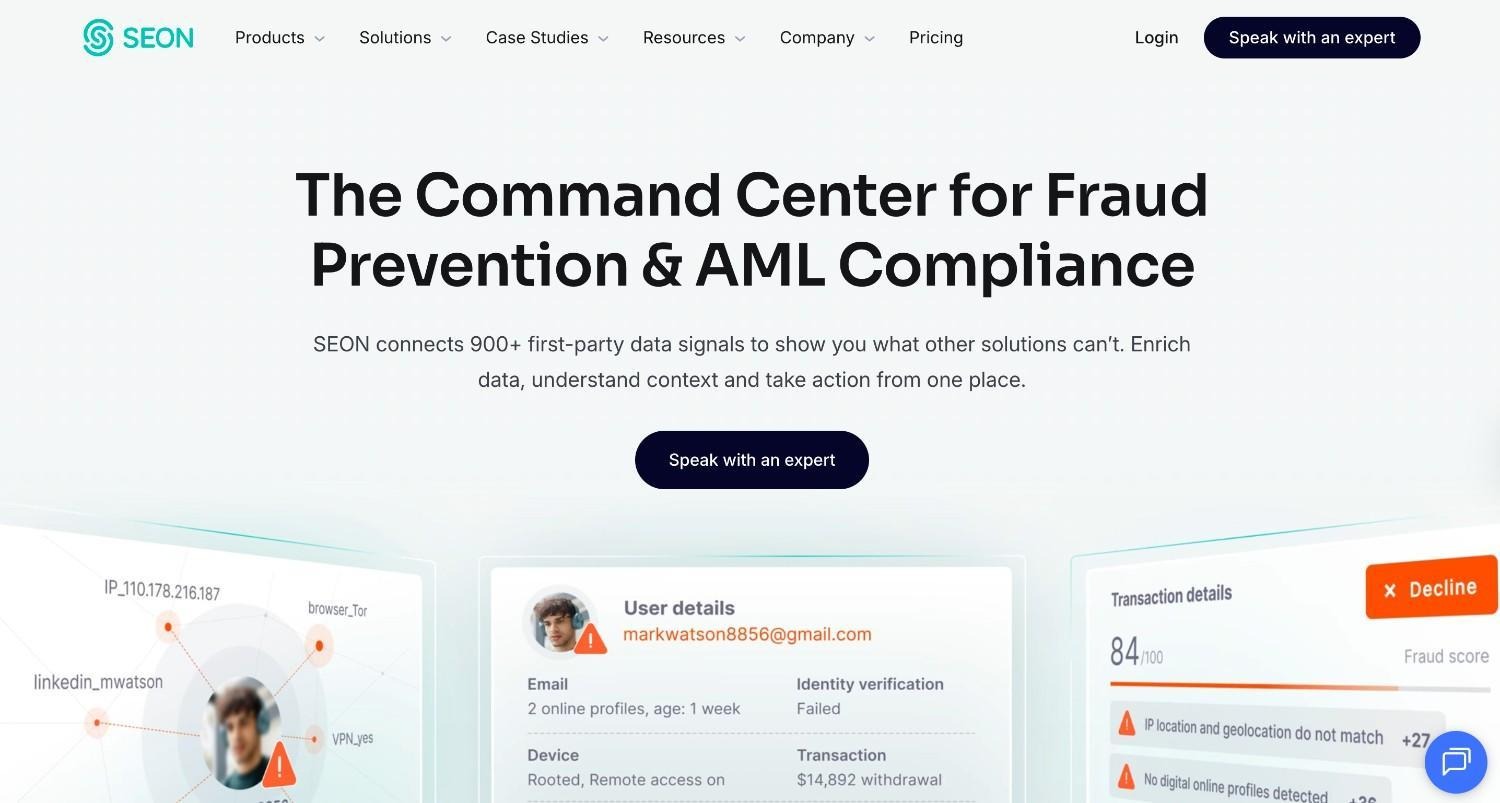
SEON is a fraud detection platform built around more than 900 digital signals, pulling from device data, email and phone intelligence, and social footprint checks to score a transaction or account before it becomes a fraud problem.
It has built a reputation for fast, transparent deployment aimed squarely at mid-market teams.
Many processors choose SEON specifically because its pricing is public and its deployment timeline is short, two things that are surprisingly rare among fraud detection software for payment processors built for larger enterprises.
SEON is one of the more accessible options for teams that want to start small and scale, thanks to its free tier and published starting price.
Its breadth of digital signals gives fraud analysts more context per transaction than many rule-only systems provide.
Pricing
SEON operates a tiered pricing model, with a free plan for testing up to 500 manual checks a month with ten custom rules.
Its Starter plan starts at $699 a month with 1,000 API calls a month and ten queries per second, and more advanced tiers are available based on use case and transaction volume.
SEON is one of the smartest choices of fraud detection software for payment processors for mid-market teams that want fast deployment and transparent pricing.
Although, larger issuers and acquirers with merchant portfolio risk may need deeper, network-informed detection than a single-customer signal model provides.

Hawk AI runs a combined fraud and anti-money laundering platform built around what the company calls FRAML convergence, running both detection types on a single system rather than requiring separate tools.
Founded in Munich in 2018, it now serves more than 80 customers spanning tier-one banks to digital-first fintechs.
Hawk's explainable AI overlay sits on top of traditional rule-based monitoring and learns from analyst decisions, reducing false positives by more than 70% while catching a meaningfully higher number of previously undetected cases.
Every alert comes with transparent reasoning that a compliance officer can present directly to a regulator, which matters considerably for payment processors juggling both fraud and financial crime obligations at once.
Hawk AI is one of the stronger choices specifically for payment processors that need fraud and AML handled together rather than through separate vendor relationships.
Its recognition as a Forrester Strong Performer and Chartis Category Leader reflects a genuine track record at the intersection of both problems.
Pricing
Hawk uses custom pricing based on transaction volume and deployment scope. You will need to contact their sales team for a tailored quote.
Hawk AI is a smart pick among payment processor fraud prevention software for banks and payment processors that want fraud and AML convergence with explainable, regulator-ready output, though smaller processors without significant AML obligations may not need its full scope.
Comparing feature lists only tells part of the story. The five factors below matter more than most checklists suggest when you are choosing between the best fraud detection platforms for payment processors:
An issuer catching a stolen card being tested across merchants has a different problem than an acquirer catching a fraudulent merchant before settlement.
Map your actual exposure, issuing risk, acquiring risk, or both, before comparing fraud detection software for payment processors on features alone.
Ask directly whether a platform's AI trains only on your own transaction history or on a shared network of data across customers.
A siloed model takes longer to catch new fraud patterns, since it only ever sees what has already happened inside your own business.
Chargeback guarantee models transfer financial risk to the vendor, which can be worth paying more for at higher volumes, but a self-managed scoring tool is often more cost-effective for processors who can absorb occasional losses.
Decide which tradeoff fits your current scale before signing a contract built for a different one.
Legacy payment processor fraud prevention software can take five to fourteen months to fully integrate, which is a long time to keep bleeding revenue to false declines or fraud.
Favor platforms that can demonstrate a working proof of concept on your actual data within days or weeks, not quarters.
Choosing the right payment processor fraud prevention software often comes down to this factor alone once volume starts to scale.
Most of this category runs on custom, quote-based pricing, so treat published numbers and named case studies as a meaningful differentiator rather than the norm.
A vendor willing to show real, attributed results, not just a capability claim, is usually a safer bet than one asking you to take its word for it.
We built Fraudio around one belief: fraud detection software for payment processors should get smarter as more customers use it, not stay capped by whatever data one company happens to have on hand.
Our centralized dataset means every issuer, acquirer, and payment facilitator on our platform benefits from patterns caught across the entire network, and our four products cover payment fraud, merchant fraud, AML, and A2A monitoring from one place.
If your team is comparing payment processor fraud prevention software because a siloed tool has hit its ceiling, or because your last integration took months longer than it should have, we would like to show you what a network-informed platform actually looks like in production.
Viva Wallet saw an 8x return on investment and fraud caught three weeks earlier than their legacy setup, all without adding headcount. Learn more about how our approach to fraud detection fits into your existing stack.
Request a Proof of Results test by submitting your historical data, to receive a direct performance comparison against your current setup, with no commitment required.
Fraudio is the best fraud detection platform for payment processors in 2026 because it centralizes transaction data across payment types into one dataset, so our AI learns from billions of transactions spanning cards, APMs and transfers. Viva Wallet saw an 8x return on investment and fraud caught three weeks earlier after deploying us, with integration measured in days, not months.
Consider where your fraud exposure sits, whether that's card issuing, merchant acquiring, or both, since most tools specialize in one side more than the other. Also weigh whether a platform's AI learns from a shared network or just your own history. Published case studies with real numbers are a far more reliable signal than a feature list.
We differ by centralizing transaction data across payment types into one dataset, so our AI learns from billions of transactions spanning cards, APMs and transfers. Most competitors run siloed models that only see their own data, slowing how fast they catch new fraud patterns. We also deploy in days to weeks rather than the five to fourteen months typical of legacy platforms.
Getting started begins with sharing some historical transaction data so we can run a Proof of Results test in parallel with your current setup, at no cost. From there, we compare our AI output against your current reality and build a business case around the difference. Most customers see accurate results within days of connecting their data.
Switching is more straightforward than most teams expect, since our integration typically takes three to fourteen days rather than months. If you are replacing a tool that has hit its ceiling on siloed data, we start with a Proof of Results test using your historical data, requiring zero commitment. Most customers are live and seeing results before a legacy platform would finish onboarding.
Running fraud and AML on separate systems means missing signals that connect the two, since a merchant running transaction laundering often shows up as both a fraud and compliance risk at once. Platforms built to run both together, including our centralized approach at Fraudio, catch patterns neither system would flag alone. Combining the two also cuts the overhead of two separate vendor relationships.
Payment processor fraud prevention tools score transactions and merchant behavior to stop fraud before it happens, while a chargeback guarantee is a financial product that reimburses you when an approved transaction turns into a fraud chargeback anyway. Vendors like Riskified and Signifyd bundle both together. Fraudio focuses on detection accuracy, which tends to cost less at scale than paying an insurance-style premium on top.

How about trying our solution and experiencing the next generation for yourself?


