
June 5, 2026
| Tool | Best For | Key Features | Pros | Cons | Pricing Starts |
|---|---|---|---|---|---|
| Fraudio | Payment companies needing real-time transaction fraud, MIF, AML, and P2P monitoring |
Patented Network Effect AI
Real-time Scoring
MIF, AML & P2P
Rules Engine
|
Centralized AI
Fast deployment (days)
No hidden fees
Multi-product coverage
|
No public pricing tiers
Contact required
|
Usage-based; no setup fees |
| Feedzai | Large enterprises processing trillions in volume |
RiskOps Platform
Omnichannel Fraud Detection
ML Scoring
|
Proven at tier-one scale
Deep enterprise relationships
|
Long integration (5–14 months)
High cost
|
Custom enterprise pricing |
| Sift | Mid-market to enterprise e-commerce and fintech |
AI Fraud Decisioning
Account Defense
Dispute Management
|
Flexible and adaptive
Broad signal coverage
|
Pricing opacity
Primarily e-commerce focused
|
Custom, usage-based pricing |
| Sardine | Companies needing device intelligence + behavioral biometrics |
Sub-50ms Decisions
2.2B Profiled Devices
Behavioral Biometrics
|
Extremely fast
Deep device/behavior intelligence
|
Less breadth on AML/MIF
|
Custom pricing |
| Featurespace | Tier-one banks and financial institutions |
ARIC Risk Hub
Adaptive Behavioral Analytics
Enterprise ML
|
Deep enterprise bank relationships
Gartner recognized
|
Enterprise-only pricing
Complex deployment
|
Custom enterprise pricing |
| SymphonyAI | Banks and FIs needing AI-driven financial crime detection |
Sensa Investigation Hub
AI-powered AML
SAR Automation
Network Analytics
|
Purpose-built for financial crime compliance
Strong case management
|
Enterprise-only pricing
Complex for smaller teams
|
Custom pricing |
| Hawk | Payment companies needing explainable AI for fraud and AML |
Explainable AI
Real-time Transaction Monitoring
AML Typology Detection
|
Explainability built in
Strong for regulated environments
|
Less suited for pure payment fraud scoring
No merchant detection depth
|
Custom pricing |
| Napier AI | Compliance-focused FIs needing AML workflow automation |
AI-powered AML TM
Case Management
Intelligent Screening
|
Strong regulatory workflow coverage
Configurable compliance rules
|
Primarily AML-focused
Limited payment fraud detection depth
|
Custom pricing |
| Sumsub | Companies prioritizing KYC/AML onboarding and compliance |
KYC/AML Verification
Transaction Monitoring
Fraud Prevention
|
Strong onboarding and KYC coverage
Global reach
|
Less focused on real-time transaction scoring depth
|
Starts at $1.35/verification |
| ComplyAdvantage | Teams focused on AML compliance and sanctions screening |
AI AML Screening
Real-time Risk Assessment
Adverse Media
|
Strong AML and sanctions coverage
Reduces false positives
|
Less robust on payment transaction fraud detection
|
From $99/month (100 entities) |
SEON built its reputation on accessibility and speed. The platform aggregates 900+ first-party signals from email addresses, phone numbers, IP addresses, device data, and social media profiles to generate a risk score at the point of user onboarding or login.
For mid-market companies that need to validate user identity, detect fake accounts, and block high-risk signups, without a 6-month integration project - SEON delivers genuinely well.
Its pricing transparency is also notable. At $699/month for the Starter plan, SEON gives smaller teams a predictable entry point that most enterprise fraud tools won't match. The 14-day deployment timeline and clean API documentation make it accessible for lean engineering teams.
For iGaming, financial tech/services, and other B2B/B2C businesses that primarily need digital footprint analysis at account creation or login, SEON performs well.
Users on review platforms consistently praise the UI, the volume of signals available, and the ability to build flexible custom rules without developer involvement.
The core limitation is scope: SEON is built around identity signals at user-level touchpoints, not around transaction-level payment fraud detection.
Payment processors, acquirers, issuers, and fintech companies that need to score individual card transactions in real time at pre-authorization, and detect patterns across millions of transactions per second - will find SEON's capabilities thin for that use case.
Specific gaps that drive users toward SEON alternatives include:
Fraudio is a real-time fraud detection and AML prevention platform purpose-built for payment companies: issuers, acquirers, payment facilitators, fintech companies, and processors.
Founded in Amsterdam and backed by patented technology, we currently deliver 4 core products: Payment Fraud Detection (PFD), Merchant Initiated Fraud Detection (MIF), Anti-Money Laundering (AML), and Peer-to-Peer Transfer Monitoring (P2P), from a single platform.
Our central differentiator is its patented Network Effect AI: a centralized dataset that aggregates transaction data across all connected customers, allowing models to learn from billions of transactions simultaneously rather than operating in isolation.
This breaks the data silo problem that limits most fraud detection platforms, and it means new customers benefit from the collective intelligence of the network from their very first transaction processed.
We’ve processed 2 billion transactions across 188 countries, serving over 2 million merchants from 548 industries and delivering an 8x ROI for customers like Viva Wallet, who recorded a 600% increase in fraud team efficiency and fraud was caught 3 weeks earlier than legacy solutions.
Integration with our platform takes 3 to 14 days versus 5 to 14 months for enterprise incumbents, offering a faster, more efficient and feature-rich experience.
SEON focuses on user-level identity signals at onboarding and login. What happens after every payment processed, every merchant active in a portfolio, every transfer moving between accounts is where we operate.
For payment companies, the specific audience SEON cannot fully serve, Fraudio covers the full fraud surface: card fraud detection at authorization, merchant fraud detection weeks before chargebacks arrive, AML monitoring with full case management, and P2P behavioral risk for instant payment environments.
The pricing model is also built differently. SEON charges a flat monthly fee that becomes opaque at scale. Fraudio's pay-per-transaction model means cost scales with volume, not with an arbitrary tier structure, and decreases per transaction as volume grows. There are no setup fees, no implementation fees, and no hidden costs.
While SEON's AI is siloed to each individual customer, Fraudio's centralized dataset means smaller customers get the fraud intelligence of a network processing billions of transactions. That's not a feature SEON replicates.
For European payment companies specifically, operating under PSD2, GDPR, and central bank AML mandates across the UK, Germany, Netherlands, and Portugal - we are also the only platform in this comparison built from the ground up for European enterprise reality: data residency by architecture, EU AI Act readiness, and production deployments at scale with regulated European payment institutions.
We operate on a transparent usage-based SaaS model: customers pay per transaction processed, with no setup fees, no implementation fees, no maintenance fees, and no hidden charges. The cost per transaction decreases as volume grows, creating natural alignment between Fraudio's success and customer growth.
Customers can also commit to higher volumes for locked-in buy rates. Exact pricing is available through direct contact with our sales team.
For payment companies evaluating SEON competitors, Fraudio is the best overall alternative. We directly cover the use cases SEON cannot: real-time transaction fraud scoring, merchant fraud detection, AML compliance monitoring, and P2P transfer risk. The centralized AI architecture, rapid deployment, and usage-based pricing make it accessible to emerging fintechs and compelling for established processors.
If your fraud challenge lives at the transaction and merchant layer, not just at account creation - Fraudio is the most purpose-fit option on this list.
Feedzai is one of the most recognized names in enterprise payment fraud detection, claiming to protect over $8 trillion in transactions annually.
Founded in 2011 and headquartered in Portugal, Feedzai serves tier-one banks, card networks, and large payment processors with its RiskOps platform, a unified environment for fraud detection, case management, and risk orchestration across the full customer lifecycle.
Feedzai has received consistent recognition from Gartner and Forrester and maintains deep relationships with major financial institutions globally.
The platform positions itself as an omnichannel fraud detection engine: covering online, mobile, branch, and ATM channels from a single risk management interface.
Feedzai addresses the transaction-layer gap that is the primary limitation of SEON. For enterprises that have outgrown identity-signal-based fraud detection and need a purpose-built real-time transaction scoring engine, Feedzai is one of the more capable options in the market. Its omnichannel coverage and case management depth are genuinely well-developed.
Feedzai operates on custom enterprise pricing. No publicly-available tiers on their website. For them, multi-year contracts with implementation and consulting fees are standard.
Feedzai is a strong choice for tier-one financial institutions with the engineering resources and budget to support a full enterprise deployment.
For emerging fintechs, smaller acquirers, or payment companies that need fast time-to-value, it is not a practical option - integration timelines and cost structure make it inaccessible below a certain scale.
Sift is a fraud decisioning platform founded in 2011 and headquartered in San Francisco - serving eCommerce, fintech, and marketplace businesses with AI-powered fraud prevention across the customer journey.
Its platform covers account defense, payment protection, dispute management, and content integrity, positioning it as a broad fraud management tool rather than a specialized payment transaction engine.
Sift's network of connected businesses provides shared fraud signals across its customer base, similar in concept to a shared intelligence model.
Sift is frequently cited as one of the top SEON competitors on software marketplaces and review portals like G2, TrustRadius, and Capterra - with strong user ratings for flexibility and adaptive fraud models.
Sift covers more of the transaction layer than SEON. Its payment protection module provides fraud scoring at checkout, something SEON's identity-signal approach does not natively address for payment flows.
For teams making the switch from SEON because they need transaction scoring alongside account defense, Sift is one of the best SEON alternatives in the mid-market segment.
Sift offers custom, usage-based pricing, with no publicly available pricing tiers. The packages are based on transaction volume, feature set and modules required - alongside the customer’s frequency of usage on the platform.
Sift is one of the best SEON alternatives in the mid-market segment for eCommerce and fintech companies that need both account defense and payment fraud coverage in one platform.
It is less suitable for payment processors, acquirers, or companies with significant AML compliance requirements, where more specialized tools like Fraudio cover the depth needed.
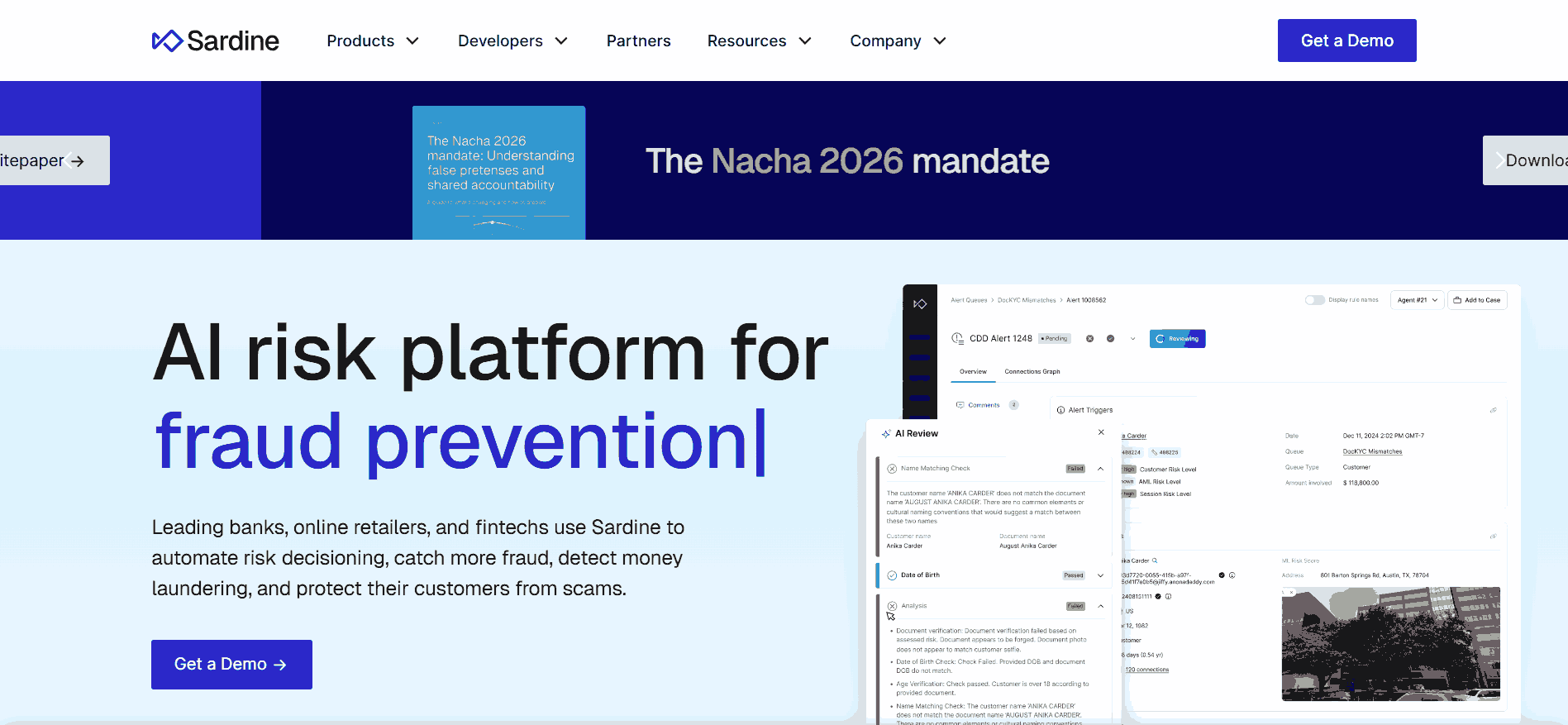
Sardine is a fraud detection and compliance platform founded by former Coinbase and Revolut executives, purpose-built for the speed and complexity of modern fintech and crypto environments.
Its core strength is device intelligence and behavioral biometrics: Sardine has profiled over 2.2 billion devices and delivers fraud decisions in under 50 milliseconds. The platform covers payment fraud, ACH fraud, account fraud, and compliance use cases with a single SDK integration model.
Sardine's origins in neobanking and crypto give it particular depth for real-time financial transaction environments where traditional identity signals aren't sufficient and speed is critical.
Sardine addresses the speed and behavioral intelligence gap in SEON's offering.
While SEON relies primarily on static digital footprint signals (email, phone, social metadata), Sardine analyzes real-time behavioral patterns during the session, catching fraud that identity signals alone miss.
For neobanks and fintechs where account takeover and authorized push payment (APP) fraud are primary concerns, Sardine is one of the stronger alternatives.
Sardine uses custom pricing based on transaction volume and deployment scope. Contact their sales team for a customized quote.
Sardine is one of the strongest choices for neobanks, fintechs, and crypto companies where behavioral biometrics and sub-50ms decisioning are the critical requirements.
For payment processors, acquirers, or organizations with merchant fraud and AML as primary needs, it's less comprehensive than purpose-built alternatives.
Featurespace is a Cambridge-based enterprise fraud detection company best known for its ARIC Risk Hub, which uses Adaptive Behavioral Analytics (ABA) to model individual customer behavior and detect deviations that indicate fraud or financial crime.
Founded in 2008 and spun out of Cambridge University, Featurespace serves over 70 major financial institutions including HSBC, NatWest, and Worldpay. It has received consistent analyst recognition from Gartner and Forrester as a leader in enterprise fraud detection.
The ARIC Risk Hub's defining capability is its individual behavioral model; it builds a baseline for each customer and flags deviations in real time, rather than relying on population-level rules or aggregate risk scores.
Featurespace directly addresses the transaction-layer depth that SEON lacks.
Its behavioral modeling approach is particularly effective for detecting subtle fraud that rule-based systems and identity signals miss, specifically account takeover and authorized push payment (APP) fraud in established account relationships.
For large financial institutions, it represents one of the more technically sophisticated options available.
Custom enterprise pricing based on transaction volume, number of accounts monitored, modules deployed, and level of customization. Users can opt for a monthly, annual or bespoke (quarterly, bi-monthly, half-yearly etc.) by connecting with their sales team.
Featurespace is a compelling option for tier-one banks that need individual behavioral modeling at scale.
The enterprise pricing and deployment complexity make it impractical for emerging payment companies, smaller acquirers, or any organization that needs fast time-to-value.
SymphonyAI is an enterprise AI company that operates a dedicated financial services division focused on financial crime detection and AML compliance.
Its flagship product for banking and payments is the Sensa Investigation Hub, an AI-powered financial crime investigation and case management platform designed to help compliance teams at banks and financial institutions detect money laundering, fraud, and financial crime more efficiently.
SymphonyAI brings together network analytics, AI-driven alert prioritization, and automated SAR (Suspicious Activity Report) preparation into a unified investigation workflow.
The platform is built around reducing the manual workload on compliance analysts: it uses AI to triage and score alerts, surfaces the most relevant contextual information for each investigation, and automates documentation tasks that typically consume significant analyst time.
SymphonyAI serves major global financial institutions and has built its positioning around measurable reductions in false positive alert rates and faster case resolution times.
SymphonyAI addresses the financial crime and AML investigation gap that SEON does not cover.
On one hand, SEON provides identity signal enrichment at account level - and on the other, SymphonyAI provides AI-powered investigation tooling for compliance teams managing high volumes of financial crime alerts.
For banks and regulated financial institutions where the challenge is not fraud detection at onboarding but financial crime investigation at scale, SymphonyAI is one of the more capable enterprise options.
Custom enterprise pricing. You’ll need to connect with their sales team directly for a quote as per your use case, features required, nature of business and transaction volume.
SymphonyAI is a strong option for large banks and financial institutions that need AI-powered financial crime investigation tooling alongside their existing AML transaction monitoring infrastructure.
It is not well-suited for payment processors, acquirers, or any organization that needs real-time fraud scoring at the transaction layer as its primary use case.
Hawk AI is a financial crime prevention platform founded in 2018 and headquartered in Munich, Germany.
It combines AI-powered transaction monitoring, fraud detection, and AML compliance tooling in a platform specifically designed for banks, payment companies, and fintechs that need explainable AI outputs alongside their risk decisions.
Hawk AI’s defining characteristic is its focus on explainability: every AI-generated alert includes a clear explanation of which signals triggered it, helping compliance analysts understand and act on decisions without relying on black-box outputs.
The platform covers real-time payment fraud monitoring, AML transaction monitoring, and typology-based detection, with pre-built AML typologies that map to known financial crime patterns and reduce the time needed to configure detection logic from scratch.
Hawk addresses the transaction-layer and AML monitoring gap that SEON leaves open, with the added dimension of explainability that makes it particularly well-suited for regulated environments.
While SEON provides digital footprint signals at account level, Hawk.ai monitors transaction behavior in real time and explains every risk decision, a combination that matters for compliance teams that need to demonstrate sound decision-making to regulators.
For European banks and fintechs evaluating SEON competitors that cover both fraud and AML with audit-ready outputs, Hawk.ai is one of the more practical mid-tier options.
Hawk AI uses custom pricing based on transaction volume and deployment scope. Contact their sales team for a tailored quote.
Hawk AI is a strong choice for banks and fintechs that need explainable, audit-ready fraud and AML monitoring with faster deployment than traditional enterprise incumbents.
It is less well-suited for payment processors or acquirers whose primary need is merchant fraud detection or real-time card transaction scoring at very high volume.
Napier AI is a compliance technology company headquartered in London, focused on AI-powered AML transaction monitoring, client screening, and regulatory compliance automation for banks, payment companies, and financial institutions.
Founded with a mission to modernize legacy compliance infrastructure, Napier AI combines configurable rules with machine learning to deliver faster, more accurate AML monitoring, reducing the false positive burden that drives up compliance costs across the industry.
The platform's core products include an Intelligent Transaction Monitoring system, Intelligent Screening for sanctions and PEP checks, and a case management environment with full audit trail capabilities.
Napier AI is designed to work alongside or replace legacy systems like NICE Actimize or Temenos AML, offering a cloud-native, API-first architecture that reduces implementation complexity compared to older compliance platforms.
The company serves regulated financial institutions in Europe and globally, with a particular focus on the mid-tier bank and payment institution segment that finds enterprise AML vendors inaccessible.
Napier AI addresses the AML compliance depth that SEON does not provide.
While SEON offers identity signal enrichment at account level, Napier AI delivers transaction-level AML monitoring with full case management and SAR reporting, the operational compliance workflow that payment companies and banks need to meet central bank and card scheme requirements.
For organizations evaluating SEON alternatives specifically because they need genuine AML transaction monitoring rather than identity-level risk signals, Napier AI is one of the stronger purpose-built compliance options at the mid-market tier.
Napier AI offers custom pricing with no publicly available pricing tiers. You’ll need to connect with their sales team for a tailored pricing plan as per your business/use case.
Napier AI is amongst the best SEON alternatives for mid-tier banks, EMIs, and payment companies that need to modernize AML transaction monitoring and screening with a cloud-native platform that deploys faster than legacy enterprise alternatives.
It is not the right fit for organizations whose primary challenge is real-time payment fraud scoring, merchant portfolio risk, or P2P transfer fraud detection, where tools like Fraudio are better suited.
Sumsub is an identity verification and compliance platform founded in 2015 and headquartered in London, serving businesses across fintech, crypto, marketplace, and financial services verticals.
The platform covers KYC verification, KYB verification, AML screening, transaction monitoring, and fraud prevention from a single integration.
Sumsub is particularly strong at the onboarding layer, providing document verification, liveness checks, and adverse media screening that help companies meet global regulatory requirements efficiently.
It has processed over 3 million verifications monthly and operates globally, with coverage for 220+ countries.
Sumsub covers more of the compliance and AML layer than SEON.
For companies that need both robust onboarding verification and ongoing AML monitoring capabilities, Sumsub is one of the more accessible combined platforms - particularly for teams at the earlier stages of building compliance infrastructure.
Plans start at $1.35 per verification, and the other plan available to users is charged at $1.85 per verification. For enterprise-level verification, you’ll need to connect with their sales team for a customized pricing plan.
Sumsub is a strong SEON alternative for fintech and crypto companies at the compliance and onboarding layer, particularly those that need KYC, AML screening, and transaction monitoring in a single platform.
For payment processors or acquirers that need deep transaction-level fraud scoring or merchant fraud detection, more specialized options provide greater depth.
ComplyAdvantage is an AI-powered AML and financial crime detection platform founded in 2014 and headquartered in London, United Kingdom.
It specializes in sanctions screening, adverse media monitoring, PEP (Politically Exposed Persons) detection, and AML transaction monitoring - serving banks, fintech companies, crypto exchanges, and payment companies globally.
The platform processes millions of screening checks daily and uses its own proprietary database of financial crime entities, updated in near-real time.
ComplyAdvantage is backed by strong VC support and has built a reputation as a modern, tech-forward alternative to legacy compliance databases like World-Check.
ComplyAdvantage covers the AML and compliance gap that SEON leaves open for payment companies.
While SEON provides identity signals at account level, ComplyAdvantage provides real-time sanctions screening, adverse media monitoring, and transaction-level AML analysis; addressing the regulatory compliance layer that payment companies operating under PSD2, GDPR, and central bank requirements need.
ComplyAdvantage Starter plan starts at approximately $99/month for up to 100 entities (charged at $319/month for up to 2000 monitored entities). Enterprise plans with the full Mesh platform including agentic AI workflows are custom-priced. You’ll need to contact their sales team for current details.
ComplyAdvantage is one of the stronger alternatives for organizations whose primary need is AML compliance and sanctions screening. It is less suitable for teams that need real-time payment transaction fraud scoring or merchant fraud detection as the primary use case.
Card issuers and acquirers need real-time fraud detection at the point of authorization, a specific technical requirement that SEON's identity signal approach does not address.
Fraudio's Payment Fraud Detection (PFD) product sits at pre-authorization, scoring every transaction between 0 and 1 with color-coded recommendations (approve, screen, or block) in real time.
The AI operates beneath the rules engine: rules fire first for known patterns, then the AI analyzes the transaction using centralized intelligence from billions of cross-customer transactions.
For issuers dealing with Card-Not-Present (CNP) fraud, credit card testing, and account takeover, and for acquirers managing chargeback rates, this is the right tool for the right use case - from an integration in days, not months.
Approximately 3% of new digitally boarded SMEs turn out to be fraudsters. Payment facilitators that onboard merchants digitally at scale face this risk on every new merchant activation. SEON does not have a product that addresses this problem.
Fraudio's MIF product analyzes merchant entities across time, assessing all money flows, payment patterns, and associated data points - and delivers prioritized alerts weeks before chargebacks arrive.
For a PayFac or acquiring bank, that early detection window is the difference between a recoverable situation and a settlement loss that arrives too late to act on.
Fintech companies and payment processors subject to central bank oversight, PSD2, and card scheme requirements need more than a rule engine.
They need a full AML product: configurable rules, AI modeling, link analysis, case management with SLA logic, and SAR reporting.
Fraudio's anti money laundering solution delivers all of this, including team queue logic, audit trails, and direct SAR report downloads - in a platform that is accessible to companies that cannot afford to scale compliance headcount proportionally with transaction growth.
For a fintech that just received its EMI license and needs a compliant AML monitoring solution ready in days, Fraudio is a realistic option where enterprise alternatives are not.
Authorized Push Payment (APP) fraud and money mule networks are the primary fraud vectors for digital banks and instant payment providers. SEON's identity signals help at account creation but do not profile behavioral patterns across transfer flows over time.
Fraudio's P2P product combines event-level scoring on each transfer with entity-level behavioral profiling across time - tracking inflow-to-outflow ratios, velocity, counterparties, and sanctions exposure; to identify coordinated mule networks and abnormal transfer behavior.
For a wallet provider or A2A payment network where a single mule ring can distribute fraud proceeds across dozens of accounts within minutes, this real-time behavioral detection is the difference between early intervention and widespread loss.
Enterprise fraud platforms price out emerging fintechs. A 5 to 14-month integration timeline is impossible for a company that just got its license and needs transaction monitoring live before processing its first transaction.
Fraudio's usage-based pricing (no setup fees, no implementation fees, cost per transaction) and 3 to 14-day integration window directly address this gap. The centralized AI means that even a new customer with limited historical data benefits from network-level fraud intelligence from day one. Customers can provide historical data at setup to accelerate model tuning further.
For a fintech company moving from an underpowered rule engine to AI-grade fraud detection, Fraudio is designed to be the transition that doesn't require 12 months and a large consulting budget.
Not every fraud detection tool is a genuine replacement for SEON for every use case. Here are the five capabilities a tool needs to actually cover the ground SEON leaves open.
A genuine SEON replacement for payment companies must provide real-time fraud detection at the transaction layer, not just assess user identity at onboarding.
This is the foundational capability that separates tools built for payment infrastructure from tools built for identity verification.
If a platform can't return a fraud score on a card transaction in real time, it is not filling the primary gap in SEON's product set.
Identity-signal tools like SEON assess individual users. Payment companies also need to assess merchants as entities, tracking behavioral patterns across time to identify bust-out fraud, transaction laundering, and abnormal settlement patterns.
A genuine SEON alternative for acquirers and PayFacs must include merchant-level risk assessment, not just user-level or transaction-level scoring.
For regulated payment companies, AML is not optional. An alternative to SEON for fintech and payment processors must include transaction monitoring against AML rules, link analysis for layering detection, case management with audit trails, and reporting capabilities that satisfy regulatory requirements.
Platforms that offer AML as a checkbox feature without operational depth are not genuine replacements for compliance-driven use cases.
SEON's AI is limited to each individual customer's data. The best SEON alternatives use shared datasets that allow models to learn from the collective transaction history across all connected clients.
This network effect is particularly critical for new customers and smaller payment companies that don't have enough historical data to train meaningful models in isolation.
Platforms without this shared learning capability will require a long ramp-up period before their models are genuinely useful.
Fraud attacks don't wait for 12-month integration timelines. An alternative must integrate in days to weeks, not months.
Moreover, for emerging and mid-market payment companies that SEON has historically served, the pricing model matters: per-transaction cost that decreases at scale, with no setup fees or mandatory consulting charges, is the model that works for growing companies.
Alternatives that require enterprise contracts and lengthy professional services engagements are not serving the same market SEON addresses.
Choosing the best SEON alternative for your business can be a herculean task.
Here’s what you need to consider before zeroing-in on a specific tool/platform:
This is the most important technical question to ask any fraud or AML vendor, and most payment companies never ask it directly.
Most platforms train their machine learning models only on a single customer's transaction history. For an emerging fintech processing a few million transactions a month, that means the model is learning from limited data, takes months to produce reliable signals, and has no visibility into fraud patterns occurring at other institutions.
Our patented ‘Network Effect’ AI is the structural exception: it trains on billions of transactions across all connected customers simultaneously, while maintaining full legal and data separation between them.
A payment company connecting to Fraudio gets network-level fraud intelligence from the very first transaction processed - not after months of model training on its own limited history.
Ask every vendor on your shortlist: does your AI train on my data only, or across a shared network?
If the answer is only your data, ask how long it takes for the model to reach optimal performance. That ramp-up period is your detection blind spot.
Start by mapping what you actually need to protect: account creation and login, payment transactions at authorization, merchant portfolio behavior, account-to-account transfers, or regulatory AML compliance. SEON covers the first area.
Most SEON competitors mentioned on this list cover one or more of the others.
Pick the alternative whose primary product matches your primary fraud surface, not the one with the most features overall.
Some alternatives (like Featurespace, Feedzai) require months of integration and a dedicated ML engineering team. Others (such as Fraudio, Sift) integrate in days to weeks with standard API documentation.
If your team doesn't have the capacity for a 6-month integration project, narrow your evaluation to platforms with realistic deployment timelines for your context.
Setup fees, implementation fees, consulting charges, and mandatory training can add significantly to the first-year cost of any fraud platform.
For usage-based models like Fraudio's, model the cost at your current transaction volume and at 3x growth; some models that look affordable at low volume become expensive at scale, and vice versa.
Platforms with no setup fees and decreasing per-transaction cost at volume are generally better aligned with fast-growth payment companies.
Some teams need deep capability in one area - a specialized AML engine, or a dedicated merchant fraud product. Others need reasonable coverage across multiple fraud types from one integration.
If you're running one integration and need to cover card fraud, merchant risk, and AML compliance simultaneously, a multi-product platform like Fraudio or Feedzai is more practical than stitching together three specialized tools.
If your primary need is specifically explainable AI for AML compliance in a regulated European environment, a specialized tool like Hawk AI may outperform a broader platform in that dimension.
Payment companies operating in Saudi Arabia, the UAE, India, or Indonesia face data residency restrictions that most fraud platforms cannot accommodate.
Before evaluating any platform in depth, confirm that it can deploy within compliant infrastructure in your required geography.
Some platforms (Fraudio) have proven deployments in these territories; most have not.
| Category | Key Considerations |
|---|---|
| Top 3 Alternatives |
Fraudio (payment companies, full transaction + AML coverage), Feedzai (enterprise banks), Sift (eCommerce and fintech mid-market)
|
| Best Overall Option |
Fraudio — covers transaction fraud, merchant fraud, AML, and P2P monitoring with patented centralized AI and usage-based pricing with no setup fees
|
| Why Look for SEON Alternatives |
SEON focuses on identity signals at onboarding and login; lacks real-time transaction scoring, merchant fraud detection, AML monitoring, and P2P transfer risk for payment companies
|
| How to Choose |
Map your fraud surface first (transaction, merchant, AML, P2P), then assess integration timeline, total cost, and data residency requirements
|
| Price Range |
SEON: from $699/month · Fraudio: usage-based, no setup fees · ComplyAdvantage: from $99/month · Enterprise tools (Feedzai, Featurespace, SymphonyAI): $25,000+/year
|
| Ease of Switching |
Fraudio: 3–14 days with a PoR test available on historical data; SEON itself deploys in 14 days; enterprise alternatives (Feedzai, Featurespace): 5–14 months with professional services required
|
| Must-Have Features |
Real-time transaction scoring, merchant/entity-level risk assessment, AML case management, AI that learns across customers (not siloed), fast API integration with no setup fees
|
| Mistakes to Avoid |
Choosing a platform based on feature count rather than fit to your primary fraud surface; underestimating total cost of ownership; ignoring data residency requirements for your operating region
|
We are the strongest SEON alternative for payment companies that need fraud detection beyond the identity signal layer.
Where SEON stops, Fraudio starts: real-time transaction scoring at authorization, merchant fraud detection that catches fraudulent merchants weeks before chargebacks arrive, AML transaction monitoring with full case management, and P2P behavioral risk assessment for instant payment environments. All from one platform, one integration, in 3 to 14 days.
The patented Network Effect AI is the differentiator no competitor on this list fully replicates: a centralized dataset that gives every Fraudio customer the fraud intelligence of a network processing billions of transactions - from day one, not after months of model training on isolated data.
Fraudio is built for payment companies: issuers, acquirers, payment facilitators, fintech companies, and processors of any size.
The usage-based pricing model: no setup fees, no implementation fees, decreasing cost per transaction at scale - means it's accessible for companies processing millions of transactions and for those processing billions.
If your fraud challenge lives at the transaction layer and your current tools can't keep up, book a demo with Fraudio or request a Proof of Results test using your historical data.
SEON is a fraud detection platform primarily used for digital identity enrichment and account-level fraud prevention. It aggregates 900+ signals from email addresses, phone numbers, IP data, device information, and social profiles to score user risk at onboarding, login, and account access points. SEON starts at $699/month and deploys in approximately 14 days, making it accessible for mid-market companies focused on fake account detection and account takeover prevention.
Fraudio is the best SEON alternative in 2026 for payment companies. We provide real-time transaction and merchant fraud tracking, AML and P2P monitoring solutions on a usage-based, custom pricing model. We deploy between 3-14 days, instead of months or weeks. Ultimately, the right choice depends on whether your fraud surface is at the identity layer (SEON's strength) or the transaction, merchant, and compliance layer (where Fraudio and others are stronger).
A genuine SEON alternative should cover at least one of the capabilities SEON lacks: real-time payment transaction scoring at authorization, entity-level merchant fraud detection, AML transaction monitoring with case management and SAR reporting, or P2P behavioral transfer risk. Look for AI that learns from a shared cross-customer dataset rather than a siloed individual model; an integration timeline measured in days rather than months; and a pricing model without setup fees or hidden charges that scales transparently with transaction volume.
To choose the best SEON alternative, start by identifying your primary fraud surface: identity and account-level fraud (SEON's territory), payment transaction fraud (Fraudio PFD), merchant portfolio fraud (Fraudio MIF), AML compliance (Fraudio AML, ComplyAdvantage, Napier AI), or financial crime investigation at scale (SymphonyAI, Hawk AI). Then filter for integration speed, total cost of ownership including setup and implementation fees, data residency compliance for your operating geography, and AI architecture - shared network models outperform siloed individual models for most payment companies, particularly at lower transaction volumes.
Switching from SEON depends on the alternative. Fraudio integrates in 3 to 14 days via standard API connection and offers a Proof of Results test on historical data, meaning you can evaluate performance before full commitment with minimal engineering effort. Enterprise platforms like Feedzai typically require 5 to 14 months and professional services engagement. For most payment companies making the switch because SEON lacks transaction-layer or AML capabilities, Fraudio's rapid integration process makes the transition practical without disrupting current operations.
Yes. Fraudio is designed as modular infrastructure and integrates with existing tech stacks without requiring SEON to be removed first. Payment companies can run our platform for transaction-level scoring, merchant fraud, and AML monitoring while continuing to use SEON for the onboarding identity signal layer where it is still serving its purpose. This parallel deployment is particularly useful during a transition period. We even offer a Proof of Results test that runs against historical data with zero commitment, allowing teams to validate performance before cutting over fully.
Our patented Network Effect AI centralizes transaction data from all connected customers into a single shared dataset. Models learn from billions of transactions across the entire network in real time; meaning every customer benefits from the collective fraud intelligence, not just their own transaction history. SEON's machine learning models are siloed to each individual customer's data. This means new SEON customers and smaller companies with limited historical data get significantly weaker model performance during the ramp-up period, while our customers benefit from network-level intelligence from their very first transaction processed.

How about trying our solution and experiencing the next generation for yourself?


