
November 6, 2026
The best account takeover fraud prevention software has to do more than guard the login page. Attackers now show up with real credentials, clear the multi-factor prompt, and take the money at the payment or transfer that follows.
This guide reviews the top 10 tools of 2026, compares detection coverage and pricing, and shows which part of the attack each one actually catches.
One note on scope before the list, because it changes how you read it. Most tools in this category watch the front door, checking devices, sessions, and bot traffic at login.
Far fewer watch what a hijacked account does next, when the card gets charged or the balance gets wired out to a mule account. Both halves matter, and the strongest programs run one tool for each rather than hoping a single vendor covers everything.
| Company | Best For | Key Features | Pricing |
|---|---|---|---|
| Fraudio | Catching takeover at the payment and transfer layer | Centralized AI, real-time transaction scoring, mule and cash-out detection, AML case management | Pay-per-use, no setup fees |
| Sift | Digital brands wanting one fraud engine across login and checkout | Account Defense, 1 trillion annual events, session-level controls, AI investigation summaries | Custom quote |
| BioCatch | Banks fighting mobile and remote-access takeover | Behavioral biometrics, 14 billion monthly sessions analyzed, RAT and malware detection | Custom quote |
| Feedzai | Large banks needing fraud and AML on one engine | RiskOps risk decisioning, post-login behavior monitoring, mule detection | Custom quote |
| SpyCloud | Finding compromised credentials and sessions before the attack | Recaptured darknet data, session cookie feeds, exposure API at login | SMB packages plus enterprise custom |
| DataDome | Blocking credential stuffing and bot-driven login attacks | Real-time bot detection, ML traffic analysis, edge and API deployment | Custom quote, free trial |
| Arkose Labs | Wearing down persistent, human-assisted attack crews | Adaptive challenges, 175 plus risk signals, bot management | Custom quote |
| Fingerprint | Teams wanting device identification with transparent pricing | Persistent device ID, Smart Signals, VPN and bot detection | Free tier, Pro Plus from $99 per month |
| LexisNexis ThreatMetrix | Cross-border digital identity risk at login | Digital Identity Network, 200 plus countries, behavioral and device signals | Custom quote |
| Akamai Account Protector | Enterprises defending account abuse at the network edge | Lifecycle account abuse scoring, user and device reputation, edge enforcement | Custom quote |
Account takeover fraud prevention software is tooling that spots when a real account is being used by someone other than its owner, then blocks or challenges the activity before money or data leaves. The attack itself, account takeover (ATO), starts when a criminal gets working credentials through phishing, credential stuffing, malware, SIM swap, or a stolen session cookie, then signs in as the customer. Because the login itself looks legitimate, detection depends on behavior, device signals, and money movement rather than on the password.
The category covers four separate defenses that buyers often assume are one product:
Most account takeover detection software sells the first three well and treats the fourth as somebody else's job.
That's the gap worth naming, because a takeover only costs you money at the moment of the transaction, and the discipline that catches it there is AI Transaction Monitoring Software, which scores payments and transfers instead of login attempts.
The market split matters commercially too. Bot mitigation and device intelligence vendors sell to security and engineering teams, while transaction monitoring vendors sell to fraud and financial crime teams. If you buy only what your own department owns, you'll close half the chain and still take the loss.
Understanding the sequence is the fastest way to see which tool covers which risk. Account takeover is not a single event but a chain of five stages, and each stage produces different signals for a different kind of detection.
The table below maps the chain, so you can check your own coverage before you shortlist anything.
| Stage | What the attacker does | Signals that expose it | Tool type that catches it |
|---|---|---|---|
| 1. Credential acquisition | Buys or harvests passwords, cookies, and tokens from breaches, infostealer logs, or phishing kits | Exposed credentials matching your domain, reused passwords, stolen session cookies | Credential intelligence |
| 2. Access attempt | Runs credential stuffing at scale, or logs in once with a validated set | Impossible travel, IP and ASN anomalies, automation markers, velocity spikes | Bot defense and device intelligence |
| 3. Session control | Passes or bypasses MFA using a phishing proxy, SIM swap, or hijacked cookie, then holds the session | Behavioral drift, remote access tool markers, emulator signals, new device on an old account | Behavioral biometrics |
| 4. Account preparation | Changes email, phone, password, or beneficiary details and raises limits, often quietly | Profile change velocity, contact detail churn before a payment, dormant account waking up | Fraud decisioning across events |
| 5. Cash-out | Charges the stored card, wires the balance, or pushes funds to mule accounts and crypto wallets | Abnormal inflow to outflow ratio, unfamiliar counterparties, structured amounts, circular flows | Transaction and payout monitoring |
Stage five is where the loss becomes real, and it's the stage the FBI describes plainly. Once criminals control an account they "quickly wire funds to other criminal-controlled accounts, many of which are linked to cryptocurrency wallets," which is why funds are hard to trace and harder to recover, according to the FBI's IC3.
That has a practical consequence for your shortlist. A tool that only scores the login can tell you a session looked odd, but it cannot tell you that a payout beneficiary added 20 minutes ago has already received funds from 14 other customers this week. Only a system watching money movement across accounts sees that.
You need account takeover fraud prevention software because passwords stopped being evidence of identity, and the controls most teams rely on were built for a world where they still were.
In a November 2025 alert, the FBI's Internet Crime Complaint Center reported more than 5,100 account takeover complaints since January that year, with losses exceeding $262 million. Every one of those started with an access event that looked authorized.
The pressure is not limited to consumers. Payment fraud in the European Economic Area reached €4.2 billion in 2024, up from €3.5 billion in 2023, with card payment fraud alone rising 29% to €1.329 billion, according to the ECB and EBA.
Card fraud was 17 times higher when the recipient sat outside the EEA, where strong customer authentication is not legally required. Authentication helps, and it is also routinely bypassed.
Meanwhile, most fraud teams are still fighting this manually. 76% of US organizations experienced attempted or actual payments fraud in 2025, yet only 17% use AI to fight it, per AFP's 2026 survey. That gap is the reason attackers scale faster than defenders.
The outcome you're buying shows up on a P&L in four places, and a stricter login is not one of them:
The teams that get this wrong usually get it wrong the same way. They harden authentication, watch the ATO alert count fall, and then discover that losses did not move, because the attacks that mattered were the ones that passed authentication cleanly.
Account takeover protection software matters most to businesses that hold customer balances or move money on a customer's instruction, because they carry the loss when an instruction turns out to be fraudulent. What each of them needs from the category differs sharply.
Issuers see takeover as unauthorized card-not-present spending on cards that are perfectly valid. They need scoring at the point of authorization, so a hijacked account's first suspicious purchase is declined or stepped up rather than charged back weeks later. Their hardest constraint is decision time, because the scoring has to finish inside the authorization window without hurting approval rates on good customers.
Digital banks lose money the moment a balance moves, and instant payment rails mean the transfer settles in seconds and cannot be recalled. They need behavioral monitoring on transfers, beneficiary changes, and inflow-to-outflow patterns, not just a stronger login. The customers they serve also expect to add a payee and send money in under a minute, so blunt friction costs them accounts.
Cross-border providers face takeover as a laundering problem as much as a fraud problem, since stolen funds route through corridors and counterparties designed to break the trail. They need account-level profiling that tracks velocity, counterparty risk, and geography over time. A single transfer often looks normal; the pattern across an account does not.
PayFacs and acquirers carry merchant liability, so takeover reaches them from two directions, as fraudulent card spend flowing through their merchants and as hijacked merchant accounts changing settlement details to divert payouts. They need monitoring that treats the merchant as an entity over time rather than judging one transaction at a time. Chargebacks and scheme program thresholds make late detection expensive.
Fraud managers, chief risk officers, and analysts are the people who live inside these tools daily. They need alerts they can act on, evidence they can explain to an auditor, and rules they can change themselves without waiting on an engineering sprint. Their real problem is rarely a shortage of alerts; it's the time lost proving which ones were worth working.
We reviewed each tool on where it sits in the attack chain, the quality of the data behind its detection, how quickly it deploys, how it prices, and how well it fits a payments or financial services workload. The list leads with transaction-layer detection, because that's the stage where account takeover turns into an actual loss and the stage the rest of the field covers least.
Fraudio is a real-time fraud detection and anti-money-laundering company built for businesses that process payments, including card issuers, acquirers, digital banks, fintechs, payment facilitators, and wallet providers.
It isn't a bot mitigation or login-security tool, so it sits behind your authentication stack rather than replacing it. What it owns is stage five, the money movement a takeover exists to produce, which it scores in real time on every payment, transfer, and payout.
The core problem it solves is the one that survives a hardened login. A criminal signs in with valid credentials, clears the authentication prompt, and starts spending or wiring, and a control that only watched the door has nothing left to say.
Fraudio's centralized AI reads behavior across one dataset spanning card payments, transfers, and remittances, so a cash-out that starts on a card and ends in a transfer is scored as one pattern rather than two unrelated events.
That centralized view matters most on the receiving side of a takeover. Stolen funds rarely stop at one account; they land in mule accounts that also receive from other victims at other institutions. Fraudio's A2A monitoring profiles inflows against outflows, velocity, and counterparties on every account, which is how it flags a receiving account behaving like a mule while the funds are still in motion.
Fraudio covers the stage where account takeover costs money, and it covers both sides of it. Because a processor legally cannot merge its own issuing and acquiring data, most tools see one half of a flow; Fraudio's centralized model reads both sides in one dataset, and pre-built rules protect a new customer from the first transaction with no ramp-up period.
It runs fraud scoring and a full anti money laundering platform on that same dataset, with case management, sanctions and PEP (politically exposed person) data, and audit trails, so takeover losses and the laundering that follows are worked in one place instead of two disconnected tools.
Deployment is the other differentiator. Integration runs in days to weeks through API, webhook, or batch, against 5 to 14 months for older enterprise systems, and pricing is per transaction with no setup or implementation fees.
Fraudio uses pay-per-use pricing with no setup, implementation, or maintenance fees, and the cost per transaction falls as volume grows. Higher committed volumes unlock buy rates that lock in lower per-transaction pricing for the term.
A Proof of Results test can run on your historical data alongside your current setup, so you compare output before signing anything, and exact rates come through direct contact.
Fraudio is the clearest choice for the half of account takeover that most of this category leaves uncovered, scoring the payments and transfers that follow a hijacked login and tracing the mule accounts that receive them.
For issuers, digital banks, wallets, and payment facilitators, that's the stage where the money is either kept or lost, and reading payments and transfers in one place is what makes new attacks visible early.
Sift is a digital fraud company whose Account Defense product scores risk at login and through the session that follows. It's built for consumer-facing digital brands that want one engine covering account takeover, payment fraud, and policy abuse rather than separate tools per problem.
The pitch is breadth, with a shared risk model reading signals from across its customer base.
Sift reports a network of roughly 1 trillion annual events and 16,000 risk signals, and it integrates with an existing identity stack rather than replacing authentication. Customers cited by the company span travel, marketplaces, media, and fintech.
Sift is one of the stronger choices for digital brands that want fewer vendors. Its network scale gives it useful visibility into repeat actors, and the same console handles account abuse and payment fraud, which shortens investigations that cross both. The company publishes customer results including a 47% reduction in fraud losses and 37% fewer false positives.
Sift quotes custom pricing based on event volume and the products selected, with no public rate card. Third-party reviews put it in the enterprise bracket, and add-on products raise the total.
Sift suits consumer digital brands that want takeover, payment fraud, and abuse handled by a single engine with strong network data behind it. It's a practical consolidation play for teams drowning in point tools and manual reviews.
Regulated payment companies needing mule detection, AML case management, and examiner-ready reporting will find the coverage thin at exactly the point their obligations begin.

BioCatch is a behavioral biometrics company that detects account takeover by how a person interacts with a device rather than by what they know. It profiles typing rhythm, swipe and mouse patterns, and navigation habits, then flags a session whose behavior does not match the account's owner. Banks are its home market, and mobile banking is where it does its most distinctive work.
The company reports analyzing more than 14 billion digital banking sessions every month, building profiles from thousands of interaction patterns per user. It targets fraud methods that defeat credentials outright, including remote access trojans, emulators, malware, and coached social engineering.
BioCatch is one of the smartest picks for banks whose takeover losses come through the mobile channel. Behavioral signals are difficult for an attacker to fake convincingly, and the detection runs passively, so genuine customers notice nothing.
Published case results include a 66% increase in fraud detection rates at a LATAM bank and a 95% cut in Zelle fraud losses at a US bank within two months.
BioCatch does not publish pricing, quoting by user volume, channels covered, and deployment scope. Contracts sit in the enterprise range and typically run multi-year.
BioCatch is the right call for banks whose account takeover problem lives in the mobile app, particularly where remote access tools and coached social engineering are the dominant methods. Its detection is genuinely hard to spoof and costs the customer nothing in friction.
The SDK requirement, enterprise pricing, and profile ramp-up time make it a poor match for smaller fintechs or teams that need coverage live in weeks.

Feedzai is an enterprise financial crime company whose RiskOps product covers account opening, transaction fraud, mule detection, and anti-money-laundering in one system.
Account takeover is handled as part of continuous risk monitoring, watching post-login behavior alongside device and network context. Its customers are large banks, payment networks, and acquirers.
The company reports protecting more than 1 billion people and safeguarding trillions of dollars in annual payment volume. That scale is the argument, and so is the single-engine coverage across fraud and compliance.
Feedzai is one of the strongest options at the top of the market, with proven deployments at scale and a genuinely broad product footprint. Running fraud and AML on one engine removes the handoffs that let a takeover cash-out slip between two teams. Its analyst recognition also shortens internal approval for institutions that need it.
Feedzai quotes custom enterprise pricing based on transaction volume and modules, with no public rates. Expect implementation and professional services costs on top of licensing.
Feedzai is a sound choice for large banks and payment networks that want fraud and financial crime handled by one enterprise engine and have the internal team to run it. The breadth is real and the scale references are strong.
Emerging fintechs, smaller issuers, and anyone who needs protection live this quarter will struggle with the implementation timeline and the price of entry.
SpyCloud works one stage earlier than the rest of this list, finding the credentials and session cookies that make takeover possible before an attacker uses them. It recaptures data from breaches, infostealer malware logs, and criminal markets, then matches it against your users so you can force a reset or step up authentication.
Its buyers are usually security teams rather than fraud teams. The company reports surpassing 1 trillion recaptured identity assets, and it recaptured 8.6 billion stolen session cookies from criminal markets in 2025. Its own reporting notes that stolen session data has overtaken passwords as the asset attackers want most, which is why cookie exposure now matters as much as password exposure.
SpyCloud is one of the few options that acts before an attack rather than during it, which makes it complementary to almost everything else here. Its focus on session cookies addresses the specific weakness that renders MFA moot, and remediation can be automated rather than manual. The data set size is the differentiator competitors find hardest to match.
SpyCloud offers packaged plans for smaller organizations and custom enterprise pricing above that, scaled by user count and the data feeds selected. Public entry pricing for SMB packages has been reported in the low thousands of dollars per year.
SpyCloud is the right addition for any team whose takeover attempts start with credentials or cookies already circulating, and it pairs well with detection tools rather than competing with them. Automated reset and step-up workflows turn exposure data into action instead of a report nobody reads.
On its own it stops nothing in progress, so it can only ever be part of an account takeover protection platform, never the whole of one.
DataDome is a bot and online fraud company that blocks automated attacks at the edge, including the credential stuffing and password spraying that produce takeover in the first place. It analyzes every request in real time and decides whether the traffic is human, before the request reaches your login endpoint. Ecommerce, classifieds, ticketing, and media sites make up much of its base.
Its Account Protect product extends that to account-specific abuse, covering login, signup, and password reset endpoints across web, mobile, and API traffic. The value is volume filtering, removing the noise so your fraud tools work on real users.
DataDome is one of the strongest choices for stopping the industrial end of account takeover, where millions of stolen credential pairs get tested automatically. Filtering that traffic at the edge protects infrastructure cost as well as accounts. Deployment is fast compared with most tools in this category, usually through a module or connector rather than a code rewrite.
DataDome quotes by traffic volume and the products selected, and offers a free trial. It does not publish rates for its account protection module, so a quote is the only way to size it.
DataDome earns a place for any business whose login page is under constant automated attack, and it removes a large share of that traffic before it becomes anyone else's problem.
Edge deployment makes it one of the faster tools here to get live. It's blind to the patient attacker who logs in once with a valid credential set and then drains the account, so it needs a detection layer behind it.
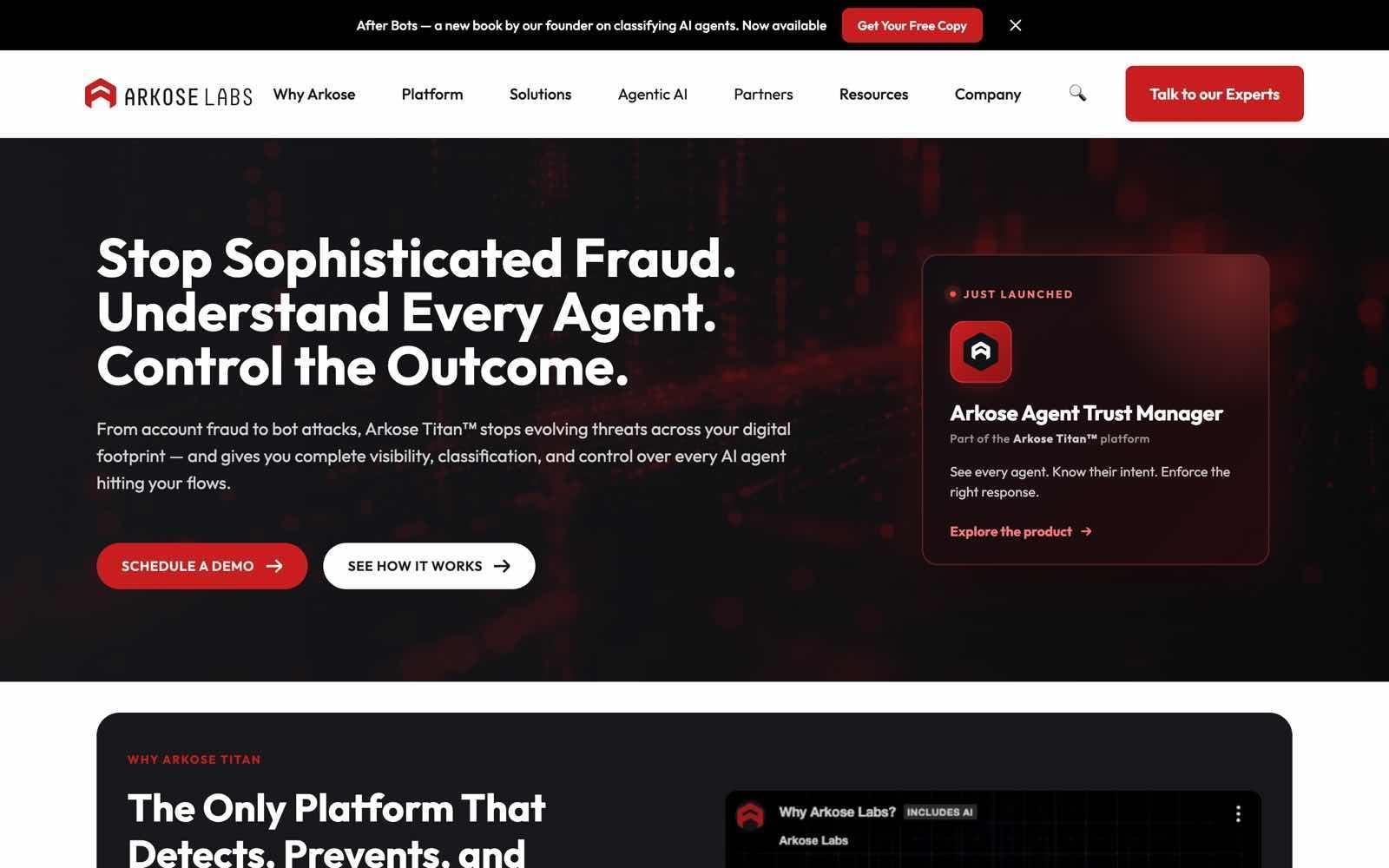
Arkose Labs attacks the economics of account takeover rather than only the traffic. Its bot management product combines risk assessment with adaptive challenges that get harder as an attacker persists, making a campaign expensive enough to abandon. Large consumer platforms, gaming companies, social networks, and financial services firms make up its customer base.
The company reports over 175 risk signals in its intelligence network and publishes throughput figures showing most genuine users pass without seeing a challenge. Its distinctive claim is deterrence, driving attackers to easier targets.
Arkose is one of the few vendors whose model targets attacker economics directly, which is useful against crews that retool the moment they are blocked. Challenges adapt to the attacker instead of repeating as static puzzles, so they hold up better than traditional CAPTCHA against automated solving services. For platforms where compromised accounts have resale value, that deterrence effect compounds.
Arkose Labs prices custom, based on traffic, attack volume, and the risk profile of the site. There's no published rate card, and pricing can move with the intensity of the attacks you face.
Arkose Labs suits large consumer platforms under sustained attack from organized crews, where making the campaign uneconomic is worth more than blocking one more request.
The adaptive challenge model holds up better than static defenses against solvers. Businesses with modest attack volumes, or those whose real losses happen after a successful login, will get little from it.
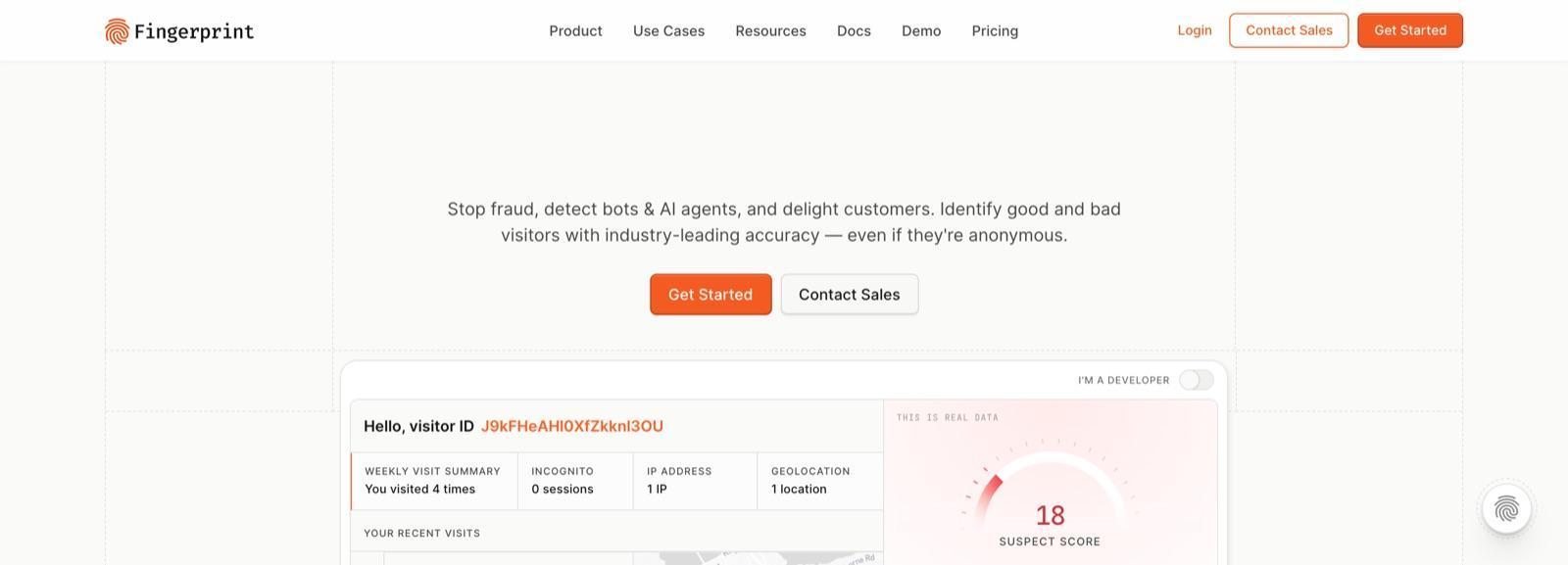
Fingerprint is a device identification company that assigns a persistent identifier to a browser or device and keeps recognizing it across sessions, even when cookies are cleared or a VPN is used.
Teams use it to spot a familiar account being accessed from an unfamiliar device, which is one of the earliest reliable takeover signals. It sells to developers and product teams as much as to fraud teams.
Alongside device ID it offers Smart Signals covering VPN and proxy use, bot activity, browser tampering, and emulators. It's one of the few options here with public, self-serve pricing.
Fingerprint is one of the clearest options for teams that want a strong signal rather than a full decisioning product, and it prices accordingly. A free tier covers 1,000 API calls a month, Pro Plus starts at $99 per month with 20,000 web and iOS calls, and additional calls run $4 per 1,000. That transparency is rare in this market and makes budgeting straightforward.
Fingerprint publishes a free plan with up to 1,000 API calls per month and a 14-day Pro Plus trial. Pro Plus starts at $99 per month covering 20,000 web and iOS API calls, with extra calls at $4 per 1,000, and Enterprise plans are custom with a 99.9% SLA.
Fingerprint is a good fit for product and engineering teams that want reliable device recognition to feed their own risk rules, with pricing they can see before a sales call. It's the most accessible entry point on this list for a smaller team.
Because it hands you signals rather than decisions, fraud teams without engineering support will need something more complete on top.

LexisNexis ThreatMetrix is a digital identity risk product that assesses logins, account changes, and payments using its Digital Identity Network. It combines device, location, behavior, and transaction context to judge whether a returning user is genuinely the same person. Banks, insurers, crypto exchanges, and gaming operators are its main markets.
The network spans more than 200 countries and territories, which makes it useful for businesses whose customers cross borders. It sits inside a wider LexisNexis risk data portfolio that many financial institutions already buy.
ThreatMetrix is one of the more established choices for regulated institutions, with global reach and a long deployment record. Its shared network catches devices and identities already associated with fraud elsewhere, which is difficult for a single institution to replicate alone. Buying it alongside other LexisNexis data can also simplify procurement.
LexisNexis quotes ThreatMetrix by transaction volume and the data elements you consume, with no published pricing. Costs typically climb as you add screening or risk data from the wider portfolio.
ThreatMetrix works well for regulated institutions with cross-border customers that value network intelligence and an established vendor relationship. The global reach is genuine, and the passive model keeps friction off genuine customers.
Teams that want fast deployment, transparent pricing, or coverage of the cash-out stage will find it slow, opaque, and incomplete on that last point.
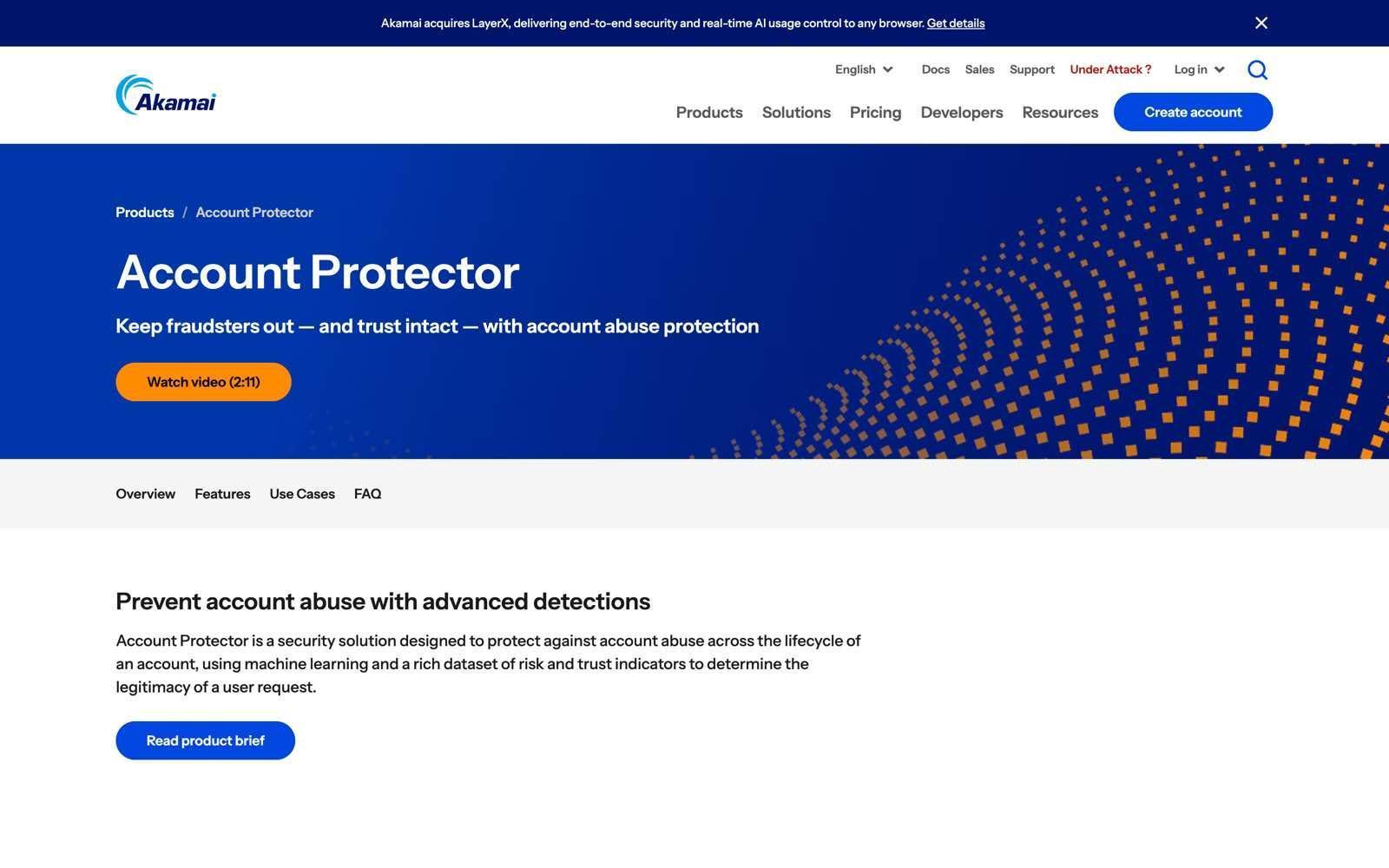
Akamai Account Protector defends account abuse across the full account lifecycle, from creation through login and post-login activity, using Akamai's edge network. It scores each request against user, device, IP, network, bot, and reputation indicators, then blocks, alerts, or allows based on your policy. It's aimed at enterprises already running Akamai for delivery or security.
Because it works at the edge, decisions happen before traffic reaches your origin. That makes it strong on volume and latency, and it earned Gartner Peer Insights Customers' Choice recognition in 2025.
Akamai's advantage is the visibility that comes with carrying a large share of global web traffic, which gives its models unusual breadth on reputation and bot signals. Running enforcement at the edge keeps latency low and attack traffic off your origin. For organizations already on Akamai, it's an incremental deployment rather than a new vendor program.
Akamai prices Account Protector as part of its enterprise security portfolio, quoted by traffic and deployment scope. There's no public rate card, and it's usually bought alongside other Akamai products.
Akamai Account Protector makes sense for enterprises already on Akamai that want account abuse handled at the edge with minimal added latency. Lifecycle coverage from account creation onward is broader than pure bot tools.
For anyone not already an Akamai customer, or whose losses happen after a valid login, the commercial case and the coverage both weaken.
Choosing well starts with knowing which stage of the attack chain is costing you money, because the tools in this category are not substitutes for each other. A shortlist built only around login signals will look complete in a demo and still leave the payout stage open. These six factors separate the right fit from the impressive one.
Map your own losses to the five stages first, then ask each vendor which ones it covers and which it expects another tool to handle. Most account takeover detection software covers stages one through three; far fewer cover four and five, where the money actually leaves. If a vendor cannot describe how it scores the payment or payout a takeover produces, plan for a second tool.
Detection quality depends on data, not on the word AI. Static rules decay as attackers test around them, models trained only on your own history need months to become useful and stay blind to patterns they've never seen, and models trained across many institutions recognize an attack the first time it reaches you. Ask each vendor exactly what its models train on, because that answer sets the ceiling on what they can catch.
Two clocks matter here. Scoring has to finish inside the authorization or payment window, usually tens of milliseconds, or it cannot be used to block anything in real time. Integration time is the second clock, and the gap between a tool that connects in days and one that takes 5 to 14 months is a year of losses you either avoid or absorb.
Every control you add to stop takeover can also stop a real customer, and blocking good payments is a loss that never shows up in a fraud report. Ask for false positive rates alongside detection rates, and check whether the tool can step up authentication instead of only blocking outright. The right target is precision on the risky minority, not friction for everyone.
Your team needs to change a rule the day an attack appears, not raise a ticket and wait for a release. Check whether fraud analysts can deploy rules themselves, how quickly they can find a transaction or a device, and whether every decision comes with an explanation an auditor will accept. For regulated businesses, confirm the tool produces audit trails and suspicious activity reporting in the format your regulator expects.
Compare the model, not just the headline number. Per-user, per-request, per-transaction, and traffic-based pricing behave very differently as you grow, and setup fees, professional services, and add-on modules often outweigh the licence. Usage-based pricing with no setup fee is the easiest to forecast, so ask what the bill looks like at three times your current volume before you sign.
Your obligations decide part of the shortlist for you. Card issuers in Europe need scoring that supports strong customer authentication decisions and exemption thresholds, and any regulated business needs data residency where it operates. Confirm hosting regions, certifications such as ISO27001, and reporting formats early, because these constraints eliminate vendors faster than features do.
This table condenses the review into the factors buyers actually compare. Pros and cons list the top three points for each tool, while the remaining columns rate ease of use, integrations, support, and affordability from one to five stars, with the last column naming the stage of the attack chain each one covers.
| Company | Pros | Cons | Ease of Use | Integrations | Support | Affordability | Attack Stage Covered |
|---|---|---|---|---|---|---|---|
| Fraudio | Catches takeover at payment and payout; network AI with no cold start; days to deploy | Not a login or bot tool; built for payment companies; monitoring-focused | Payment and cash-out | ||||
| Sift | Broad fraud coverage; large signal network; cuts manual review | Consumer-centric; no public pricing; light on AML | Login, session, and checkout | ||||
| BioCatch | Hard-to-spoof behavior signals; zero friction; strong bank results | SDK integration needed; profile ramp-up; enterprise pricing | Session behavior | ||||
| Feedzai | Enterprise scale; fraud plus AML; deep customization | Long implementation; enterprise-only cost; needs internal expertise | Login through transaction | ||||
| SpyCloud | Acts before the attack; session cookie data; automated remediation | Blocks nothing live; no transaction cover; value varies by exposure | Credential exposure | ||||
| DataDome | Stops credential stuffing; fast deployment; clear attack analytics | Misses human attackers; no money-layer cover; tuning risk | Automated access attempts | ||||
| Arkose Labs | Deters organized crews; low friction for good users; API-driven | Some checkout friction; access-only cover; volume-linked pricing | Access attempts | ||||
| Fingerprint | Public pricing and free tier; accurate device ID; quick to integrate | Signals not decisions; no case management; costs scale with calls | Device recognition at access | ||||
| LexisNexis ThreatMetrix | Global network; institutional trust; passive detection | Opaque pricing; slower rollout; dated workflows | Login and account changes | ||||
| Akamai Account Protector | Huge traffic visibility; edge enforcement; lifecycle coverage | Best only for Akamai customers; specialist tuning; no money-layer cover | Account creation and login |
Account takeover keeps costing money because the loss lands after the part most tools watch. An attacker arrives with working credentials, clears authentication, changes a beneficiary, and wires the balance to a mule account before anyone opens an alert. Harden the login all you like; the payment still settles.
Fraudio was built for the businesses that carry that loss, including card issuers, digital banks, wallet and remittance providers, acquirers, and payment facilitators.
It scores every payment and transfer in real time and reads them in one dataset, so a cash-out pattern surfaces at the first transfer rather than after the account is drained.
It's the same layer Viva Wallet used to reach 8x ROI on merchant fraud and money laundering. Test it on your own historical data first through a Proof of Results run, with no commitment and no setup fee. Book a consultation with our team.
The best account takeover fraud prevention software in 2026 depends on which stage of the attack costs you money, with Fraudio leading at the payment and cash-out stage, BioCatch and Sift strong on session behavior, and DataDome and Arkose Labs built for automated login attacks. Most mature programs run two tools, one covering access and one covering money movement. Fraudio scores every payment and transfer in real time and profiles the receiving accounts, which is how it catches mule cash-out patterns early. Match the tool to where your losses land, not to the loudest feature list.
In account takeover protection software, look for coverage across the five-stage attack chain, what the detection models train on, decision and deployment speed, false decline rates, control and reporting, and total cost. Coverage matters most, because most tools stop at login while the loss happens at the payment. Ask each vendor what its models learn from, since models trained on one company's history need months to become useful. Confirm scoring completes inside your authorization window, usually tens of milliseconds, or it cannot block anything live.
Compared with other account takeover detection software, Fraudio scores the payments, transfers, and payouts that follow a hijacked login rather than judging the login itself. Its centralized AI reads card payments, transfers, and remittances in one dataset, and its rules library covers known attack patterns from your first transaction. It also traces the receiving side, detecting the mule accounts that collect stolen funds, and runs AML case management on the same data. You pair it with a device or bot tool for login defense, and Fraudio covers everything after.
You get started with Fraudio by running a Proof of Results test on your historical data, which compares its output against your current setup with no commitment and minimal work from your team. Integration then takes days to weeks through API, webhook, or batch, depending on how you want to connect. Pay-per-use pricing means no setup, implementation, or maintenance fees. Booking a consultation is the fastest way to scope it against your volume and risk profile.
Switching to Fraudio is straightforward because it runs alongside your existing authentication and security tools instead of replacing your whole stack. Integration takes days to weeks rather than the 5 to 14 months older enterprise systems need, and a Proof of Results test validates performance in parallel first. There's no setup fee or upfront licence cost, so the commercial risk of switching is low. Its centralized AI scores accurately from the first transaction, so you avoid the ramp-up period a self-trained model requires.
Account takeover prevention software does not replace multi-factor authentication; it covers what MFA misses. Attackers routinely bypass MFA with phishing proxies, SIM swaps, infostealer logs, and stolen session cookies, and SpyCloud recaptured 8.6 billion stolen session cookies from criminal markets in 2025. A stolen session cookie skips authentication entirely, so the account looks fully verified. MFA raises the cost of access, while detection tools judge whether the verified session is actually behaving like the real customer.
You detect account takeover after login by scoring behavior and money movement instead of credentials, since the credentials already passed. Useful signals include behavioral drift within the session, remote access or emulator markers, contact detail and beneficiary changes shortly before a payment, and abnormal inflow-to-outflow ratios on the account. The clearest evidence usually appears at the transaction, where an unfamiliar counterparty or a structured payout pattern gives the attack away. Real-time transaction scoring is what turns those signals into a block before funds settle.
Account takeover protection software costs range from a free tier and $99 per month for self-serve device intelligence to six-figure annual enterprise contracts quoted by traffic or transaction volume. Fingerprint publishes its rates, with Pro Plus at $99 per month for 20,000 API calls and $4 per 1,000 calls after that, while BioCatch, Feedzai, LexisNexis, and Akamai all quote custom enterprise pricing. Usage-based models such as Fraudio's pay-per-use charge per transaction with no setup or implementation fees, so cost tracks volume. Budget for integration time and professional services too, since those often exceed the licence on enterprise deployments.

How about trying our solution and experiencing the next generation for yourself?


