
September 24, 2026
The Best Overall AML Screening Software: Fraudio ranks first because it pairs sanctions, PEP, and adverse media screening with real-time behavioral monitoring on one shared, centralized dataset. That combination catches the laundering risk that name-matching alone misses, and it cuts the false alerts that drain compliance teams.
Why Do You Need It: Regulators fined financial firms billions in 2024 for weak controls, and static list-checking misses money mules and layering that use clean identities. AML screening software flags high-risk parties and suspicious flows before they turn into penalties or license loss.
Who It's For: AML screening software fits card issuers, merchant acquirers, payment facilitators, neobanks, wallet providers, and remittance firms that move regulated money at volume. It suits any payments business under central bank, FATF, or EU AML oversight.
How to Choose the Right One: Weigh three things first. Start with whether screening and transaction monitoring run in one system, then how well the tool controls false positives, and finally how fast it integrates against its total cost. Data quality and audit-ready reporting decide the rest.
Expected Price: Fraudio uses pay-per-use pricing with no setup, implementation, or maintenance fees, so cost tracks your transaction volume. Across the market, modern screening tools like Sanction Scanner and Sumsub bill per check or per verification, while enterprise suites from NICE Actimize, SAS, and Oracle run on custom annual contracts that often reach six or seven figures.
AML screening software checks customers, merchants, and transactions against sanctions lists, politically exposed person (PEP) records, and adverse media, then flags matches that need review.
It sits at the center of an anti-money laundering program, telling compliance teams which parties carry regulatory risk before money moves. If you want a deeper primer on the monitoring side, our guide to AML transaction monitoring walks through the full workflow.
The category grew out of a simple regulatory demand. Banks and payment firms must know who they do business with, screen them against watchlists at onboarding, and keep watching as relationships and rules change.
Sanctions regimes shift weekly, so screening cannot be a one-time check at signup.
Modern tools have moved well past static list matching. The strongest ones now blend screening with real-time transaction monitoring, behavioral analytics, and AI that scores risk in context. That shift matters because laundering rarely announces itself through a name on a list; it shows up in how money behaves.
An AML screening solution typically covers four jobs. It screens parties against lists, monitors transactions for suspicious patterns, manages alerts through investigation, and produces audit-ready reports for regulators. Some vendors specialize in one job, such as watchlist data, while others cover the full chain.
Fraudio and the tools reviewed below sit at different points on that spectrum, which is why fit depends on what you actually process. For payment companies specifically, screening tied to live transaction flows tends to matter more than onboarding checks alone, and our roundup of the best AI Transaction Monitoring Software covers that adjacent category in depth.
The cost of getting AML wrong keeps climbing. In 2024, global regulatory fines hit a record $19.3 billion, with a large share tied to weak anti-money laundering programs, and TD Bank alone agreed to $3 billion in penalties for Bank Secrecy Act failures. For a payments business, a single enforcement action can mean frozen growth, lost partnerships, or a revoked license.
Manual review cannot keep pace with modern transaction volumes. As you scale into new markets, merchant categories, and payment types, the number of parties and flows you must screen grows faster than any team you can hire. Static rule engines respond by flagging everything that looks slightly off, which buries analysts.
That is the second problem, and it is expensive. Industry analysis shows that up to 95% of alerts from traditional AML systems turn out to be false positives, so most of your compliance budget goes to chasing noise. Every hour spent clearing a false match is an hour not spent on the real risk hiding underneath.
The risk that hides underneath is the third problem. Sanctions and PEP lists catch known bad actors by name, but they cannot see a money mule using a clean, verified identity to move stolen funds. Layering, structuring, and mule networks pass list checks and only reveal themselves through behavior, which is why screening on its own leaves a gap.
Good AML screening software closes that gap. It confirms who your customers are against the lists, watches what they do afterward, and uses AI to separate genuine risk from noise. The outcome you want is fewer penalties, lower investigation costs, and the confidence to grow without adding compliance headcount at the same rate.
AML screening software matters most for regulated businesses that move other people's money at scale. The five audiences below feel the pressure earliest, and each has a distinct reason to care.
Issuers must screen cardholders and monitor spending for signs of laundering, sanctions evasion, and account takeover. When a processor supplies the technology but has limited visibility, issuers lose the control they need to set their own risk thresholds. They need screening tied to real-time transaction data so they can act on their own portfolio, not wait for a monthly report.
Acquirers and payment facilitators hold liability when a merchant launders money or busts out. Roughly 3% of newly onboarded small businesses turn out to be fraudulent, and many pass identity checks cleanly before misusing their accounts. These firms need screening that extends past onboarding into continuous merchant monitoring, so risk that appears weeks later still gets caught.
Neobanks and wallet providers onboard customers fast and at volume, which is exactly what launderers exploit. Their core exposure is mule accounts that receive and disperse stolen funds within minutes. They need screening paired with behavioral monitoring that spots abnormal inflow-to-outflow patterns, because a mule's name seldom appears on a list.
Remittance firms move money across borders and corridors that carry heavy sanctions and structuring risk. They must screen both senders and receivers, then watch for patterns that suggest funds are being broken up to dodge reporting thresholds. Data residency rules in many corridors add another requirement, since screening must run where the data legally lives.
Fintechs pursuing an Electronic Money Institution license need transaction monitoring and screening in place to satisfy regulators and card schemes. Many start with a basic rule engine that no longer passes muster as they grow. They need an AML screening solution that deploys quickly, produces clean audit trails, and scales without a year-long integration project.
The ten tools below cover the range of the market, from data providers to full financial crime suites. We reviewed each on screening depth, monitoring, false-positive control, integration effort, and cost, with a focus on what payment companies actually need.
Fraudio leads because it treats screening and monitoring as one job rather than two products.

Fraudio is a fraud and anti-money laundering software built for companies that process payments, including issuers, acquirers, payment facilitators, fintechs, and processors. Its anti-money laundering platform combines rule-based controls with AI modeling and link analysis, and it connects to PEP lists, sanctions databases, and adverse media feeds for a full view of party risk.
The core problem it addresses is that legacy AML tools are slow, siloed, and expensive, which leaves emerging and mid-market payment firms exposed. Fraudio positions itself as the challenger that makes screening and monitoring accessible without a year of integration.
Fraudio's advantage is its patent-pending network-effect AI, which centralizes data from issuing, acquiring, transfers, and remittances into one dataset. Competitors run siloed models that see only each customer's slice of activity, so they need months to ramp and still miss cross-portfolio patterns.
Because screening and monitoring share that dataset, you catch a sanctioned party and the suspicious flow around it in the same system. Fraudio integrates in days to weeks rather than the 5 to 14 months typical of legacy tools, and its pay-per-use pricing removes the enterprise cost barrier.
Its money mule detection solution shows the behavioral edge that list-only screening cannot match.
Fraudio uses usage-based pricing with no setup, implementation, or maintenance fees. Cost per transaction falls as volume grows, and every plan covers infrastructure costs, which keeps total cost of ownership below enterprise incumbents. Exact tiers come through direct contact with the team.
Fraudio is the best AML screening software for payment companies because it closes the gap between list screening and behavioral monitoring on one shared dataset.
You get faster integration, lower cost, and detection that improves as the network grows, which is why it earns the top spot for issuers, acquirers, and fintechs that need results without a year-long build.
ComplyAdvantage is an AI-led anti-money laundering software known for its proprietary, frequently updated risk database. It offers sanctions, PEP, and adverse media screening alongside transaction monitoring and dynamic risk scoring.
The company serves fintechs, banks, and payment firms that want screening depth without a legacy integration. Its positioning centers on real-time data and configurable matching logic.
ComplyAdvantage is one of the strongest choices for teams that value screening data freshness and AI-driven risk scoring in a single workflow. Its combination of proprietary data and configurable rules helps fintechs launch screening quickly and adapt it as they grow.
ComplyAdvantage uses custom, usage-based annual contracts priced on screening volume and data modules. Pricing is not public and comes through a sales quote.
ComplyAdvantage suits fintechs and mid-market firms that want fresh screening data and adaptable risk scoring in one workflow.
It is less ideal for companies that need deep, payments-native transaction monitoring, and its annual contracts may not fit the smallest or early-stage teams.
NICE Actimize is an enterprise financial crime software used by many tier-one banks. It covers watchlist screening, transaction monitoring, and case management across a broad suite.
The company targets large, complex institutions with strict regulatory demands. Its strength is breadth and analyst tooling built for big compliance operations.
NICE Actimize is one of the smartest choices for large institutions that need one vendor to cover the full financial crime program. Its analyst tooling and coverage depth are built for the scale and audit demands of tier-one banks.
NICE Actimize uses custom enterprise licensing based on modules and scale. Deployments typically involve significant setup and services costs.
NICE Actimize is recommended for large banks that need enterprise-wide financial crime coverage and have the budget and staff to run it.
For smaller payment firms and fintechs, the cost, complexity, and long implementation make it hard to justify.
LexisNexis Risk Solutions provides AML screening through products such as Bridger Insight XG and Firco, backed by extensive entity and watchlist data. Its strength is data depth and entity resolution against sanctions, PEPs, and watchlists.
The company serves banks, insurers, and regulated firms that need reliable screening data. Positioning centers on data quality and matching accuracy.
LexisNexis is one of the strongest choices for institutions that treat data quality as the deciding factor in screening. Its entity resolution and data breadth help large, regulated firms reduce match noise.
LexisNexis uses custom pricing based on data tiers and volume. Quotes come through direct sales.
LexisNexis Risk Solutions is recommended for larger regulated institutions that prioritize screening data depth and entity resolution.
It is a weaker fit for smaller payment firms wanting a fast, monitoring-led setup at a predictable cost.
LSEG World-Check, formerly Refinitiv World-Check, is a risk intelligence data provider rather than a full screening engine. It supplies structured sanctions, PEP, and adverse media data that firms feed into their own screening systems.
Many vendors and banks rely on World-Check as the underlying data behind their checks. Its positioning is data quality and global coverage.
World-Check is one of the strongest choices for data quality, often treated as a reference standard for screening records. It gives teams reliable, structured data to power whatever screening engine they run.
LSEG World-Check is sold as a data subscription with custom pricing based on coverage and usage.
LSEG World-Check is recommended for firms that need top-tier screening data to feed an existing system.
It is not a fit for teams wanting an end-to-end AML screening solution, since it supplies data rather than monitoring, scoring, or case management.
Napier AI is a financial crime compliance software offering configurable screening and AI-driven transaction monitoring through its Continuum engine. It targets banks, payment firms, and PSPs modernizing legacy systems.
The core problem it addresses is rigid, rules-heavy tooling that generates too many alerts. Positioning centers on configurability and AI-assisted detection.
Napier AI is one of the smartest choices for firms that want a modern, configurable approach to screening and monitoring in one toolset. Its AI scoring helps teams cut false positives against a legacy baseline.
Napier AI uses custom, module-based pricing tied to deployment scope. Quotes come through sales.
Napier AI is recommended for banks and PSPs modernizing legacy compliance systems that have the resources to configure it well.
Smaller teams wanting fast, low-effort setup may find it heavier than needed.
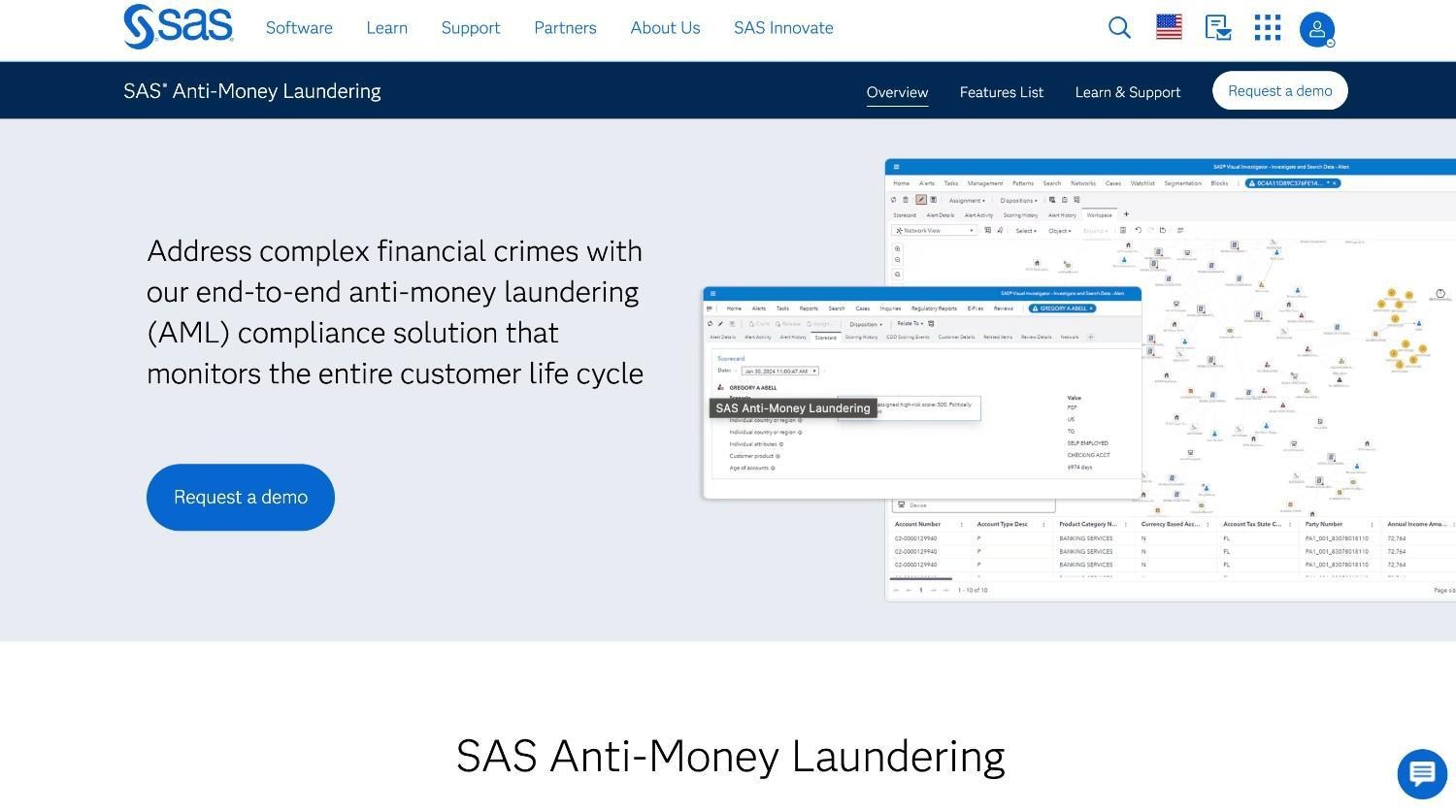
SAS Anti-Money Laundering is an enterprise analytics software for large institutions with in-house data science capacity. It covers watchlist screening, transaction monitoring, and network detection with advanced analytics.
The company serves large banks that treat analytics as a core capability. Positioning centers on analytical depth and scenario control.
SAS is one of the strongest choices for institutions that want maximum analytical control over detection logic. Its modeling depth suits teams that build and tune their own scenarios.
SAS uses custom enterprise licensing based on modules, scale, and deployment. Costs are significant and quoted directly.
SAS Anti-Money Laundering is recommended for large institutions with the data science staff to exploit its analytics.
It is a poor fit for lean payment firms that need fast deployment and low operational overhead.
Oracle Financial Services Analytical Applications (FCCM) is an enterprise financial crime and compliance software for global banks, especially those standardized on Oracle infrastructure.
It covers watchlist screening, customer risk scoring, case management, and regulatory reporting. The company targets large institutions with complex, multi-jurisdiction needs. Positioning centers on enterprise integration and coverage.
Oracle is one of the smartest choices for global banks already invested in Oracle systems that want financial crime coverage in the same stack. Its breadth and reporting suit complex, regulated institutions.
Oracle uses custom enterprise licensing tied to modules and scale, typically with significant implementation costs.
Oracle Financial Services is recommended for large global banks standardized on Oracle that need broad coverage in one stack.
Its cost and complexity make it unsuitable for most fintechs and mid-market payment firms.
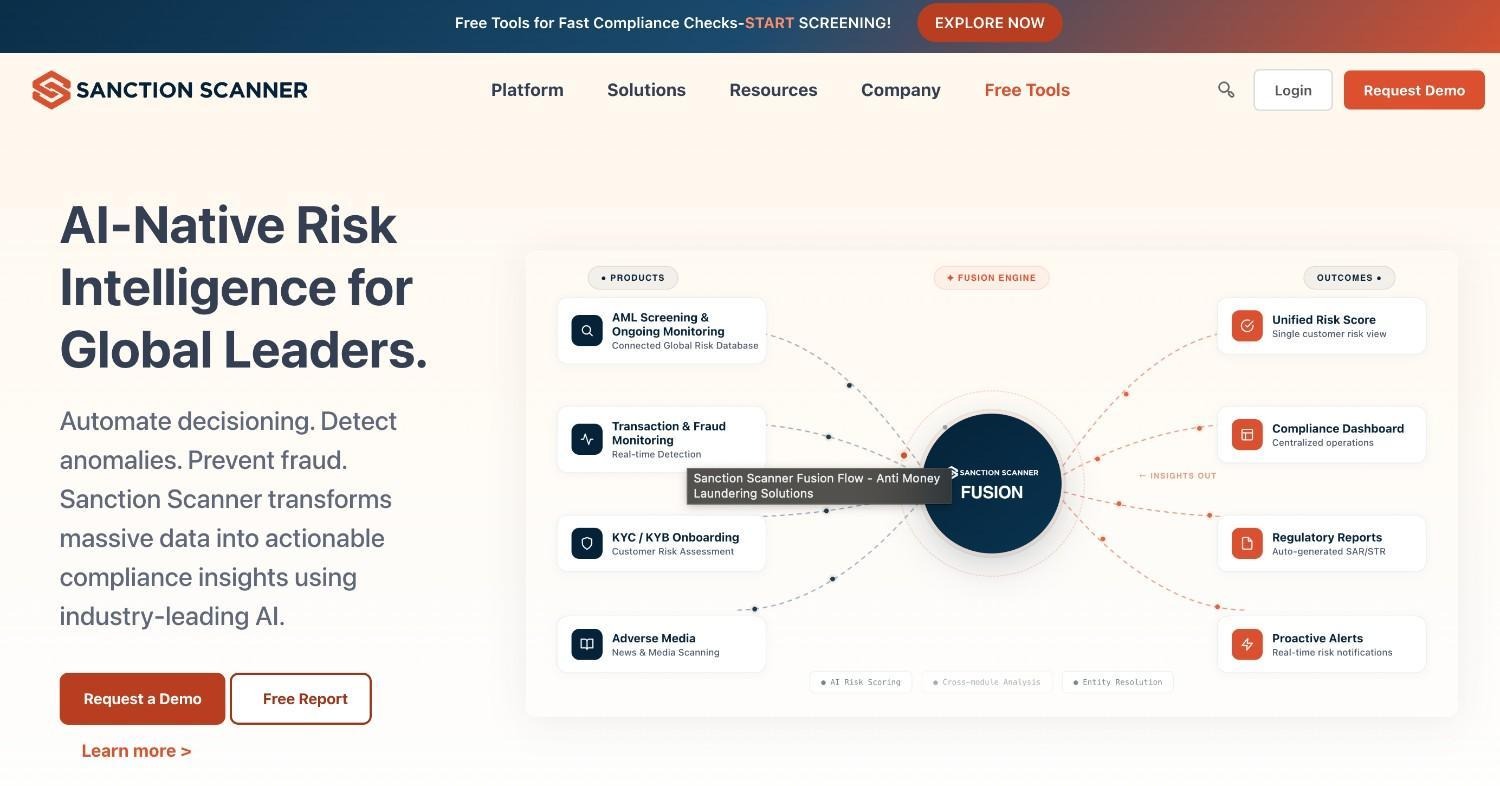
Sanction Scanner is an AML screening software focused on affordable sanctions, PEP, and adverse media screening with transaction monitoring. It serves smaller banks, fintechs, and regulated firms that need core compliance without enterprise cost.
The core problem it addresses is access, since many small firms cannot afford incumbent suites. Positioning centers on affordability and quick setup.
Sanction Scanner is one of the smartest choices for smaller firms that need credible screening at an accessible price. Its transparent pricing and quick setup lower the barrier for early-stage compliance.
Sanction Scanner uses usage-based, transparent pricing, often per check or by volume tier, which suits smaller budgets.
Sanction Scanner is recommended for smaller institutions and fintechs that need affordable, credible screening without enterprise overhead.
Firms needing advanced AI monitoring or tier-one data depth will likely outgrow it.
Sumsub is a verification-first compliance software that pairs KYC and KYB identity checks with AML screening and ongoing monitoring. It serves fintechs, crypto firms, and marketplaces that want onboarding and screening in one flow.
The core problem it addresses is fragmented onboarding and compliance tooling. Positioning centers on identity verification with screening attached.
Sumsub is one of the strongest choices for teams that want identity verification and AML screening in a single onboarding flow. Its combined coverage reduces vendor sprawl for onboarding-heavy businesses.
Sumsub uses per-verification, credit-based pricing that scales with checks performed. Custom plans are available for higher volumes.
Sumsub is recommended for onboarding-heavy fintechs, crypto firms, and marketplaces that want identity checks and screening together.
It is a weaker fit for issuers and acquirers that need deep, payments-native transaction monitoring beyond onboarding.
Knowing the tools is only half the decision; the other half is matching one to how your business actually moves money.
The factors below turn the review above into a short checklist you can score vendors against. Weight them by your own regulatory exposure and volume.
Screening tells you who is risky; monitoring tells you what they do next. Tools that split these into separate products leave a gap where mules and layering hide. Favor an AML screening solution that runs list checks and behavioral monitoring on the same data, so a flagged party and its suspicious flow surface together.
Screening is only as good as the data behind it, and detection is only as good as the transactions a model has seen. Ask whether the tool uses current, well-structured sanctions and adverse media data, and whether its AI learns from a wide transaction network or only your own history. Broader data means earlier detection and fewer blind spots.
With up to 95% of alerts proving false in traditional systems, false-positive control is a budget decision, not a technical footnote. Look for AI scoring and link analysis that rank alerts by real risk, plus explainable reasoning your analysts and auditors can follow. Lower noise means faster investigations and lower cost per alert.
Every month spent integrating is a month of regulatory exposure and delayed value. Compare deployment timelines honestly, since enterprise suites can take 5 to 14 months while modern tools go live in weeks. Then weigh pricing model against total cost, because setup fees, per-rule charges, and services can dwarf the license.
Detection is worthless if you cannot investigate and report cleanly. Check for case management with team queues, SLA tracking, and a complete audit trail, plus SAR-format outputs ready for your regulator. Strong reporting cuts the manual work between an alert and a filing, which is where compliance teams lose the most time.
If you operate in regions with data residency rules, screening must run where the data legally lives. Confirm the vendor can deploy in your markets, whether that is Europe, the Middle East, Asia-Pacific, or Latin America. Coverage gaps here can block expansion or force a second vendor.
This table summarizes the review above, with the top three pros and cons for each tool and star ratings for the factors that decide most purchases.
Weak AML controls now carry real cost, from record fines to lost licenses, and list-only screening keeps missing the mules and layering that move through clean identities.
If you run payments, you feel this as rising false positives, slow investigations, and a compliance bill that grows faster than your revenue.
Fraudio closes the gap by combining sanctions, PEP, and adverse media screening with real-time behavioral monitoring on one centralized dataset. Its network-effect AI spots emerging patterns weeks earlier than siloed tools, cuts the noise that buries analysts, and produces SAR-ready reports.
You integrate in days to weeks, pay only for what you process, and see results from the first transaction, the way Viva Wallet reached 8x ROI and caught fraud three weeks earlier.
Ready to screen and monitor in one system without a year-long build? Book a consultation with our team to see how Fraudio fits your payment flows.
The best AML screening software in 2026 is Fraudio for payment companies, because it combines sanctions, PEP, and adverse media screening with real-time behavioral monitoring on one shared dataset. ComplyAdvantage and Napier AI are strong for fintechs modernizing screening, while NICE Actimize, SAS, and Oracle suit large banks that need enterprise breadth. Data providers like LSEG World-Check and LexisNexis lead on screening data quality. The right pick depends on whether you need onboarding checks, transaction monitoring, or both. Fraudio wins for firms that need both without a long, costly build.
When choosing AML screening software, start with whether screening and transaction monitoring run in one system, since splitting them leaves gaps where mules and layering hide. Next, weigh data quality, false-positive control, integration speed, and total cost, because up to 95% of alerts in traditional systems are false positives that drain budgets. Check for SAR-ready case management and a full audit trail for clean regulatory reporting. Confirm the vendor can deploy in your data-residency regions. Match these factors to your own volume and regulatory exposure before you shortlist.
Fraudio differs from similar alternatives through its patent-pending network-effect AI, which learns from billions of transactions across all connected customers rather than each firm's isolated history. That shared, centralized dataset detects emerging patterns weeks earlier and removes the months-long cold-start ramp that siloed tools require. Fraudio also runs screening and monitoring together, so a flagged party and its suspicious flow surface in the same system. Its fraud detection and AML products share that data, unlike vendors that treat them separately. Integration takes days to weeks with pay-per-use pricing and no setup fees.
Getting started with Fraudio begins with a consultation, where the team reviews your payment flows, regulatory needs, and current tooling. You connect through an API in real time, post-event, or by batch, and you can supply historical data to sharpen models from day one. Fraudio also offers a Proof of Results test that runs on your historical data with no commitment, so you see accuracy before you switch. Most integrations take days to weeks, not months. From there, screening and monitoring go live together.
Switching to Fraudio is designed to be low-effort, with integration measured in days to weeks rather than the 5 to 14 months typical of legacy tools. You can run Fraudio in parallel with your current system through a Proof of Results test, comparing detection on your own historical data before committing. Its flexible connection methods adapt to your existing systems rather than forcing a rebuild. Pay-per-use pricing means no large upfront setup fee to justify the move. The result is a switch you can validate before you fully commit.
Fraudio is not a standalone sanctions screening data provider; it integrates PEP, sanctions, and adverse media feeds and adds the AI monitoring and case management around them. This matters because screening data alone catches only known parties by name, while money mules and layering use clean identities that no list flags. Data providers like LSEG World-Check and Dow Jones supply the underlying records, but they do not monitor transactions or manage cases. Fraudio combines third-party screening data with behavioral detection on its centralized dataset. That pairing is what catches risk that list-checking alone misses.
AML screening and transaction monitoring solve different halves of the same problem, and strong programs use both. Screening checks customers, merchants, and counterparties against sanctions, PEP, and adverse media lists to flag known-risky parties, usually at onboarding and on an ongoing basis. Transaction monitoring watches how money actually moves, scoring patterns like rapid inflows and outflows that signal mules or layering. Screening catches who is risky by identity; monitoring catches suspicious behavior that lists cannot see. Running both on one dataset, as Fraudio does, closes the gap between them.

How about trying our solution and experiencing the next generation for yourself?


