
November 9, 2026
The best fraud prevention platforms for acquirers solve a problem no merchant-side tool was built for. An acquirer doesn't lose money on one bad checkout. It loses money when a merchant it underwrote disappears with the settlement already paid.
Acquirers, payment facilitators, and independent sales organizations carry liability for thousands of merchants at once, so portfolio-level merchant monitoring matters as much as transaction scoring.
This guide reviews the top 10 tools on merchant risk coverage, detection timing, card scheme compliance, integration effort, and cost, and shows where each one falls short.
| Company | Best For | Key Features | Pricing |
|---|---|---|---|
| Fraudio | Acquirers and payment facilitators needing merchant risk and transaction fraud in one layer | Merchant-initiated fraud detection, real-time authorization scoring, AML case management, centralized AI | Pay-per-use, no setup fees |
| Featurespace | Large acquirers and processors wanting a dedicated merchant acquiring product | Adaptive Behavioral Analytics, merchant peer analysis, multi-tenancy, on-premise option | Custom quote |
| Feedzai | Tier 1 banks and global processors running one financial crime program | Omnichannel risk engine, AI-native detection, case management, AML convergence | Custom quote |
| ACI Worldwide | Acquiring banks needing on-premise or hybrid deployment | Real-time authorization scoring, network intelligence sharing, AML and SAR reporting | Custom quote |
| Fraud.net | Mid-sized acquirers wanting merchant KYB and portfolio monitoring together | Merchant KYB risk scoring, policy monitoring, no-code rules, unified merchant dashboard | Custom quote |
| Sardine | Acquirers and fintechs where device and behavior signals drive the decision | Device intelligence, behavior biometrics, merchant oversight, agentic investigation | Custom quote |
| SEON | Growth-stage payment companies wanting fast deployment and published pricing | Digital footprint and email or phone enrichment, custom rules, case management | From $699 per month |
| Hawk | Payment companies converging fraud and AML under one compliance function | Transaction fraud, AML monitoring, sanctions screening, unified case manager | Custom quote |
| Ravelin | Acquirers reselling fraud tooling to enterprise merchant clients | Payment fraud scoring, 3D Secure optimization, chargeback and refund abuse control | Custom quote |
| NICE Actimize | Large institutions running enterprise financial crime programs | Configurable detection models, AML transaction monitoring, deep investigation tooling | Custom quote |
Fraud prevention platforms for acquirers are systems that monitor both the payments an acquirer processes and the merchants it processes them for. An acquirer, sometimes called a merchant acquirer or acquiring bank, is the licensed institution that signs merchants up to accept card payments, routes their authorizations to the card schemes, and settles the funds into their accounts.
That role carries a specific liability: if a merchant disappears, refuses refunds, or turns out to be laundering payments, the acquirer is the party the schemes and issuers come to.
Because of that liability, the category splits into two layers that most fraud tooling treats as separate products.
The first layer is transaction fraud. This is real-time scoring at authorization, catching card-not-present fraud, card testing, enumeration attacks, and account takeover across every merchant in the portfolio. It's the layer merchants also buy, though an acquirer runs it across thousands of merchants at once rather than one storefront.
The second layer is merchant risk, and it is the one that separates acquirer tooling from everything else. Here the system treats the merchant as the entity under observation rather than the transaction, watching processing volumes, refund rates, dispute rates, category codes, settlement behavior, and peer comparisons over weeks and months. This is how bust-out fraud and transaction laundering are caught, and it has no equivalent in merchant-side products.
Both layers sit inside the wider category of AI Transaction Monitoring Software, which serves issuers, acquirers, and wallet providers alike. What makes a system acquirer-grade is the merchant entity layer and the ability to act on settlement rather than only on the authorization.
A third layer runs underneath both. Money laundering moves through acquiring portfolios in the same flows as fraud, which is why an acquirer usually needs an anti money laundering platform reading the same data rather than a disconnected compliance system.
Fraud and laundering signals read from one dataset catch patterns that split systems miss, because a laundering merchant and a bust-out merchant look identical for the first few weeks.
You need fraud prevention software for acquirers because the losses land on your balance sheet on a delay you cannot see coming. A fraudulent merchant processes clean-looking volume for six weeks, collects settlement, and disappears.
The chargebacks arrive after the money has left. Nothing in a standard authorization stream flags this in advance, because each transaction looked fine on its own.
The scale of that exposure is documented. US merchants now pay $4.61 for every $1 of fraud once fees, labor, and chargebacks are counted, according to the LexisNexis True Cost of Fraud study, and acquirers inherit the share their merchants can't cover.
In the European Economic Area, total payment fraud rose to €4.2 billion in 2024 from €3.5 billion in 2023, per the joint EBA-ECB report.
Regulation has turned this from a loss line into a licensing risk. Under the consolidated Visa Acquirer Monitoring Program, an acquirer's portfolio is identified as Above Standard when its VAMP ratio reaches 50 basis points and Excessive at 70 basis points, measured monthly as the count of fraud reports plus disputes divided by settled card-not-present transactions, according to Visa's program fact sheet.
The merchant-level Excessive threshold tightened again to 150 basis points across the US, Canada, EU, and Asia Pacific on 1 April 2026. Our Visa VAMP breakdown covers how the ratio is calculated in practice.
Onboarding volume makes the pressure worse. Digital merchant sign-up removed the friction that used to filter out bad actors, and some newly boarded small and medium merchants are set up to defraud from day one. At a few thousand new merchants a quarter, that is a real number of accounts you have already agreed to settle.
Meanwhile the fraud your merchants face keeps hitting your ratio. 76% of organizations experienced attempted or actual payments fraud in 2025, according to the Association for Financial Professionals, and every one of those attempts that succeeds through your portfolio counts toward your monitoring numbers.
So the outcome you are buying is not a lower fraud score. It is a portfolio that stays under scheme thresholds, settlements you do not pay out to merchants who will vanish, and a risk team that can approve merchants faster because it can watch them properly afterward.
Fraud prevention platforms for acquirers serve any business that holds liability for merchants it did not underwrite as carefully as a bank would. The requirements shift with the model, so the right tool depends on which of these describes you.
Acquiring banks hold the scheme licence, which means scheme thresholds and fines land on them directly. They need portfolio-level monitoring that shows which merchants are pushing the VAMP ratio up, transaction scoring that reduces fraud without declining good volume, and audit trails that satisfy both the schemes and their regulator. Their hardest problem is acting early enough, because a merchant flagged after settlement is a merchant they are already paying for.
Payment facilitators onboard sub-merchants under their own master account, often in minutes and often without a human review. That speed is the product, and it is also the exposure, because a payment facilitator carries the full loss when a sub-merchant busts out. They need automated merchant risk scoring that runs continuously after onboarding, plus the ability to withhold settlement on a specific sub-merchant without freezing the rest of the book.
Independent sales organizations and payment service providers sit between the acquiring bank and the merchant, and their contracts usually pass some liability down to them. They need visibility into merchant behavior they do not directly process, per-merchant configurability so a high-risk category can run tighter rules than a low-risk one, and reporting they can show to the acquiring bank that sponsors them.
Processors and orchestrators serve many acquirers at once, so they need multi-tenancy: separate rules, separate dashboards, and separate data boundaries per client, with oversight across the whole estate. Their buying criteria skew toward integration flexibility and throughput, since the tool has to fit existing authorization flows rather than replace them.
Chief risk officers, fraud managers, and analysts are the people who live in the tool. They need alerts prioritized well enough to work through in a day, context attached to each case so a decision does not require a data request, and one place where fraud and money laundering investigations happen. For them the difference between a good and bad tool is how many minutes it takes to answer a question about a merchant.
We assessed each tool on five criteria weighted for an acquiring business: merchant risk coverage, real-time transaction scoring, card scheme and AML compliance support, integration effort, and total cost. The list leads with merchant risk, because that is where an acquirer's largest single losses occur and where most fraud tooling has nothing to offer.

Fraudio is a real-time fraud detection and anti-money-laundering company built specifically for the businesses that process payments rather than the merchants that accept them. Issuers, acquirers, payment facilitators, and processors are its named customers, and it doesn't sell to merchants directly.
That focus is why it sits first here: the product was designed around the liability an acquirer holds, not adapted from a merchant checkout tool.
It covers both directions of acquirer exposure in one system. Payment Fraud Detection scores every authorization in real time and returns a value between 0 and 1 with a color-coded call, so high-risk transactions are blocked, borderline ones trigger step-up authentication, and the rest pass untouched. Merchant Initiated Fraud Detection runs on a separate entity rail that profiles each merchant across time, comparing its volumes, refunds, disputes, and money flows against its own history and against peer merchants in the same category.
The practical difference shows up in timing. A bust-out merchant looks legitimate at the transaction level by design, so a transaction-only system has nothing to flag until the disputes arrive, typically several weeks after settlement has been paid. Fraudio's merchant rail raises a graded alert before that: a moderate alert to start monitoring, a higher one to open an investigation and stall settlement, and a top-priority alert to block the account.
Viva Wallet, a European payments business, used this to catch fraud attempts three weeks earlier than its previous setup and reported an 8x return on investment alongside a 600% increase in fraud team efficiency, while supporting 7x transaction growth without scaling its fraud team to match.
Fraudio's differentiator is structural rather than incremental. A processor that handles both issuing and acquiring is legally prevented from joining those datasets internally, which means most tools see one side of a payment and model it in isolation. Fraudio's centralized dataset removes that limitation, so its models read behavior across the full flow and across many customers at once, with no cold-start period while a model learns your book.
For an acquirer that translates into two things competitors rarely deliver together. Merchant risk and transaction fraud run on the same data, so a merchant flagged by unusual settlement behavior is immediately visible in its transaction detail, and its AML exposure sits in the same case file.
Integration takes days rather than months through API, webhook, or batch, and a Proof of Results test can run on historical data alongside an incumbent system before any commitment.
Alongside the fraud rails, its money mule detection solution reads inflow-to-outflow ratios and circular flows for acquirers whose portfolios include payout and transfer activity.
Fraudio charges per transaction processed with no setup, implementation, or maintenance fees, and the unit cost falls as volume rises. Buy rates are available for customers committing to higher volumes over a term. A Proof of Results test runs on your historical data in parallel with your current system at no commitment, which gives you a measured comparison before a contract exists. Exact rates are quoted directly.
Fraudio is the strongest choice for an acquiring business because it treats the merchant as a monitored entity rather than a billing record, which is the gap that produces the largest unrecoverable losses in acquiring.
The combination of network-trained detection, settlement-stage alerting, and pricing without fixed fees makes it accessible to payment facilitators and mid-market acquirers that enterprise vendors quote out of reach.

Featurespace is an enterprise fraud and financial crime company built on Adaptive Behavioral Analytics, a modeling approach developed from AI research at the University of Cambridge. It's one of the few vendors with a named merchant acquiring product rather than a generic engine pointed at acquiring, covering chargeback fraud, merchant and cardholder collusion, BIN attacks, and merchant bust-outs at the individual transaction level.
Visa completed its acquisition of Featurespace in December 2024, and the business now sits inside Visa's Risk and Identity Solutions unit. That changes the buying calculus for an acquirer in both directions. It brings scheme-adjacent data and a very deep balance sheet, and it also means an acquirer processing across multiple schemes is buying core risk infrastructure from one of them.
Its published results skew to large portfolios. A global payments processor handling over 3 billion transactions a year reported a 98% reduction in genuine card-not-present transactions declined and a 50% cut in fraud losses, while a European processor reported alert volume falling from more than 1,000 to under 200 per day.
The company states it processes more than 100 billion events per year and cites a 75% reduction in false positive rates across deployments.
Featurespace is one of the strongest options for acquirers operating at scale, largely because merchant acquiring is a named product line rather than something the engine can be pointed at. Its behavioral modeling has a long track record at tier-one institutions including NatWest, Worldpay, and Danske Bank, and its on-premise option answers a requirement most modern vendors can't meet at all.
Featurespace does not publish pricing. Contracts are quoted per deployment based on volume, modules, and whether the system runs on-premise or hosted, and they typically run multi-year.
Featurespace is recommended for large acquirers and processors that need proven behavioral modeling, multi-tenancy, and the option to run on their own infrastructure.
Growth-stage acquirers and payment facilitators will find the implementation weight and contract structure hard to justify against the volume they process.

Feedzai is an AI-native financial crime company that runs fraud detection, anti-money-laundering monitoring, and case management on one risk engine. It's built for tier-one banks, large processors, and acquirers that want a single program covering account opening, transaction fraud, and compliance rather than separate tools per risk type.
Its scale is the pitch. Feedzai states it protects trillions of dollars in transactions annually and has deep enterprise deployments across retail banking, corporate banking, and payments. For acquirers, the relevant capability is omnichannel transaction risk with configurable models that can be pointed at merchant behavior as well as cardholder behavior.
Where it is less specialized is the merchant entity itself. Feedzai's strength is a general-purpose risk engine of considerable depth, which means merchant portfolio monitoring is something you configure rather than something you switch on, and that configuration work is typically part of a lengthy implementation.
Feedzai is among the smartest choices for institutions that want one financial crime program rather than a stack of specialized tools. Its analyst recognition and tier-one deployments give it credibility in procurement processes where vendor risk is scrutinized heavily, and the breadth of its engine means fewer gaps to fill with additional vendors.
Feedzai uses custom enterprise pricing scoped to volume, modules, and deployment model. There is no public rate card and no self-serve entry point.
Feedzai is recommended for large institutions consolidating fraud and financial crime into one program, particularly where acquiring is one line of business among several. Smaller acquirers and payment facilitators will struggle with the implementation timeline and the internal expertise the engine assumes.
For a business whose main exposure is merchant bust-out specifically, its generality is a real drawback.

ACI Worldwide is a long-established payments software company whose fraud management product serves banks, acquirers, processors, and billers. It sits close to the payment rails themselves, which is its defining characteristic: many acquirers already run ACI software elsewhere in their stack, so fraud detection can be added inside an existing relationship rather than as a new integration.
The product combines self-learning models with real-time scoring during authorization, alongside AML monitoring and suspicious activity reporting. ACI also operates network intelligence that lets banks, processors, and networks share fraud signals, which is a partial answer to the isolated-data problem that limits single-institution models.
Its published performance figures are detection rates above 85% and a 3-to-1 false positive ratio, which is a reasonable enterprise baseline rather than a category-leading one. The stronger argument for ACI is deployment flexibility, since it supports on-premise, cloud, and hybrid installations in a market that has largely moved to cloud-only.
ACI is one of the strongest options for acquirers that already run its payment infrastructure or that cannot deploy to public cloud. Its breadth across acquiring, issuing, and real-time payments means one vendor can cover several rails, and its long presence in the market gives it a level of institutional familiarity that shortens procurement.
ACI quotes custom pricing based on deployment model, transaction volume, and modules licensed. On-premise installations carry infrastructure and maintenance costs on top of the licence.
ACI Worldwide is recommended for acquiring banks with existing ACI infrastructure or hard on-premise requirements, where the integration advantage is genuine and immediate. Its merchant risk layer isn't the reason to buy it, so an acquirer whose main loss driver is bust-out fraud will likely need a second system.
The enterprise cost base and slower innovation cycle also make it a poor fit for payment facilitators scaling quickly.

Fraud.net is a cloud fraud detection company that markets a dedicated service line for acquirers, covering merchant onboarding risk, transaction screening, and portfolio monitoring in one console. It is one of the few mid-market vendors that describes acquiring as a distinct problem rather than folding it into general merchant fraud.
Its acquirer offering pairs machine learning transaction scoring with KYB risk scoring at onboarding, which is a combination most vendors split across two purchases. Live policy monitoring watches chargeback, refund, and volume behavior per merchant, and a no-code rules engine lets risk teams adjust thresholds without engineering involvement.
The published outcomes are self-reported and unusually strong, at 97% fewer false positives, 88% fraud reduction, and 60% cost savings, so they are best treated as vendor claims to be tested in a pilot rather than benchmarks. The company positions around 600-plus fraud schemes covered, which speaks to breadth of typology rather than depth of merchant behavioral modeling.
Fraud.net is one of the smartest choices for a mid-sized acquirer that wants merchant onboarding checks and ongoing portfolio monitoring from a single vendor. Bundling KYB with transaction screening removes an integration and a contract, and the no-code layer makes the system workable for teams without dedicated engineering support.
Fraud.net does not publish pricing and quotes per customer based on volume and modules. Expect a subscription with usage components rather than a purely per-transaction rate.
Fraud.net is recommended for mid-sized acquirers and payment facilitators that want merchant KYB and portfolio monitoring bundled without an enterprise implementation. Larger acquirers will find the data network and behavioral modeling shallower than the specialists, and compliance-heavy institutions will need separate AML tooling.
Its performance claims also carry no independent validation, so a pilot on your own data is the only reliable test.
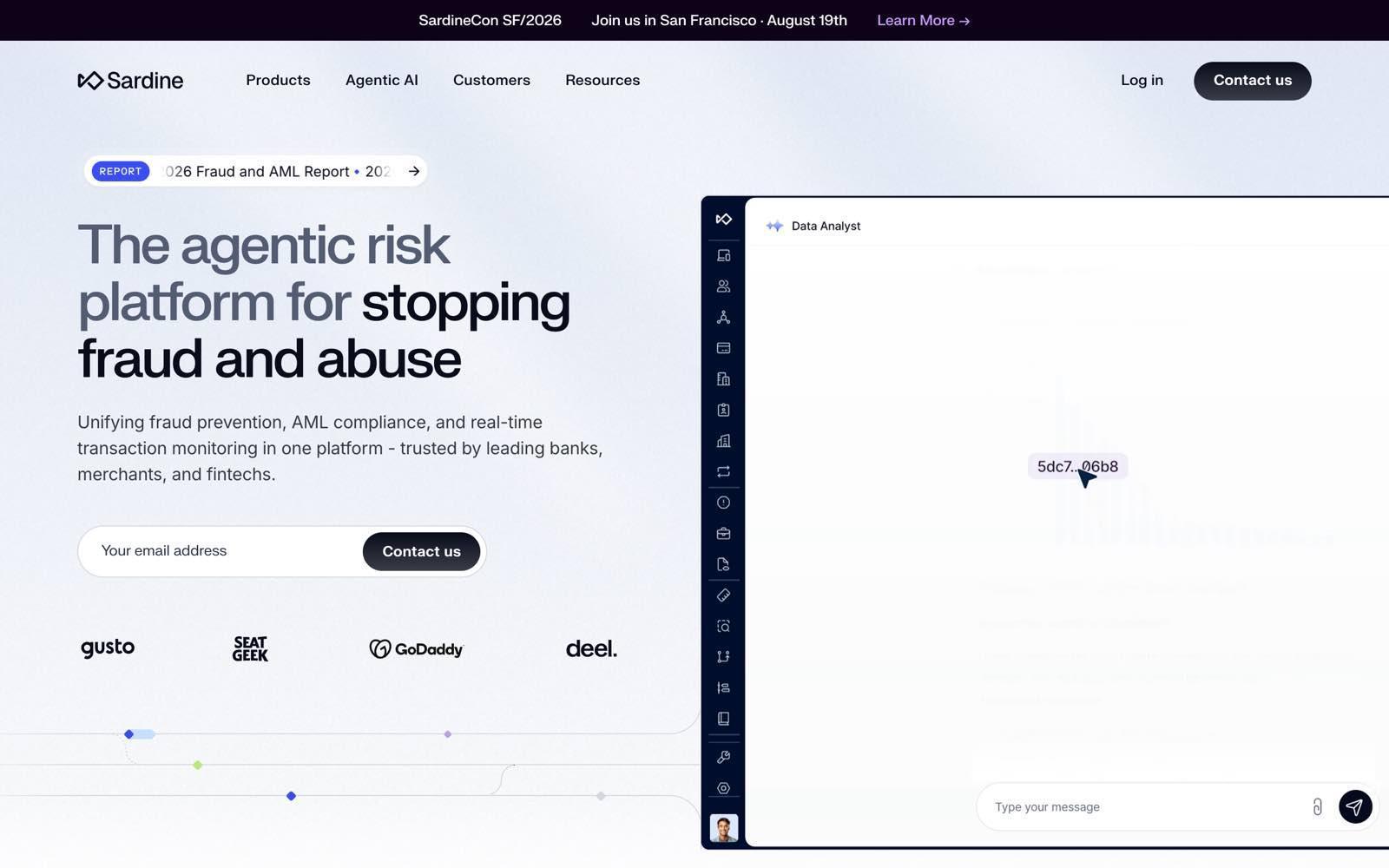
Sardine is a risk company built around device intelligence and behavior biometrics, layered with fraud, compliance, and onboarding modules. It reads how a user interacts with a device, typing cadence, navigation patterns, session behavior, and uses those signals to separate a genuine customer from an automated or coached one before the payment is even submitted.
For acquirers the relevant modules are transaction fraud, merchant oversight, and AML monitoring, supported by a large behavioral dataset. Sardine reports 6.2 billion devices profiled, 985 million consumers covered, and $1.48 trillion in monitored transaction volume, which gives its models a wide base of behavioral context that transaction data alone cannot supply.
Its newer direction is agentic automation, with autonomous agents running investigative steps such as open-source research, sanctions screening, graph analysis, and suspicious activity report drafting. That cuts the manual work in each case, though it also means an acquirer needs a governance process for decisions an agent has prepared.
Sardine is one of the strongest options where the fraud problem is behavioral rather than purely transactional. Its device dataset is among the largest in the category, and the combination of pre-transaction signals with post-transaction monitoring gives a fuller view of a session than a scoring engine reading authorization fields alone.
Sardine does not publish pricing. Contracts are quoted by module and volume, typically as an annual subscription with usage tiers.
Sardine is recommended for acquirers and payment facilitators whose losses are driven by account takeover, bots, and coached fraud, where behavioral signals genuinely change the outcome. Its device-first model depends on capturing signals at checkout, which is harder for an acquirer that does not own the merchant's front end.
Merchant portfolio risk is also not where its depth lies, so bust-out exposure needs another answer.
SEON is a fraud prevention company known for digital footprint analysis, enriching an email address, phone number, or IP into a picture of a real person's online presence. It's one of the very few vendors in the category that publishes pricing, and it deploys faster than the enterprise field, which makes it a common choice for growth-stage payment companies.
For an acquirer, SEON works best as a screening and enrichment layer rather than a portfolio risk system. Its custom rules engine and case management are accessible to small risk teams, and its scoring combines digital footprint signals with device fingerprinting and transaction data.
The trade-off is scope. SEON models individuals and sessions well, and it has less to say about a merchant entity observed across weeks of settlement behavior. An acquirer using it typically pairs it with either a merchant monitoring system or a manual underwriting process.
SEON is one of the smartest choices for payment companies that want transparency and speed rather than an enterprise procurement cycle. Publishing a rate card is rare in this category and makes budgeting straightforward, and the digital footprint approach adds signals that transaction data alone does not contain.
SEON publishes a Starter plan at $699 per month covering platform and API access, 2,500 fraud checks, 10 users, and 50 custom rules. The Premium plan is custom-quoted and adds case management, AML compliance, unlimited API calls, unlimited rules, and a dedicated implementation team. A free trial is available.
SEON is recommended for growth-stage payment companies and payment facilitators that need fast deployment, predictable cost, and strong identity signals when screening merchant applicants. It's a screening layer rather than a portfolio risk system, so an acquirer still needs merchant monitoring elsewhere.
Per-check pricing also scales awkwardly once monthly transaction counts reach acquiring volumes.

Hawk is an anti-financial-crime company that unifies fraud detection and anti-money-laundering monitoring under one system, an approach the industry calls FRAML. It serves banks, payment companies, neobanks, and fintechs, with an emphasis on explainable AI that satisfies model governance requirements in regulated institutions.
Its coverage spans transaction fraud, scams and mule detection, customer and payment screening, customer risk rating, and a unified case manager with suspicious activity report filing. The convergence argument is genuine: an acquirer investigating a merchant for fraud and for laundering in two separate systems duplicates work and loses signal between them.
Hawk publishes outcome figures including 3 to 5x more threats identified, 70% fewer false alerts, and a 62% reduction in AML investigation time. Its named customers include payment businesses such as VR Payment, though its positioning is oriented toward regulated institutions and compliance functions rather than merchant portfolio risk specifically.
Hawk is one of the strongest options for regulated payment companies that want fraud and AML to stop being two disconnected programs. Its explainability focus is a practical advantage in supervisory conversations, and its published false positive reductions address the single largest cost in most compliance operations.
Hawk quotes custom pricing by module and volume. There is no published rate card or self-serve tier.
Hawk is recommended for regulated payment companies that want fraud and AML on one system with model explainability strong enough for supervisory review. It is a compliance-led product, so an acquirer whose central problem is merchant bust-out and scheme ratio management won't find that covered.
The absence of an acquiring-specific module is the clearest limitation for this audience.
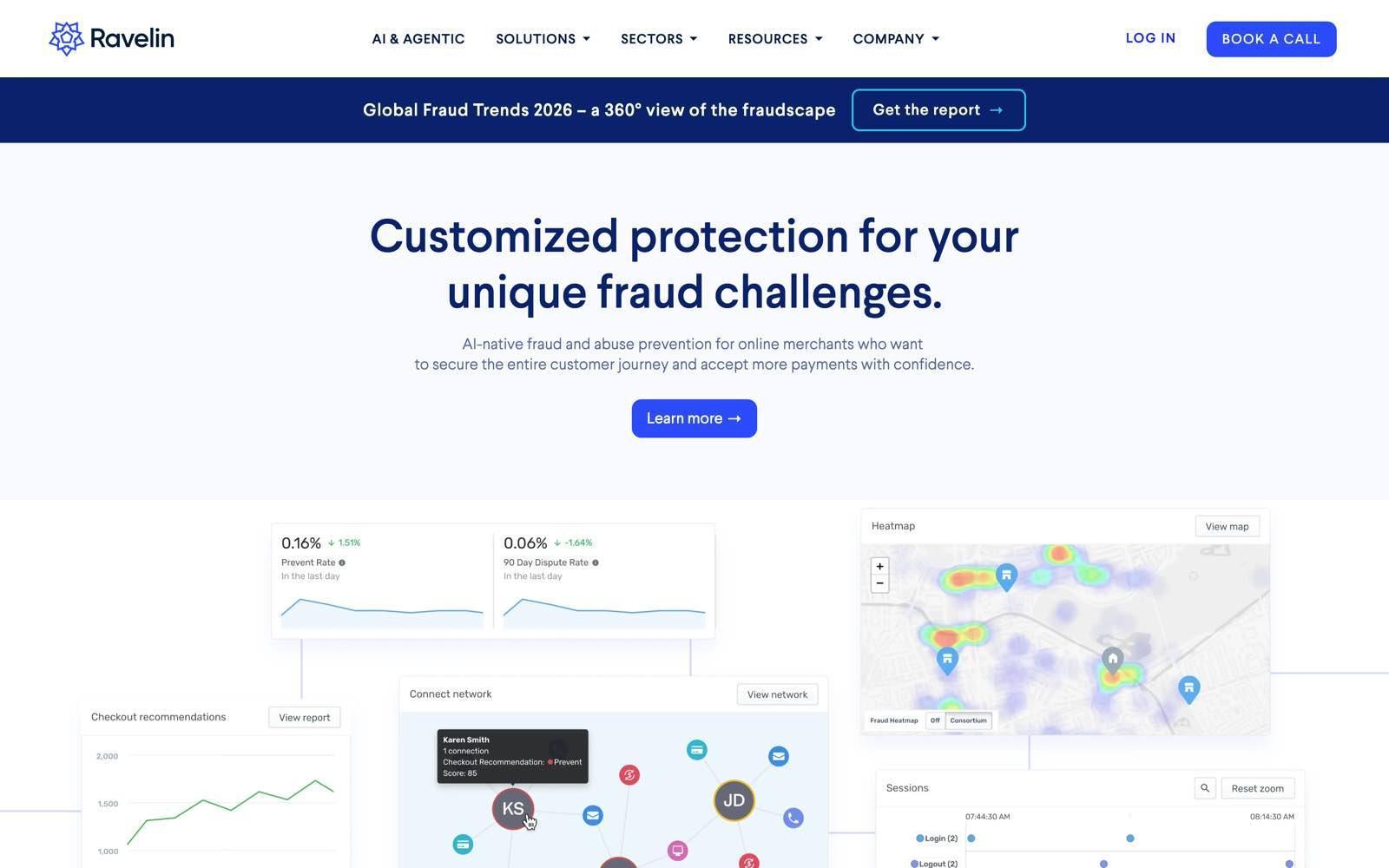
Ravelin is an AI-native fraud and abuse prevention company focused on online merchants, covering payment fraud, chargebacks, refund abuse, promotion abuse, account takeover, and 3D Secure optimization. Its customer list is merchant-side and well known, including Spotify, Deliveroo, Trainline, and Tesco.
The acquirer relevance comes through the channel. Ravelin works with payment providers including Fiserv and Elavon, which means acquirers can resell or embed its fraud tooling for their enterprise merchant clients rather than deploy it for portfolio oversight. That's a legitimate job for the tool, though a different one from monitoring your own merchant risk.
Its consortium approach gives it scale on the merchant side, with more than 9 billion identity elements in its shared database, and its 3D Secure optimization directly affects authorization rates, which is a revenue argument acquirers can take to merchants.
Ravelin is one of the smartest choices for acquirers that want a credible fraud product to offer their merchant clients. Its merchant references are strong, its abuse coverage is broader than payment fraud alone, and the 3D Secure work translates into a measurable lift in approvals rather than only a reduction in losses.
Ravelin does not publish pricing and quotes per customer, with channel arrangements available through partner acquirers and processors.
Ravelin is recommended for acquirers and payment service providers that want a strong fraud product to package for enterprise merchant clients, particularly where 3D Secure optimization and abuse coverage are selling points.
It doesn't address the acquirer's own portfolio risk, since the merchant is its customer rather than its subject. For an acquirer buying to protect its own book, that makes it the wrong category of tool.

NICE Actimize is an enterprise financial crime company covering fraud, anti-money-laundering, and market surveillance for large banks and financial institutions. It's one of the most established names in the field, with detection models, investigation tooling, and regulatory reporting built for institutions running formal financial crime programs.
For acquirers, the fit depends on organizational scale. A bank that runs acquiring inside a wider financial crime function can extend NICE Actimize across it, using the same case management, the same reporting, and the same governance. A standalone acquirer or payment facilitator is buying far more program than it needs.
Configurability is both its strength and its cost. The detection models can be tuned in considerable depth, which suits institutions with dedicated model risk teams, and becomes an obstacle for teams that expected the system to work out of the box.
NICE Actimize is one of the strongest options for institutions that need one vendor across the whole financial crime program and have the staff to run it. Its longevity and regulatory familiarity carry real weight in supervisory conversations, and few competitors match the depth of its investigation and reporting tooling.
NICE Actimize quotes custom enterprise pricing based on modules, volume, and deployment. Contracts are typically multi-year with implementation services priced separately.
NICE Actimize is recommended for large banks that run acquiring inside a broader financial crime program and already have the compliance staff to operate it.
Payment facilitators, independent sales organizations, and mid-market acquirers will find the cost and rollout impossible to justify against their volumes. Its merchant risk coverage is also not where its depth lies, which is the specific gap an acquirer most needs filled.
Choosing well comes down to matching coverage to where your losses actually occur, which for most acquirers is not where the demo focuses. Transaction scoring is easy to evaluate and easy to compare. Merchant risk, settlement timing, and scheme ratio management are harder to assess and are where the money goes. These seven factors separate the right fit from the impressive one.
Ask whether the system models the merchant as an entity observed across time or only scores individual payments. A transaction-only engine can't detect a bust-out, because every transaction in a bust-out looks legitimate until the merchant vanishes. Request a specific answer on how the vendor detects a merchant that processes clean volume for six weeks and then disappears.
Detection is only worth what it saves, and that depends entirely on whether the alert arrives before or after you have paid the merchant. Map the vendor's typical detection lead time against your own settlement schedule, then ask whether alerts can trigger a settlement hold automatically rather than waiting for a manual review. A system that flags a merchant two days after payout has told you something you'll read in a chargeback report anyway.
Detection quality depends on the data behind the model, and there are three tiers. Static rules decay as attack patterns change. Single-customer AI learns only from your own history and needs months before it performs. Consortium and centralized AI see more of each flow, so patterns that cross rails or merchants show up sooner. Ask each vendor directly what its models train on, because that answer determines what the system can catch that you have never seen before.
Your VAMP ratio is a licensing matter, so the tool should help you manage it rather than leave you to calculate it. Check whether the system tracks the count-based fraud and dispute ratio at both portfolio and merchant level, whether it can identify which merchants are driving the number, and whether it produces the evidence an acquirer needs when a scheme asks what remediation is underway. Vendors still quoting retired thresholds are a signal in themselves.
An acquiring portfolio isn't one risk profile. A high-risk merchant category needs tighter rules than a low-risk one, and a processor serving several acquirers needs separate configurations and data boundaries per client. Confirm you can run different rules, thresholds, and dashboards per merchant or per client without deploying a second instance, and check whether the vendor charges per rule, because some do.
Money laundering and merchant fraud move through the same settlement flows and often look identical for the first few weeks. When fraud and compliance run on separate systems, each team sees half the picture and the work is duplicated. Ask whether both read the same dataset and share one case file, and whether the system produces suspicious activity reports in a format your regulator accepts.
Consolidation has changed this market. Visa completed its acquisition of Featurespace at the end of 2024, Mastercard absorbed its acquired fraud assets years ago, and several once-independent brands now sit inside credit bureaus. If you process real volume across competing schemes, ask what data your vendor's owner can see and what happens to your contract if commercial priorities shift. Then price the whole picture: integration time, per-rule fees, minimum commitments, and the internal headcount the system assumes you have.
| Company | Pros | Cons | Ease of Use | Integrations | Support | Affordability | Merchant Risk |
|---|---|---|---|---|---|---|---|
| Fraudio | Merchant risk plus transaction fraud in one layer; no AI ramp-up; deploys in days | No KYB or document checks; payment companies only; no in-product chargeback tools | |||||
| Featurespace | Named acquiring product; peer group analysis; on-premise option | Scheme-owned; enterprise cost; needs internal analysts | |||||
| Feedzai | Fraud and AML breadth; proven at scale; strong explainability | Merchant monitoring is configured; long rollout; enterprise pricing | |||||
| ACI Worldwide | In-line scoring; on-premise support; signal sharing | Thin merchant risk layer; dated tooling; slow releases | |||||
| Fraud.net | Explicit acquirer product; KYB bundled; no-code rules | Self-reported metrics; smaller network; lighter AML | |||||
| Sardine | Large device dataset; pre-transaction signals; agentic work | Needs checkout access; limited bust-out depth; broad focus | |||||
| SEON | Published pricing; fast to deploy; strong identity signals | No portfolio monitoring; costly at volume; limited AML | |||||
| Hawk | Fraud and AML converged; explainable models; EU footing | No acquiring module; compliance-led; vendor-reported metrics | |||||
| Ravelin | Strong merchant references; abuse coverage; 3DS optimization | Merchant-side only; no bust-out detection; no AML | |||||
| NICE Actimize | Deep configurability; full crime coverage; mature reporting | Enterprise cost; rollout in quarters; needs internal experts |
An acquirer's worst losses are the ones that arrive late. A merchant processes clean volume, collects settlement, and disappears before the disputes land, while every transaction in the sequence looked ordinary.
Most fraud tooling was built to score those transactions, not to watch the merchant behind them, which is why the exposure keeps showing up after the money has gone. Scheme thresholds have tightened around the same numbers, so the cost is now measured in scheme standing as well as write-offs.
Fraudio was built for the businesses that hold this liability. It profiles merchants and scores transactions on one centralized dataset, so bust-out patterns surface in time to stall settlement rather than after a chargeback report.
Viva Wallet used it to catch fraud attempts three weeks earlier than its previous setup, at 8x return on investment. If merchant risk is where your losses concentrate, Book a consultation with our team.
The best fraud prevention platforms for acquirers in 2026 are Fraudio for combined merchant risk and transaction fraud, Featurespace for large processors needing a dedicated acquiring product, and Feedzai for tier-one institutions running one financial crime program. Fraudio leads because it profiles merchants as entities and scores transactions on the same centralized dataset, which is what catches bust-out fraud before settlement. Mid-sized acquirers often shortlist Fraud.net for bundled merchant KYB, while growth-stage payment companies choose SEON for its published $699 per month entry price. The right pick depends on whether your losses come from transactions flowing through merchants or from the merchants themselves.
In fraud prevention software for acquirers, look for merchant risk coverage, detection timing against your settlement cycle, what the models learn from, card scheme compliance support, and total cost of ownership. Merchant risk coverage matters most, because a transaction-only engine can't detect a bust-out where every individual payment looks legitimate. Detection timing decides whether an alert saves money or only explains a loss, so ask whether alerts can trigger a settlement hold automatically. Also confirm the system tracks your VAMP ratio at both portfolio and merchant level, since Visa flags an acquirer portfolio as Above Standard at 50 basis points.
Fraudio differs from similar alternatives by covering merchant risk and transaction fraud in one layer rather than treating them as separate products. Its centralized AI brings issuing, acquiring, transfers, and alternative payment methods into one dataset, with a rules library live before your own portfolio has absorbed the loss. Most competitors run models trained on a single customer's data, which need months to ramp. Fraudio also charges per transaction with no setup, implementation, or per-rule fees, and integrates in days rather than months.
You get started with Fraudio by running a Proof of Results test, which scores your historical transaction and merchant data alongside your existing system with no commitment and minimal work from your team. That gives you a measured comparison of detection performance on your own portfolio before any contract exists. Integration afterward takes days rather than months through API, webhook, or batch, whichever fits your authorization flow. Pay-per-use pricing means there's no setup or implementation fee to approve first.
Switching to Fraudio is straightforward because it runs in parallel with your existing setup during evaluation rather than replacing it on day one. The Proof of Results test uses historical data, so you validate performance before committing, and flexible contracting allows up to a six-month freeze period if your integration window is further out. Centralized AI protects your portfolio from the first transaction processed, so there's no ramp-up period where detection is weaker than what you left behind. Integration runs in days across API, webhook, or batch connections.
Acquirers can rely on card scheme fraud tools, but they cover one scheme's traffic and rarely address merchant-initiated fraud, which is where acquiring losses concentrate. Visa and Mastercard tooling scores transactions on their own networks, so an acquirer processing across multiple schemes gets a partial view and no unified merchant profile. Scheme tools also don't typically stall settlement or run AML monitoring on the same data. Most acquirers run scheme tools alongside an independent system rather than choosing between them.
Acquirers stop merchant bust-out fraud by monitoring the merchant as an entity over time rather than scoring its transactions individually, since bust-out volume is designed to look legitimate. The signals that matter are processing volume against forecast, refund and dispute trends, changes in merchant category behavior, and deviation from peer merchants in the same segment. Bust-out merchants look legitimate for weeks after onboarding, so continuous monitoring after onboarding matters more than the application review. The saving comes from stalling settlement on a flagged merchant before payout, not from declining transactions afterward.
The VAMP ratio is Visa's count-based measure of fraud reports plus disputes divided by settled card-not-present transactions, calculated monthly across an acquirer's whole portfolio. It matters because Visa identifies an acquirer as Above Standard at 50 basis points and Excessive at 70 basis points, and entities that exceed thresholds must implement remediation measures. The merchant-level Excessive threshold tightened to 150 basis points across the US, Canada, EU, and Asia Pacific on 1 April 2026. For an acquirer, that turns a handful of bad merchants into a portfolio-wide compliance problem.

How about trying our solution and experiencing the next generation for yourself?


