
November 12, 2026
The best identity theft protection software does one of two different jobs, and most buyers only shop for one of them. Consumer tools watch your credit files and the dark web, then alert you once your data has already leaked.
Business tools sit inside banks, card issuers, and payment companies, which is where a stolen identity actually gets turned into money.
This guide ranks the top 10 tools across both layers, with real pricing, the features that matter, and the gap each one leaves behind. We tell you plainly which entries are consumer subscriptions and which are built for the institutions holding the liability, because buying the wrong layer is the most expensive mistake in this category.
| Company | Best For | Key Features | Pricing |
|---|---|---|---|
| Fraudio | Banks and payment companies stopping stolen identities in use (business) | Centralized AI, real time transaction scoring, money mule and APP fraud detection, AML case management | Pay per transaction, no setup fees |
| Aura | All in one household protection (consumer) | 3 bureau credit monitoring, instant credit lock, $1M to $5M insurance, VPN, antivirus, data removal | $12 to $32 per month, billed annually |
| Norton LifeLock | Insurance limits and US based restoration (consumer) | Identity and credit alerts, scam reimbursement, home title monitoring, up to $3M coverage | $124.99 to $349.99 per year |
| Identity Guard | Low cost entry monitoring (consumer) | Dark web monitoring, high risk transaction alerts, 3 bureau credit monitoring on higher tiers | $7.50 to $25 per month, billed annually |
| Experian IdentityWorks | Credit bureau native monitoring (consumer) | Free Experian tier, 3 bureau monitoring, dark web scans across 600,000 pages, fraud resolution | Free, $24.99, or $34.99 per month |
| IdentityIQ | Deep credit report access (consumer) | Monthly 3 bureau reports and scores, synthetic ID protection, application alerts, $1M stolen funds cover | About $8.49 to $31.49 per month |
| EverSafe | Older adults and family caregivers (consumer) | Bank, investment, and card monitoring, caregiver access, AI scam email detection, 6 month lookback | $7.49 to $16.99 per month |
| Surfshark Alert | Cheapest breach alerting (consumer) | Email, credit card, and ID leak alerts across 90 countries, bundled with VPN and antivirus | Roughly $2.50 to $4.50 per month on long terms |
| Socure | Verifying identity at account opening (business) | Identity graph with 40 billion known outcomes, document verification, decision orchestration | Custom, usage based quote |
| LexisNexis Risk Solutions | Enterprise digital identity data (business) | ThreatMetrix network of 3 billion digital identities, behavioral biometrics, case management | Custom enterprise quote |
Identity theft protection software is any tool that watches for signs your personal information is being stolen or misused, then helps you shut the misuse down. On the consumer side it monitors credit files, bank and card accounts, court records, and dark web marketplaces, then sends an alert and hands you a restoration specialist plus an insurance policy when something goes wrong.
On the business side it scores logins, applications, transfers, and payments to work out whether the person behind them is who they claim to be.
Most identity theft software you will see advertised is the consumer kind, sold as a monthly subscription with credit monitoring at its core. The category grew out of credit bureau services in the 2000s, so credit report alerts remain the anchor feature, with dark web scanning, data broker removal, VPNs, and password managers layered on top over the past decade.
The business half of the market is bigger and much quieter. Banks, card issuers, acquirers, payment facilitators, and fintechs buy detection tools because they carry the loss when a stolen identity opens an account, drains a card, or receives scam proceeds.
Those tools overlap heavily with AI Transaction Monitoring Software, which watches money movement rather than credit files.
Both layers matter, and neither replaces the other. A credit alert tells you your Social Security number surfaced somewhere it should not be, which is useful and completely reactive. Transaction level detection is what stops the account application, the card test, or the mule transfer from going through in the first place.
You need identity theft protection software because the volume of exposed personal data has stopped being an event and become a permanent condition. The Identity Theft Resource Center tracked 3,322 data compromises in 2025, a record, and financial services was the most breached industry with 739 of them. Worse, 70% of breach notices did not say how the attack happened, so most people cannot even judge their own exposure.
The losses follow. The Federal Trade Commission reported that about $16 billion was reported lost to fraud in 2025, the highest on record and an increase of about 25% on the 2024 figure. It also noted that some of the costliest impersonation scams start with a fake security alert, often from a bank, after which people are convinced to move money in order to protect it.
That pattern is why monitoring alone falls short. The theft of your data and the theft of your money are separated by weeks or months, and they happen in different places. Your credit report shows the damage. The bank, the wallet, or the card issuer is where the damage is done.
The fastest growing version of this problem never triggers a consumer alert at all. Synthetic identity fraud, where criminals stitch a real Social Security number to a fake name and history, is reported by the Federal Reserve to be the fastest growing type of financial crime in the United States.
In a Boston Fed interview, Federal Reserve payments expert Mike Timoney put the cost at roughly $8 billion around 2020 rising past $30 billion within five to six years, and described generative AI as an accelerant. Nobody gets a dark web alert about a person who does not exist.
Regulators are watching the same shift. The joint EBA-ECB report on payment fraud put the total value of fraud in the European Economic Area at €4.2 billion in 2024, up from €3.5 billion in 2023, and found that strong authentication still works against the fraud it was designed for while new types rise, particularly the manipulation of payers.
So the outcome you are buying differs by who you are. An individual is buying faster warning, a smaller cleanup bill, and someone to make the phone calls. A payment company is buying fewer chargebacks, fewer reimbursed scam victims, fewer laundered dollars on its books, and a detection trail that holds up when an examiner asks how it knew.
Identity theft touches individuals and institutions differently, and the right tool follows from which side of the transaction you sit on. If you are asking who offers tools to help stop identity theft, the honest answer is that the vendors serving these five groups barely overlap.
If your information turned up in a breach notice, you need to know when someone tries to use it. Credit monitoring across all three bureaus, dark web scanning, and a restoration specialist who will contact lenders on your behalf are the features that matter here.
The insurance limit is less important than how fast the alert arrives and who does the paperwork.
Children are attractive targets because nobody checks a nine year old's credit file for a decade, and older adults are targeted through scam calls and account manipulation rather than credit applications. Family plans that cover several adults plus dependents, add caregiver visibility into account activity, and monitor investment and retirement balances fit this group best.
A sole trader's personal and business identity are the same identity, so a stolen SSN or EIN can turn into a fraudulent business account, a merchant account used to launder card payments, or credit taken out in the company's name.
These buyers need consumer monitoring plus an eye on new account and application activity, and they are usually the ones most exposed to the business side of the problem without any business side tooling.
Issuers and neobanks carry the cost of card not present fraud, account takeover, and authorized push payment scams, where a customer is manipulated into sending money to a criminal.
They need real time scoring at authorization, behavioral profiling across the life of an account, and the ability to freeze a mule account within minutes rather than after a chargeback lands. Credit file monitoring is irrelevant to them, because the file they need to watch is the transaction log.
Anyone onboarding merchants at speed inherits a different version of identity fraud, where a criminal uses stolen or synthetic details to open a merchant account, processes stolen cards through it, then disappears before chargebacks arrive.
Bust-out merchants look legitimate for weeks after onboarding, so these firms need merchant level monitoring that flags the pattern weeks before settlement is lost.
The ten tools below are ranked by how much of the identity theft problem each one actually removes, not by how loudly it markets. Each entry states whether it protects an individual or an institution, so you can skip straight to your layer.
Fraudio is a real time fraud detection and anti money laundering company built for the businesses that process payments, including issuers, acquirers, digital banks, fintechs, and payment facilitators. It is not a consumer subscription and it does not check identity documents at sign up. What it owns is the moment that matters most in identity theft, when someone tries to use a stolen or invented identity to move money.
That moment is where consumer monitoring cannot help. A criminal buys credentials, passes an onboarding check with clean details, then tests a card, drains an account, or receives scam proceeds through a mule account.
Fraudio scores each of those events as it happens, using a patent-pending centralized dataset that spans issuing, acquiring, transfers, and remittances. It processes more than 2 billion transactions across 188 countries for over 1 million merchants, and scores at authorization, so the decision fits inside a live payment rather than a next day report.
Fraudio closes the gap that both halves of this market leave open. Consumer tools tell a victim after the fact, and onboarding tools check a document once at the door, while the actual theft happens in the transactions that follow.
Because a processor legally cannot merge its own issuing and acquiring data, most detection tools only ever see half a fraud pattern, whereas Fraudio's centralized model reads both sides together and protects a customer from its first transaction.
It also runs fraud scoring and compliance on one dataset rather than two disconnected tools, pairing detection with a full anti money laundering platform covering rules, link analysis, sanctions and PEP data, case management, and audit trails. Fraudio reports up to 30 times better results than single dataset models and 15 times better than card scheme tools, and Viva Wallet reached 8x return on investment while catching fraud three weeks earlier than its previous setup.
Fraudio charges per transaction with no setup, implementation, or maintenance fees, and the cost per transaction falls as volume grows. Teams committing to higher volumes can lock in buy rates for the term. A Proof of Results test runs on your historical data alongside your current setup, so you can measure the difference before signing anything, and exact rates come through direct contact.
Fraudio is the strongest choice for any organization that pays for identity fraud rather than reads about it, because it acts at the transaction layer where stolen identities are converted into cash.
Pair it with an identity verification vendor at onboarding and you cover the full lifecycle, from the application through every payment that follows.
Aura is a consumer identity protection service that bundles monitoring, insurance, and digital security tools into one household subscription. It targets people who want a single product covering credit, finances, devices, and children rather than four separate ones, and it has become the default recommendation on most consumer roundups for that reason.
The breadth is real rather than cosmetic. A single plan carries three bureau credit monitoring with instant credit lock, home and auto title monitoring, financial transaction alerts, antivirus, a VPN, a password manager, data removal from more than 200 broker sites, and AI screening of spam calls and messages, with US based fraud remediation behind it. Insurance scales from $1 million on an individual plan to $5 million on the family plan.
Aura is one of the strongest picks for coverage per dollar, mainly because the bundle genuinely replaces other purchases. A family paying $32 per month gets protection for five adults, unlimited children, and unlimited devices, along with the antivirus and VPN most people already pay for separately. The 14 day free trial and simple three tier structure also make it easier to evaluate than competitors with five overlapping plans.
Individual plans are $12 per month billed annually or $15 billed monthly, couples pay $22 or $29, and the family plan covering five adults and unlimited children is $32 or $50. A kids only plan is $10 per month billed annually. Every tier includes a 14 day free trial.
Aura is the best all round consumer pick for a household that wants one bill and broad coverage, particularly families with children who need monitoring plus parental controls. The credit lock and title monitoring are the features most likely to prevent real loss.
Its weakness is the same as every consumer tool here, since it tells you about misuse rather than blocking the transaction that causes it.
LifeLock, now part of Norton, is the most recognized brand in consumer identity protection and the one most people think of first. Its pitch centers on what happens after theft, with US based restoration specialists assigned to a case and reimbursement limits that run higher than most rivals.
Coverage is tiered rather than uniform, which is the detail buyers miss. The entry Core plan carries up to $1.05 million of identity theft coverage with two bureau credit monitoring and alerts on up to two accounts.
Advanced raises coverage to $1.2 million and adds $5,000 of scam reimbursement, data broker removal, three bureau monitoring, and five monitored accounts. Total reaches up to $3 million of coverage with $10,000 of scam reimbursement, home title monitoring, retirement and investment account alerts, and unlimited account monitoring.
LifeLock is one of the smartest choices when recovery support matters more than monitoring breadth, because its restoration process and insurance limits are among the strongest on offer. Annual plans also carry a 60 day money back guarantee, which lowers the risk of committing for a year. Brand scale means phone support and staffing depth that smaller services cannot match.
Core is $124.99 per year, Advanced is $199.99 per year, and Total is $349.99 per year, which work out to $10.42, $16.67, and $29.17 per month respectively. Annual plans include a 60 day money back guarantee.
LifeLock suits anyone who wants the deepest safety net after identity theft rather than the widest monitoring before it, and homeowners in particular get value from title monitoring on the Total plan.
For a household comparing on features per dollar, the entry tier's two bureau limit makes it weaker value than it first appears.
Identity Guard sells identity monitoring at the lowest sustained entry price among the full service consumer tools here, starting at $7.50 per month for an individual on an annual plan. It is aimed at people who want alerting and insurance without paying for antivirus or a VPN they do not need.
The tier structure decides what you get. Value covers data breach notifications, dark web monitoring, high risk transaction monitoring, safe browsing, and a password manager, with $1 million of insurance for an individual and $5 million on family plans.
Total adds bank account monitoring, three bureau credit monitoring, and a monthly credit score. Ultra adds white glove fraud resolution, social media monitoring, card monitoring, retirement account monitoring, home and auto title monitoring, and credit lock.
Identity Guard is one of the strongest options for cost per feature at the entry level, since $7.50 per month still includes dark web monitoring and $1 million of insurance. The family pricing is also aggressive, at $12.50 per month for the Value plan covering five adults and unlimited children. For buyers who only want monitoring and a policy, that focus keeps the bill down.
Individual plans are $7.50, $16.67, and $25 per month for Value, Total, and Ultra, all billed annually. Family plans covering five adults and unlimited children are $12.50, $25, and $33.33 per month on the same tiers.
Identity Guard is the right pick for someone who wants monitoring and an insurance policy at the lowest credible price, especially a family shopping the Value tier. The Ultra plan is also competitive if social media and title monitoring matter to you.
The catch is that the headline $7.50 plan omits credit monitoring entirely, which is the feature most buyers assume they are paying for.
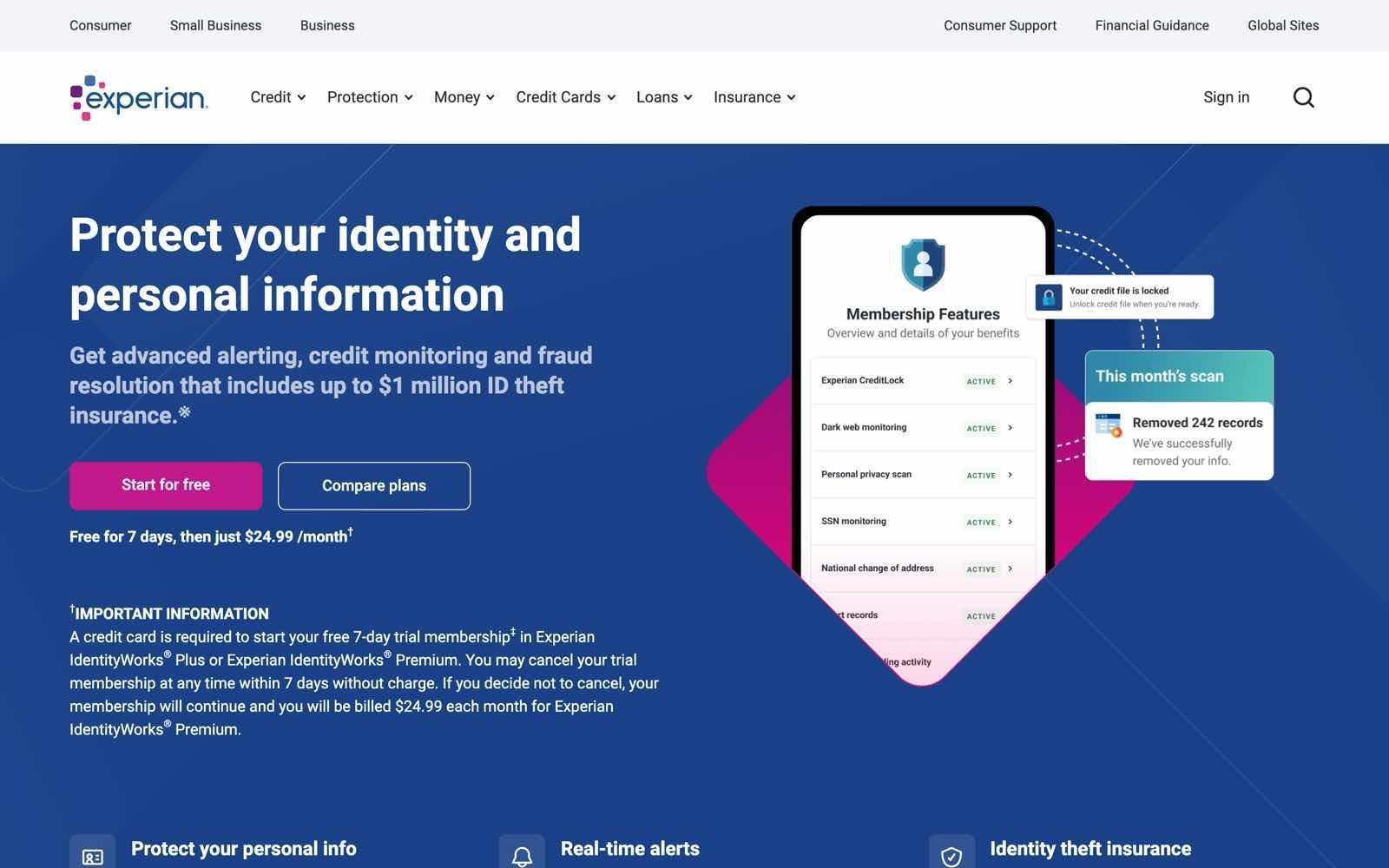
Experian is one of the three credit bureaus, so IdentityWorks monitors credit from inside the system that generates the data. That gives it the most direct route to credit file alerts, along with a free tier that no independent vendor can match.
The lineup is short and easy to read. Basic is free and includes an Experian credit report, FICO score, credit monitoring, and alerts.
Premium is $24.99 per month after a seven day trial and adds advanced identity monitoring, three bureau credit monitoring, up to $1 million of identity theft insurance, dark web surveillance across more than 600,000 web pages daily, and dedicated fraud resolution support. Family is $34.99 per month and extends Premium to a second adult and up to ten children, with monthly privacy scans and help removing personal information.
Experian is one of the smartest choices for credit centered protection, because the bureau relationship removes a layer between you and the data. Ten child slots on the Family plan is also more generous than most rivals offer. The free Basic tier lets you start monitoring today and decide later whether the paid features earn $24.99 per month.
Basic is free. Premium is $24.99 per month after a seven day free trial, and Family is $34.99 per month on the same trial terms. Both paid tiers require a card at signup.
Experian IdentityWorks makes the most sense for buyers focused on credit and new account fraud, and the free Basic tier is worth taking regardless of what else you buy. Families get real value from ten child slots.
Against Aura or Identity Guard, though, Premium's $24.99 monthly price buys less breadth outside credit.
IdentityIQ competes on credit report depth rather than bundled extras. Its top tier delivers monthly three bureau credit reports and scores, which is more frequent access than most consumer tools include at any price.
Plans climb in four steps and the credit access is what separates them. Secure Basic covers daily one bureau credit report monitoring, Secure Plus adds annual three bureau reports with scores, Secure Pro moves that to twice yearly, and Secure Max delivers monthly three bureau reports and scores plus three bureau monitoring.
Every plan carries $1 million of stolen funds reimbursement, dark web and internet monitoring, application and SSN alerts, synthetic ID theft protection, change of address alerts, and US based restoration, with family plans adding $25,000 of identity theft insurance per member.
IdentityIQ is one of the strongest picks for credit visibility per dollar, since $1 million of stolen funds reimbursement is included even on the $8.49 tier. The synthetic identity feature is also a rare acknowledgement in consumer software that this attack pattern exists. For people in an active dispute or rebuild, monthly reports beat quarterly summaries.
Plans run from about $8.49 per month for Secure Basic to $31.49 per month for Secure Max, with Secure Plus and Secure Pro in between at roughly $11.49 and $21.49. A cybersecurity add on raises each tier by about $2 per month, and annual billing lowers the effective rate.
IdentityIQ fits people who want frequent, detailed credit reports and a reimbursement policy, particularly anyone actively repairing their credit. The synthetic identity monitoring is a genuine differentiator at this price.
Working out which of four tiers you need, and paying for the top one to get monthly reports, is the friction you accept in exchange.
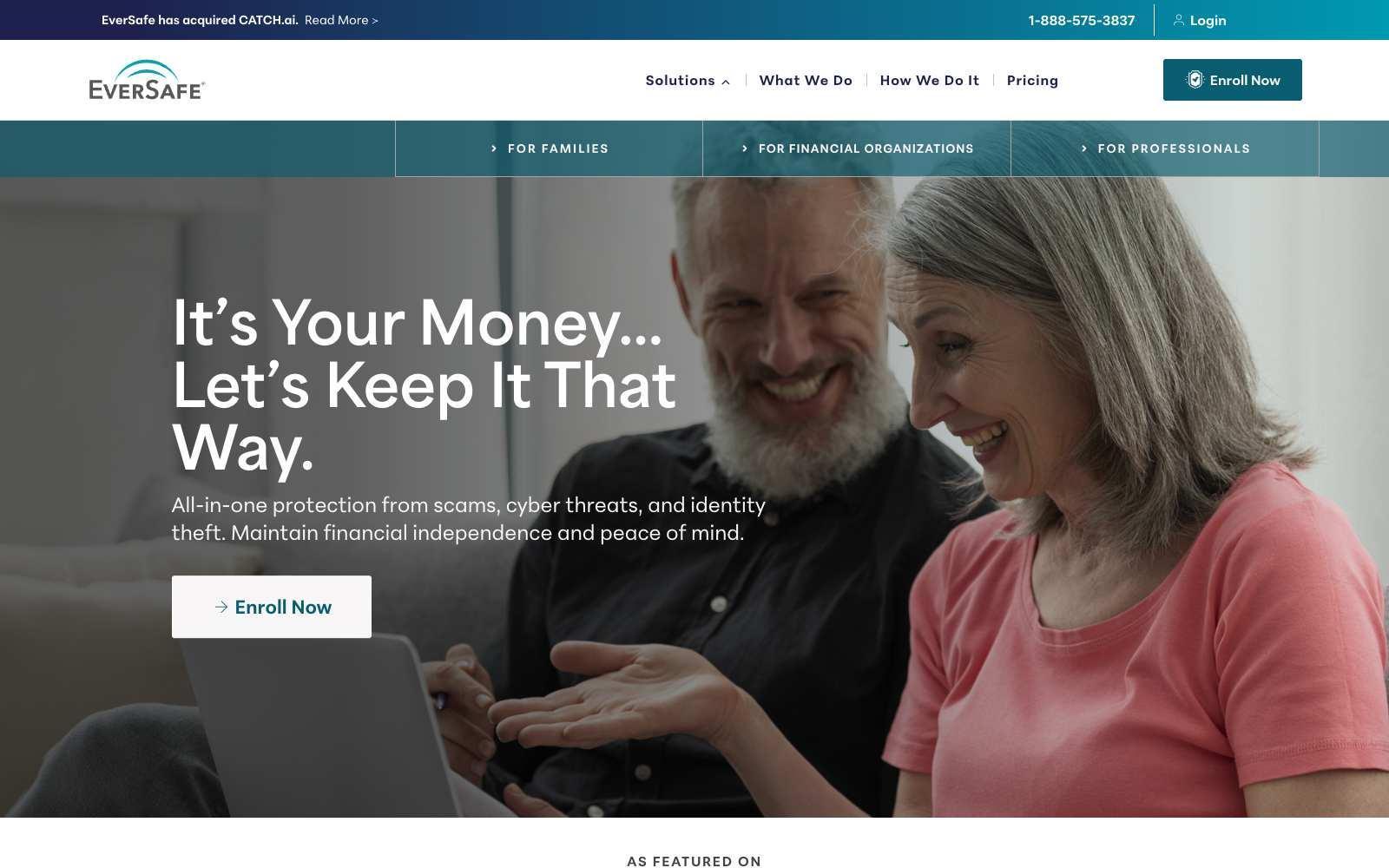
EverSafe watches money rather than credit files, which makes it the sharpest fit for older adults and the families helping them. It monitors banking, investment, and credit card accounts alongside all three credit bureaus, and looks for the patterns that signal financial exploitation instead of only new account fraud.
The caregiver design is what sets it apart. Members can designate trusted people as an extra set of eyes on account activity, so an adult child sees a suspicious withdrawal or a missed bill without taking over the account.
Alerts cover erratic spending, unusual withdrawals, missing deposits, and balance changes across institutions, with a six month historical lookback at enrollment, AI screening that flags scam emails before money moves, monthly scam notices, and $1 million of identity theft coverage.
EverSafe is one of the strongest options for financial exploitation specifically, a category most identity theft protection software treats as out of scope. Real estate monitoring and email monitoring are available as paid add ons, so you can extend coverage without moving to a higher tier. A 30 day free trial, a 10% discount for members aged 60 and over, and a lifetime price guarantee make the commitment low.
Essentials is $7.49 per month, or $76.32 per year at an effective $6.36 per month. Plus is $16.99 per month, or $173.28 per year. All plans start with a 30 day free trial, members aged 60 and over receive a 10% discount, and annual billing saves 15%.
EverSafe is the right choice for households protecting an older relative, because it watches the accounts where exploitation actually happens and lets a family member help. The scam email screening addresses a route most competitors ignore.
If you want device security and a VPN in the same subscription, this is not the tool for that.
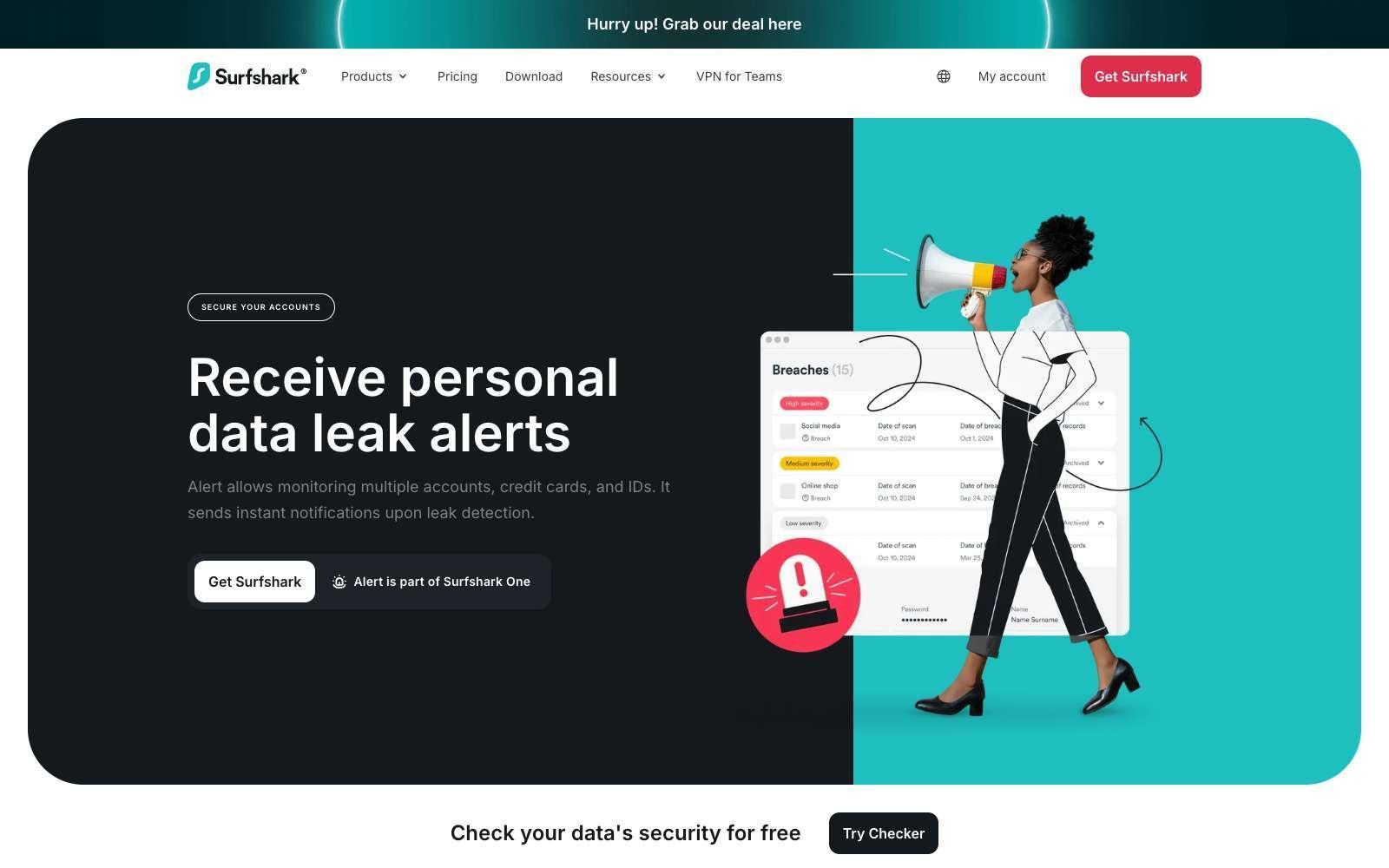
Surfshark Alert is a data breach notification tool sold inside Surfshark's security bundles, and it is the cheapest way on this list to learn that your information has leaked. It monitors emails, credit card numbers, and identity documents from more than 90 countries, then shows what leaked and what to do next.
It is important to be clear about what it is not. Alert has no credit monitoring, no identity theft insurance underwriting of its own, and no restoration case management, so it warns you and stops there. It also cannot be bought on its own, since it only comes inside the Surfshark One and One Plus bundles alongside the VPN, antivirus, and Incognito data removal.
Surfshark is one of the smartest picks purely on price, since long term bundle rates land in the low single digits per month for monitoring plus a VPN and antivirus. The multi country ID coverage also serves people that US centric services do not. For someone who wants awareness rather than insurance, that is a reasonable trade.
Alert comes only inside Surfshark One or One Plus. Long term bundle pricing runs from roughly $2.50 to $4.50 per month on two year terms, with shorter terms and monthly billing costing considerably more, and rates varying by currency and promotion.
Surfshark Alert works for someone who wants to know when their data leaks and already handles the rest themselves, and it is hard to argue with the price when a VPN and antivirus are included. It is the right answer for awareness on a budget.
It is the wrong answer if you want anyone to help you clean up afterwards, since restoration and credit monitoring are both absent.
Socure sits on the business side of identity theft, verifying that the person opening an account is real and is who they claim to be. It sells to banks, credit card issuers, fintechs, government agencies, and marketplaces, where a stolen or synthetic identity that clears onboarding becomes someone else's loss.
Scale is the argument. The company reports more than 3,000 customers, including 19 of the 20 largest US banks and 13 of the 15 largest US credit card issuers, and an identity graph built on 40 billion known outcomes.
Its products span identity verification, document verification, fraud scoring, and decision orchestration, with a strong focus on synthetic identity and AI generated impersonation such as deepfakes and voice clones.
Socure is one of the strongest choices for onboarding accuracy in the US market, and its concentration among large banks and issuers is hard to argue with. Its focus on machine generated identity attacks, including deepfakes and device farms, reflects where the threat is moving. For teams whose losses cluster at account opening, that is the right place to spend.
Socure quotes custom, usage based pricing tied to verification volume and the modules selected. There is no self serve tier and no public rate card, so scoping runs through its sales team.
Socure is the right pick for a US bank, issuer, or fintech whose fraud losses start at account opening, particularly against synthetic identities. It is a serious tool with serious references behind it.
What it does not do is watch what a verified customer does next, so it needs a transaction monitoring layer beside it.
LexisNexis Risk Solutions sells identity and fraud data to large institutions, and its ThreatMetrix product is the piece most relevant to identity theft. It assesses digital identity at login, application, and payment, combining device, geolocation, IP, email, phone, and behavioral signals into a risk decision.
The network is the product. ThreatMetrix draws on more than 3 billion digital identities across 200 countries and territories, with machine learning models trained on that history and behavioral biometrics from LexisNexis BehavioSec layered in. It covers new account fraud, account takeover, scams, money laundering, and bot attacks, with case management, reporting, and workflow orchestration around the decisions.
LexisNexis is one of the smartest choices when breadth of identity data is the deciding factor, since few vendors can match its cross industry network or its reach into insurance, government, and lending data. Coverage across 200 countries suits institutions operating in many markets at once. The BehavioSec addition also gives it a genuine behavioral angle rather than data alone.
LexisNexis Risk Solutions quotes custom enterprise pricing by volume, product, and data modules, with contracts arranged through its sales team. Nothing is published publicly and there is no self serve option.
LexisNexis Risk Solutions fits large, multi market institutions that want identity, device, and behavioral data from a single established vendor and have the team to implement it. For global account takeover work, the network is a real asset.
Smaller payment companies and fintechs will find the procurement cycle, setup effort, and opaque pricing hard to justify.
Choosing well starts with a question most comparison tables skip, which is what you are actually trying to prevent. The seven factors below move in order, from the decision that rules out most of the market to the details that separate close rivals.
If you are protecting yourself or your family, you want a consumer subscription with monitoring, insurance, and restoration. If you carry the loss when someone else's stolen identity is used, meaning you are a bank, issuer, acquirer, payment facilitator, or fintech, no consumer product will help you at all. Getting this wrong wastes the whole budget, so settle it before comparing features.
Credit monitoring only catches fraud that touches a credit file, which leaves out bank and investment account takeover, home title fraud, medical identity theft, and scam payments you were manipulated into making. Look for coverage of financial accounts, titles, court records, and the dark web, and check whether all three bureaus are included or only one. On the business side, the equivalent question is whether the tool sees logins, applications, transfers, and payments or only one of them.
Every consumer vendor advertises up to $1 million or more, but the limit matters far less than what the policy covers and who does the work. Ask whether the figure covers stolen funds or only expenses such as legal fees and lost wages, whether a named specialist handles creditor calls for you, and whether family members are each covered or share one limit. A $1 million policy with hands on restoration beats a $5 million policy with a call center queue.
There are three approaches in this market and they perform differently. Static rules catch yesterday's fraud and need constant manual upkeep. Single company AI learns only from your own history, so it needs months of ramp up and stays blind to any pattern it has not seen internally. Centralized AI that reads every payment flow together catches attacks that cross rails, which a single-rail model misses.
Consumer plans advertise annual rates that are far lower than monthly billing, and some services publish a first year price that differs from the renewal, so check both before committing. Watch for features sold as add ons, such as extra property or email monitoring, and for bundles that duplicate antivirus or a VPN you already pay for. For business tools, total cost of ownership includes integration time, per check or per transaction fees, and any third party data the vendor resells.
An alert that arrives a week late has almost no value, and an alert stream full of noise gets ignored, which is functionally the same problem. Consumers should look for instant alerts and the ability to lock a credit file from the app rather than waiting on a phone queue. Payment companies should measure false declines and analyst review volume alongside detection rates, because blocking good customers is a real cost that vendor accuracy claims tend to leave out.
This factor only applies to organizations, and it eliminates otherwise strong vendors. Confirm the tool produces the audit trail, case history, and suspicious activity reporting your regulator expects, and check data residency if you operate where data must stay in country. If fraud detection and anti money laundering monitoring run as separate tools on separate data, expect duplicated alerts and gaps between them.
This table summarizes how the ten tools compare on the factors that decide fit. Pros and cons list the top three points for each, and the remaining columns rate ease of use, integrations, support, and affordability from one to five stars.
| Company | Pros | Cons | Ease of Use | Integrations | Support | Affordability |
|---|---|---|---|---|---|---|
| Fraudio (business) | Stops fraud at point of use; centralized AI, no cold start; fraud plus AML in one | Not a consumer tool; no ID document checks; payment companies only | ||||
| Aura (consumer) | Broadest bundle; $1M to $5M cover; 14 day trial | Monthly billing costs more; duplicate antivirus; alerts are reactive | ||||
| Norton LifeLock (consumer) | Up to $3M cover; US restoration staff; scam reimbursement | Entry tier is 2 bureau; top features cost most; annual only | ||||
| Identity Guard (consumer) | Lowest entry price; $5M family cover; no forced bundle | No credit monitoring on entry; features split by tier; annual billing | ||||
| Experian IdentityWorks (consumer) | Free tier with FICO; direct bureau data; 10 child slots | Premium is pricey; free tier is 1 bureau; heavy cross selling | ||||
| IdentityIQ (consumer) | Monthly 3 bureau reports; $1M on all tiers; synthetic ID watch | Four tiers plus add ons; depth gated to top plans; dated interface | ||||
| EverSafe (consumer) | Financial account focus; caregiver access; senior discount | No VPN or antivirus; paid add ons; thin device security | ||||
| Surfshark Alert (consumer) | Cheapest option here; 90 country ID cover; VPN included | No credit monitoring; no restoration help; bundle only | ||||
| Socure (business) | Used by 19 of 20 top US banks; large identity graph; strong on synthetic ID | Enterprise only; US centric; onboarding not ongoing | ||||
| LexisNexis (business) | 3 billion digital identities; 200 country reach; behavioral biometrics | Heavy setup; opaque pricing; pays for unused signals |
Identity theft protection software mostly reports damage after the fact. Data leaks, an alert lands weeks later, and the loss surfaces elsewhere, on a card, in a drained account, or in a mule transfer a victim was talked into making. If you process payments, that loss is yours to reimburse and yours to explain to a regulator.
Fraudio detects it at the moment of use, scoring transactions, transfers, and merchant behavior in real time with centralized AI.
A stolen or synthetic identity gets flagged on its first attempt, not after the chargeback. For example Viva Wallet reached 8x return on investment and caught fraud three weeks earlier than its previous setup, with integration measured in days and no setup fees while working with us.
If your team is carrying the cost of other people's stolen identities, Book a consultation with our team.
The best identity theft protection software in 2026 depends on which layer you need, with Fraudio leading for organizations that must stop stolen identities being used, and Aura leading the consumer market at $12 per month for an individual. Norton LifeLock offers the highest consumer reimbursement at up to $3 million, while Experian IdentityWorks has the only genuinely free tier. Businesses onboarding customers at volume should look at Socure or LexisNexis Risk Solutions instead. No single tool covers both consumer monitoring and transaction level detection.
When choosing identity theft software, settle which layer you need first, then compare monitoring breadth, insurance and restoration terms, detection method, and total cost. Credit monitoring alone misses bank account takeover, title fraud, and scam payments, so check whether financial accounts and titles are covered and whether all three bureaus are included. Insurance limits matter less than whether the policy covers stolen funds and who handles creditor calls for you. For businesses, detection method decides everything, because static rules and single company AI both miss patterns they have not seen before.
Tools to help stop identity theft come from three distinct groups of vendors. Consumer services such as Aura, Norton LifeLock, Identity Guard, IdentityIQ, EverSafe, and Surfshark monitor your data and help you recover, priced between roughly $2.50 and $35 per month. Credit bureaus including Experian sell monitoring directly, with a free entry tier. Businesses that carry fraud liability buy from vendors such as Fraudio for transaction level detection, and Socure or LexisNexis Risk Solutions for identity verification at account opening.
Fraudio differs from consumer identity theft software by acting at the point where a stolen identity is used rather than reporting that it leaked. Consumer tools watch credit files and dark web listings and then alert an individual, while Fraudio scores transactions, transfers, and merchant behavior in real time for the banks and payment companies that reimburse the loss. Its centralized AI reads cards, transfers and payouts in one dataset. It is sold to organizations, not individuals.
You get started with Fraudio through a Proof of Results test that runs on your historical data alongside your current setup, with no commitment and minimal work from your team. Integration then takes days to weeks using API, webhook, or batch connections that fit your existing stack. Pricing is per transaction with no setup, implementation, or maintenance fees, so there is no upfront cost to model. Book a consultation and the team will scope it against your volume and risk profile.
Switching to Fraudio is straightforward because it runs alongside your existing tools rather than replacing your whole stack at once. The Proof of Results test lets you compare detection against your current setup before you commit, and integration takes days to weeks rather than the five to fourteen months enterprise systems often need. Centralized AI means protection from the first transaction, with no training period on your own data. Pay per transaction pricing removes the large upfront cost that usually blocks a switch.
Identity theft protection software cannot prevent your data being stolen, and no vendor that claims otherwise should be believed. What consumer tools do is shorten the gap between misuse and discovery, then help you undo the damage, which is why credit lock and instant alerts matter more than the insurance headline. Prevention happens at the institution, where transaction level detection blocks the fraudulent application, card test, or mule transfer before money moves. The Federal Reserve reports synthetic identity fraud to be the fastest growing financial crime in the country, and those identities never trigger a consumer alert at all.
A credit freeze is free and blocks most new account fraud, so it is worth doing whether or not you buy identity theft protection software. What a freeze does not cover is takeover of accounts you already hold, home title fraud, medical identity theft, tax refund fraud, or a scam payment you were persuaded to send. Paid monitoring earns its cost when it watches those areas, and when it gives you restoration help you would otherwise handle alone. If you only want protection against new credit accounts, freeze your files and skip the subscription.

How about trying our solution and experiencing the next generation for yourself?


