
September 21, 2026
The best KYC tools for banks do two jobs, and most buyers only shop for one. They verify who a customer is at onboarding, and they watch what that customer does for the life of the account.
This guide reviews the top 10, ranks them on features and pricing, and shows where each one fits.
We start with a note on scope, because it changes how you read the list. Identity verification stops a bad actor at the door. Ongoing monitoring catches the ones who got in clean, then started laundering, muling, or draining accounts months later. A modern bank needs both, so we cover the vendors that lead each half.
KYC tools for banks are the software a financial institution uses to confirm a customer's identity and then keep checking that the customer stays who they claimed to be. KYC stands for Know Your Customer, the set of legal obligations banks carry to verify identity, assess risk, and report suspicious activity.
The category splits into two layers, and strong KYC software for banks covers both. The first is onboarding verification: checking identity documents, matching a live selfie to the photo, and screening a new customer against sanctions, PEP, and adverse-media lists. The second is ongoing due diligence, sometimes called perpetual KYC, which re-checks risk and monitors behavior for as long as the account is open.
That second layer is where the market gets thin. Most tools sell the onboarding moment hard, then treat monitoring as a checkbox. For a bank, the split matters because the two layers answer different questions. Onboarding asks whether this person is real. Monitoring asks whether this real person is now doing something criminal.
Behind these tools sits a related discipline banks lean on heavily, i.e, AI Transaction Monitoring Software, which watches money movement rather than identity documents. The best KYC programs connect the two, so a verified identity is tied to a live risk profile that updates with every transaction.
You need KYC tools for banks because the cost of getting it wrong now runs into the billions, and the failure rarely happens at onboarding. In 2024, TD Bank agreed to pay $3.1 billion to settle anti-money-laundering allegations, including a $1.3 billion FinCEN penalty. The bank knew who its customers were. What it missed was what they did afterward.
That gap is the pattern, not the exception. Criminals pass identity checks with real or well-forged credentials, then use the account for laundering, mule activity, or scams. The onboarding form looked clean, so the loss shows up later as an unmonitored transaction, a frozen correspondent line, or a regulator's consent order.
The wider numbers explain the pressure. Global card fraud losses reached $33.41 billion in 2024, according to the Nilson Report, and 79% of organizations faced payment fraud attempts that year, per the AFP survey.
Fraud and money laundering feed each other, and both move through accounts that already cleared KYC.
So the outcome you're buying isn't a verified photo. It's fewer regulatory penalties, fewer laundered dollars moving through your book, and a due-diligence trail that holds up when an examiner asks how you knew. Good KYC software for banks turns a one-time check into a living view of customer risk.
KYC software for banks serves any institution that opens accounts, moves money, or holds liability for who does. The needs shift by business model, so the right tool depends on which of these you are.
Digital banks onboard customers remotely at high volume, with no branch to fall back on. They need fast identity checks that don't kill conversion, plus behavioral monitoring to catch account takeover and mule recruitment after sign-up. Speed and accuracy have to coexist, because every extra step at onboarding costs real customers.
Issuers carry the risk of cards being opened with stolen or synthetic identities, then used for fraud. They need KYC that ties identity to card behavior over time, so a clean application doesn't become an unmonitored liability. The value is in linking who opened the card to how the card is used.
Acquirers and payment facilitators onboard merchants, not just consumers, and roughly 3% of newly boarded SMEs turn out to be fraudulent. They need business verification (KYB) at onboarding and merchant monitoring afterward, because a bust-out merchant looks legitimate right up until it disappears with the settlement. Catching that pattern early is where the money is saved.
Compliance officers, BSA officers, and MLROs answer to regulators for the whole program. They need case management, audit trails, SAR-ready reporting, and screening that keeps false positives low enough to investigate. Their problem isn't finding a tool that flags something; it's proving they acted on the right flags.
Fraud and risk analysts work the alerts day to day and drown when the tooling is noisy. They need real-time scoring, clear context on each case, and the ability to act in seconds rather than filing a query and waiting days. For them, the difference between a good and bad tool is how fast they can separate a real threat from noise.
We reviewed each tool on lifecycle coverage, detection quality, integration effort, pricing, and fit for a bank's regulatory load. The list leads with ongoing monitoring, because that's the layer most buyers under-serve and where the largest fines land.
Fraudio is a real-time fraud detection and anti-money-laundering company built for the institutions that process payments: issuers, acquirers, digital banks, and payment facilitators. It isn't a document-verification tool, so it sits alongside your onboarding checks rather than replacing them.
What it owns is the harder half of KYC, the perpetual monitoring layer that watches transactions, entities, and money flows after a customer is verified.
The core problem it solves is the one that fined TD Bank: a customer clears KYC, then behaves criminally, and static monitoring never catches up.
Fraudio's patent-pending Network Effect AI reads behavior across billions of transactions and flags laundering, mule activity, and account takeover as it happens, not weeks later in a chargeback report.
Here's the scenario it's built for. A customer clears onboarding with valid documents, then months later starts receiving funds from dozens of unrelated accounts and moving them straight out.
A document-check tool sees nothing wrong, because the identity is real, but Fraudio reads that inflow-to-outflow pattern in real time and flags the account as a likely mule before the money leaves. Because its models train across more than 2 billion transactions in 188 countries, that context is there from your first transaction, not after a long ramp.
Fraudio closes the gap every KYC vendor leaves open,i.e, the continuous monitoring that keeps a verified identity honest. Its network effect is the differentiator: because a processor legally cannot merge its own issuing and acquiring data, most tools see only half the flow, while Fraudio's centralized model sees across the network and protects you from the first transaction.
It pairs that with a full anti-money-laundering platform covering case management, sanctions data, and audit trails, so fraud and AML run on one layer instead of two disconnected tools.
Fraudio uses pay-per-use pricing with no setup, implementation, or maintenance fees, and the cost per transaction falls as volume grows. A Proof of Results test can run on your historical data alongside your current setup, so you see the difference before committing. Exact rates are shared through direct contact.
Fraudio is the best choice for the ongoing half of KYC, where banks carry the most regulatory risk and the least tooling. Pair it with a document-verification vendor for onboarding, and you cover the full lifecycle, with Fraudio watching every transaction after the account opens.
For any bank that has been burned by what a verified customer did next, it's the clearest answer on this list.
Alloy is an identity and fraud risk decisioning tool that unifies KYC, KYB, and AML checks across more than 270 data sources through one no-code layer.
It positions itself as the control center for onboarding and monitoring, letting compliance teams configure their own policies without heavy engineering. It suits mid-market and digital banks that want flexibility over a fixed vendor stack.
The core idea is that a bank shouldn't hard-code its compliance policy into a vendor's black box. Alloy's decisioning layer lets a risk team add a data source, change a rule, or adjust a threshold themselves, which matters when a new fraud pattern appears, and engineering is booked out for months.
It reports serving more than 500 financial institutions, from credit unions to fintechs like Brex, and in 2025 added AI-driven perpetual KYC that re-checks customers when their risk changes.
Alloy is one of the smartest choices for banks that want to own their risk logic rather than inherit a vendor's. Its no-code orchestration reduces engineering dependency, and its breadth of data integrations gives strong coverage and redundancy across the customer lifecycle.
Alloy uses custom, quote-based pricing scoped to volume and modules, with no public rate card.
Alloy is recommended for mid-market and digital banks that want to configure their own compliance logic without deep engineering.
Its main limit is cost layering, since orchestration sits on top of data vendors you still pay for.
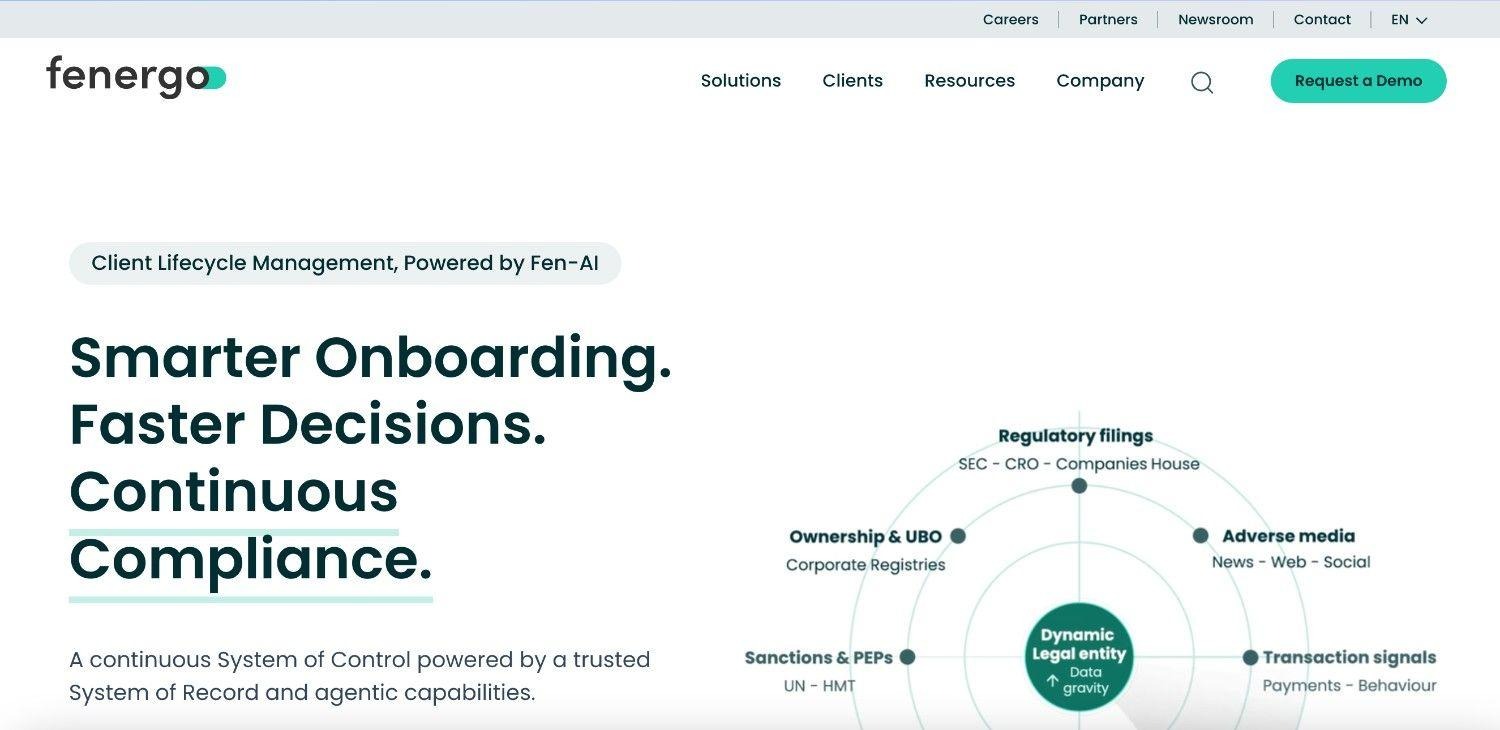
Fenergo is an enterprise client lifecycle management tool with KYC and AML rules built in for more than 120 jurisdictions.
It's designed for the complex institutional onboarding that global banks face, covering entity structures, beneficial ownership, and multi-country regulation. It targets Tier 1 and Tier 2 banks with heavy compliance obligations.
Institutional onboarding is where Fenergo earns its cost. Onboarding a corporate client means unwinding layers of ownership, mapping ultimate beneficial owners, and applying the right rules for every country the client touches, work that buries teams doing it by hand. Fenergo automates that entity resolution and regulatory logic across 120-plus jurisdictions, which is why it shows up at institutions managing tens of trillions in combined assets.
Fenergo is one of the strongest options for institutional complexity, with the deepest out-of-the-box multi-jurisdiction coverage in this segment. Analyst recognition backs it, including Luminary status in Celent's 2026 CLM report, and it's purpose-built for entity onboarding rather than simple consumer checks.
Fenergo uses custom enterprise licensing with no public pricing, and it's widely seen as a high-investment system.
Fenergo is recommended for large, global institutions with complex entity structures and multi-country obligations.
Its cost and implementation weight make it a poor fit for smaller banks.
Socure is an AI-driven identity verification and fraud company delivered through a single ID+ API.
It combines eKYC, document and biometric checks, fraud detection, and watchlist screening with an orchestration layer called RiskOS. It's strongest for large US consumer banks running high-volume account opening.
For a large US bank, the payoff is auto-approval accuracy at scale. Socure clears more genuine applicants without a manual queue while catching synthetic identities as they apply, and it reports approval rates near 98% with most fraud concentrated in the riskiest 3% of users. That accuracy is why it has become a default for high-volume consumer account opening in the US, though the same depth is still maturing for cross-border cases.
Socure is one of the smartest choices for US banks that prize onboarding accuracy at volume. It's a Gartner Magic Quadrant Leader for identity verification, and it reports adoption by 18 of the top 20 US banks, which gives it strong credibility for large-scale consumer onboarding.
Socure uses usage-based pricing, quoted for enterprise, with a startup tier offering transparent usage rates and monthly credits.
Socure is recommended for large US retail banks focused on high-volume, high-accuracy onboarding.
Its international coverage is still catching up, so banks with heavy cross-border needs should weigh that gap. It's an onboarding and fraud engine first, not a full AML case-management program.
Trulioo is a global identity company that unifies KYC, KYB, document verification, and watchlist screening through one API. Its strength is breadth, verifying both individuals and businesses across nearly every market.
It fits banks with cross-border onboarding where coverage is the deciding factor.
Coverage is the whole point of Trulioo. A bank onboarding customers in dozens of countries usually stitches together a different data source per market, and Trulioo replaces that with one connection to 450-plus sources across 195 countries. It also verifies both people and businesses, so a bank can run consumer KYC and business KYB with beneficial-ownership checks through a single integration instead of two vendors.
Trulioo is one of the strongest options for global reach, with the widest verifiable coverage in this comparison: 195 countries and 14,000+ document types. Its data-only verification is valuable where document capture fails, and its combined KYC and KYB depth is genuine rather than bolted on.
Trulioo uses custom, quote-only enterprise contracts with no published rates.
Trulioo is recommended for banks with serious cross-border or business-verification needs, where coverage breadth outweighs everything else.
Smaller teams wanting fast self-serve setup will find it heavy. It's a verification backbone, not an ongoing monitoring program.
Sumsub is an all-in-one KYC and AML company combining identity verification, fraud prevention, and compliance orchestration in one modular tool.
It's built for speed and conversion, with onboarding flows that finish in around 30 seconds. It leans toward digital banks, neobanks, and fintechs.
Sumsub optimizes for the metric digital banks care about most, conversion. Its onboarding flow finishes in about 30 seconds, and reusable KYC lets a returning customer skip re-uploading documents entirely, which cuts drop-off at sign-up. It also carries fraud tooling and transaction monitoring that keep working after onboarding, so it reaches further into the lifecycle than a pure verification vendor, even if its base skews toward fintech and crypto over incumbent banks.
Sumsub is one of the smartest choices for banks that measure onboarding by conversion. It offers the clearest per-verification pricing in this list and reports strong speed and conversion gains, paired with fraud tooling and transaction monitoring that continue after sign-up.
Sumsub charges per verification, with published rates starting near $1.35 per KYC check and lower rates for standalone AML checks, plus custom enterprise tiers.
Sumsub is recommended for digital banks and fintechs that want fast, high-conversion onboarding with predictable per-check costs.
Larger incumbent banks may want more marquee references and deeper rule transparency.

Jumio is an enterprise identity company combining AI document verification, biometrics, and AML into one orchestration layer it calls KYX.
It's built for scale and bank-grade security, with deep document coverage and hands-on support. It targets large incumbent banks and enterprises.
Jumio's draw for large banks is breadth backed by proof. It verifies 5,000-plus ID types across 200-plus countries and pairs that with liveness and deepfake detection, which matters as AI-generated documents get harder to spot. Its public roster of incumbent-bank customers gives risk teams the reference points they need to justify a premium price to a board, though uncommon documents can still drop into a manual-review queue.
Jumio is one of the strongest options for banks that want a proven enterprise name. It publicly serves HSBC, Monzo, and Metro Bank, offers very broad document coverage, and earns high marks for enterprise support and deepfake detection.
Jumio uses custom, quote-only enterprise contracts and is generally the most premium-priced option here.
Jumio is recommended for large banks that need bank-grade verification and deep support, and can absorb premium pricing.
Cost-sensitive or smaller institutions will find it heavy. It's an onboarding and verification leader, not a lightweight or budget choice.
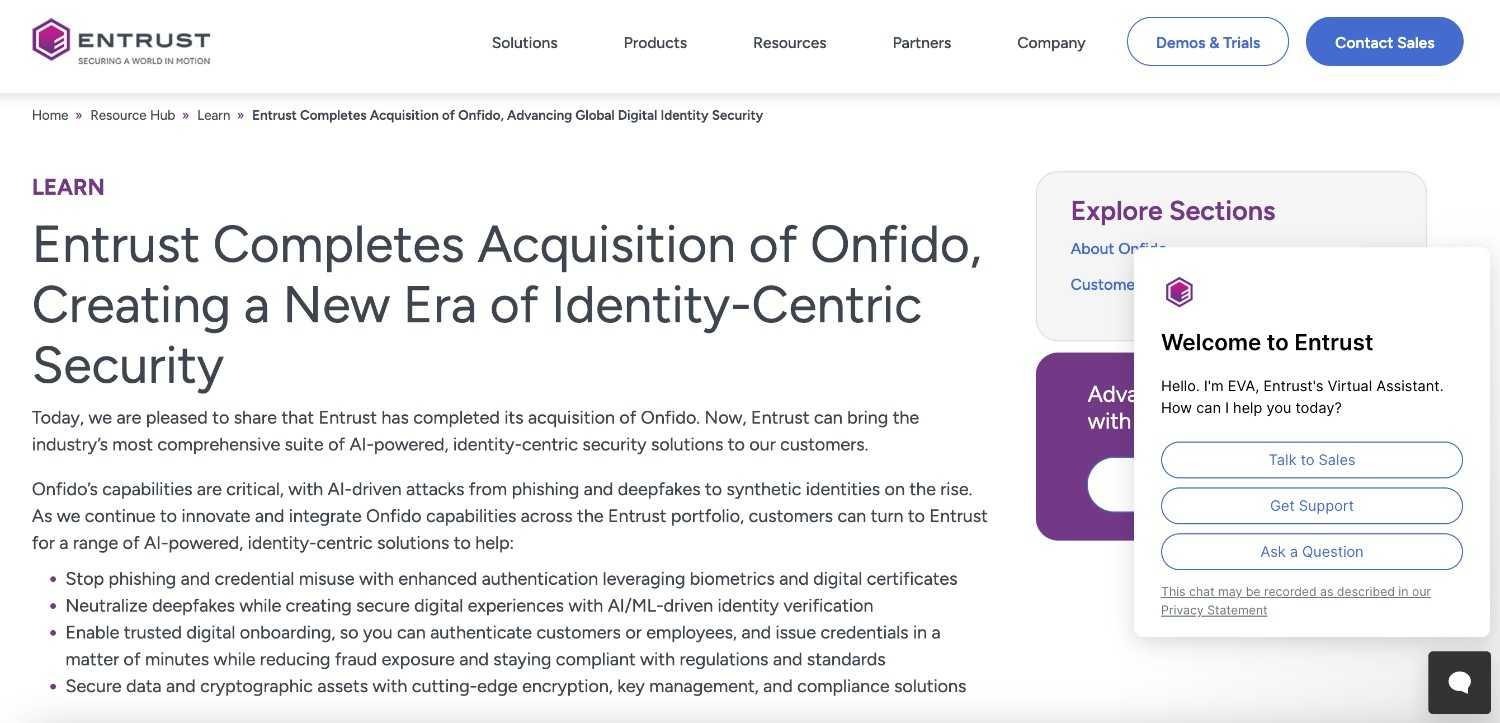
Onfido, now part of Entrust, is an identity verification suite pairing document and biometric checks with AML screening.
Since the 2024 acquisition, it sits inside Entrust's wider identity and security portfolio. It fits digital-first banks and fintechs that need fast remote onboarding.
Onfido's strength is remote onboarding that converts. Its document and biometric checks confirm a real, present person in a mobile flow, and Onfido Studio lets a team route higher-risk applicants to deeper checks without writing code. Since folding into Entrust in 2024, it sits inside a wider identity and security portfolio, which helps larger buyers but adds some transition risk as the older SDKs are retired.
Onfido is one of the smartest choices for remote onboarding at digital banks, with an intuitive dashboard and easy integration.
Its no-code Studio and passive fraud signals help teams tune risk without adding user friction, and it carries a strong reputation for support.
Onfido uses custom, quote-only pricing, and third-party reviews describe it as costly for smaller players.
Onfido is recommended for digital banks and fintechs that need strong remote onboarding and identity checks.
It handles the onboarding layer well but isn't a full financial-crime program, so larger banks pair it with dedicated monitoring. Smaller teams should weigh the cost against their volume.
LexisNexis Risk Solutions is an enterprise data and compliance company whose KYC and AML products combine large global risk datasets with screening and due diligence. It's a category incumbent, strongest where data depth drives the decision.
It serves large and enterprise banks.
LexisNexis competes on the depth of its data, not a slick onboarding screen. Its risk intelligence spans millions of profiles updated daily across dozens of categories, from sanctions and enforcement actions to politically exposed persons, which is what large banks lean on for authoritative screening and enhanced due diligence. It's trusted by many of the world's largest banks and ranks at the top of independent KYC and KYB data reviews, though it's a screening backbone rather than a fast-deploy onboarding tool.
LexisNexis is one of the strongest options for data-rich screening and due diligence, with breadth few can match. It's trusted by many of the world's largest banks and ranks highly in analyst reviews for KYC and KYB data, making it a reliable screening backbone.
LexisNexis uses custom, quote-only pricing with no public rates.
LexisNexis is recommended for large banks that need authoritative screening data and enhanced due diligence at scale.
Its complexity and cost make it a poor fit for smaller, speed-focused teams. It's a screening and data layer, not a lightweight onboarding experience.
NICE Actimize is an enterprise financial-crime company with an integrated suite spanning AML, KYC and CDD, fraud, and surveillance.
It's built for large, complex, highly regulated banks that want one program across financial-crime domains. It's the dominant enterprise incumbent in this space.
NICE Actimize is the option for banks that want one program across every financial-crime domain. Its suite covers AML transaction monitoring, KYC and customer due diligence through CDD-X, fraud, and trade surveillance, all deeply configurable to a bank's own risk model. That breadth, used by more than 1,000 institutions, is its edge, but it also drives the long, consultant-heavy implementations that make it a poor fit for smaller teams.
NICE Actimize is one of the strongest options for enterprise financial-crime programs, with strong scale and depth. It's used by more than 1,000 organizations and earns top analyst scores, making it a safe choice for banks that need everything in one heavily configurable system.
NICE Actimize uses custom, quote-only pricing by module, institution size, and volume, with no public rates.
NICE Actimize is recommended for large, complex banks that want a single, deeply configurable financial-crime program.
Its cost and implementation weight rule it out for fintechs and growth-stage institutions. For most mid-market buyers, it's more program than they can staff or afford.
Picking a tool is really about matching coverage to where your risk actually sits. Onboarding accuracy matters, but the fines and losses cluster after the account opens, so weigh the full lifecycle rather than the demo. These six factors separate the right fit from the impressive one.
Check whether the tool covers onboarding and ongoing monitoring, or only the first. Many vendors verify identity well but treat perpetual KYC as a checkbox, which leaves the exact gap regulators penalize. If a tool stops at onboarding, plan to pair it with a monitoring layer.
Look at what happens after a customer clears. Strong tools re-score risk on real events, monitor transactions and entities, and surface laundering and mule activity in real time. Ask how the tool detects a customer who passed KYC and then went bad, because that's the scenario that costs the most.
Not all AI is equal. Static rules decay, siloed AI learns only from your data and needs months to ramp, while network AI learns across many institutions and catches emerging patterns from day one. Ask each vendor what its models train on, because that determines what they can catch.
Deployment time is a real cost. Enterprise tools can take months to integrate, while lighter ones connect in days, and the difference shows up in time-to-value and engineering load. Confirm the connection methods, whether API, webhook, or batch, that fit your stack.
Read past the headline rate. Per-verification pricing, orchestration fees layered on data vendors, and add-on modules all change the real number, and quote-only models make comparison hard. Map cost to your volume and growth, not a single check.
Confirm the tool produces what an examiner asks for: audit trails, SAR-ready reporting, sanctions and PEP screening, and data residency where you operate. A tool that flags risk but can't document your response leaves you exposed. Match its reporting to your specific obligations.
KYC for banks fails where most tools stop looking. A customer clears identity checks, then launders money, runs a mule account, or drains victims months later, and the penalty lands on the monitoring gap, not the onboarding form.
That's the pattern behind the largest AML fines, and static, single-bank monitoring can't keep pace.
Fraudio was built for the institutions that own the liability after onboarding: issuers, acquirers, digital banks, and payment facilitators. Its patent-pending Network Effect AI learns from billions of transactions across many payment companies, so it catches laundering and mule activity that single-bank models miss, pairing fraud scoring with AML on one layer.
Viva Wallet used it to reach 8x ROI and catch fraud three weeks earlier than before. If you want KYC that keeps watching after the account opens, book a consultation with our team.
The best KYC tool for banks in 2026 depends on which layer you need, with Fraudio leading for ongoing monitoring and AML, Socure and Jumio strong for onboarding, and Fenergo and NICE Actimize built for enterprise complexity. Most banks combine a document-verification vendor with a monitoring layer, because no single tool leads both halves. Onboarding tools verify identity, while monitoring tools like Fraudio watch behavior afterward. The right choice matches your business model and where your regulatory risk actually sits.
When choosing KYC software for banks, weigh lifecycle coverage, detection quality, integration effort, pricing, and regulatory reporting. Lifecycle coverage matters most, because fines cluster in ongoing monitoring, not onboarding, as TD Bank's $3.1 billion settlement showed. Detection quality separates static rules from network AI that catches emerging patterns from day one. Confirm the tool produces audit trails and SAR-ready reporting for your specific obligations.
Fraudio differs from other KYC tools for banks by focusing on the ongoing monitoring layer rather than document verification at onboarding. Its patent-pending Network Effect AI learns from billions of transactions across many payment companies, so it catches fraud rings and laundering that single-bank models miss. It pairs real-time transaction scoring with AML case management on one layer. You pair it with an identity vendor for onboarding, and Fraudio watches every transaction after.
You get started with Fraudio by running a Proof of Results test on your historical data, which compares its output to your current setup with no commitment. Integration takes days rather than months, using API, webhook, or batch connections that fit your stack. Pay-per-use pricing means no setup or implementation fees. You can book a consultation to scope it against your volume and risk profile.
Switching to Fraudio is straightforward because it runs alongside your existing onboarding and monitoring tools rather than replacing your whole stack. Integration takes days, and a Proof of Results test lets you validate performance in parallel before you commit. Because it uses pay-per-use pricing with no setup fees, there's no large upfront cost to switch. Its centralized AI protects you from the first transaction, so there's no long ramp-up.
Fraudio is a monitoring and AML tool, not a document-verification KYC vendor, which is why it sits alongside your identity checks rather than replacing them. It covers perpetual KYC, the ongoing due diligence that watches transactions and behavior after a customer is verified. This is the layer regulators increasingly require and most onboarding tools skip. For banks, that split is the point, because the biggest losses happen after onboarding, not during it.
Perpetual KYC is the continuous re-checking of customer risk and behavior for as long as an account stays open, rather than a one-time check at onboarding. Banks need it because criminals pass identity verification with clean credentials, then launder money or run mule accounts later. Regulators now expect ongoing due diligence, and AML penalties target the monitoring gap, as TD Bank's 2024 settlement showed. Perpetual KYC ties a verified identity to a live risk profile that updates with every transaction.

How about trying our solution and experiencing the next generation for yourself?


