
November 4, 2026
A synthetic identity fraud tool has one job that sounds simple and isn't. It has to spot a customer who doesn't exist, built from a real Social Security number, a fake name, and a face that a generative model produced last week.
Most tools try to do that in the two seconds an application sits on screen, which is exactly when a well-built synthetic identity looks its most legitimate.
That timing problem is why this guide is organized by detection layer rather than by brand. Some tools read identity data at the application. Some read documents and device signals.
Some read what the account does over the following months, which is where the fake finally gives itself away. We ranked the top 10 on the layer they cover, the data their models learn from, how fast they deploy, and what they cost.
| Company | Best For | Key Features | Pricing |
|---|---|---|---|
| Fraudio | Catching synthetic accounts after onboarding, through behavior | Centralized AI, real-time transaction scoring, money mule and funnel-account detection, AML case management | Pay-per-use, no setup fees |
| Socure | Synthetic identity scoring at application | Sigma Synthetic V4.5, identity graph, thin-file and new-to-country coverage | Custom quote |
| SentiLink | US synthetic identity scoring with reason codes | Synthetic Fraud Score (0 to 1000), first-party and third-party split, eCBSV pairing | Custom, per query |
| LexisNexis Risk Solutions | Device and digital identity risk at scale | ThreatMetrix digital identity network, global identity data, risk orchestration | Custom quote |
| Experian | Credit-file depth and cross-industry visibility | Sure Profile, Precise ID, CrossCore orchestration | Custom quote |
| TransUnion | Public-record signals on thin credit files | TruValidate Synthetic Fraud Model, living-characteristics data, portfolio exposure reporting | Custom quote |
| Sardine | Device intelligence and behavior biometrics | Device and behavior signals, consortium data, onboarding through AML in one system | Custom quote |
| Resistant AI | AI-generated document detection | Document forensics, generative-AI document detection, transaction scoring on top of your system | Custom quote |
| SEON | Mid-market teams wanting transparent pricing | Digital footprint signals, device intelligence, rules plus machine learning, AML module | From $699 per month |
| Unit21 | No-code rules and investigation workflows | Configurable rules, case management, consortium data, fraud and AML in one system | Custom quote |
Synthetic identity fraud tools are software that detects customers who were manufactured rather than stolen. The Federal Reserve defines synthetic identity fraud as the use of a combination of personally identifiable information to fabricate a person or entity in order to commit a dishonest act for personal or financial gain.
In practice that means a real Social Security number, often belonging to a child, an elderly person, or someone without housing, paired with a name, date of birth, and address that belong to nobody.
The category splits across three detection layers, and the best tools for synthetic identity fraud detection are honest about which one they occupy. Identity-data tools score the application against bureau files, public records, and identity graphs. Document and device tools check whether the passport image was generated by a model and whether the device and network signals match the claimed person.
Behavioral tools watch what the account does after approval, scoring transactions, counterparties, and money flows over time. This third layer overlaps with AI Transaction Monitoring Software, because the signal that exposes a synthetic identity months later is the same signal that exposes laundering and mule activity.
Most buyers shop for the first layer and assume it covers the problem. It doesn't, and understanding why requires looking at how the fraud is actually built.
Synthetic identity fraud runs on a timeline, not a single moment, and each stage leaves different evidence. Knowing which stage your tool can see tells you exactly where your blind spot is. This is the part that most vendor comparisons skip, and it's the part that decides whether you catch the loss or book it.
The fraudster assembles a credible person from mismatched parts, usually a valid Social Security number with no credit history attached to it. Children are the preferred source because nobody checks a nine-year-old's credit file for two decades. Generative AI has made the rest of the package cheap, supplying a face that appears in no photo library and identity documents that hold up on screen.
This is the stage that breaks conventional fraud models. According to the Federal Reserve's Fed white paper on mitigating synthetic identity payments fraud, synthetic identity accounts behave more like normal customers, building credit over a period of time, than conventional identity fraudsters, who must rapidly cash in before the victim notices and reports the theft.
The same paper notes these accounts may not be flagged as suspicious using conventional fraud detection models, which affords perpetrators the time to cultivate these identities, build positive credit histories, and increase their borrowing or spending power before busting out. A cultivated synthetic identity pays on time, keeps balances low, and looks like your best customer for a year or more.
Then the account converts into cash, and it happens in one of three ways depending on your business. Credit-side fraudsters bust out, maxing every line with no intention to repay, and the Fed notes that if an identity busts out on one account it's likely to bust out on other accounts around the same time.
Payments-side fraudsters use the account differently. A FinCEN alert on deepfake media reports that criminals opened accounts using generative-AI-created identity documents and used them as funnel accounts, collecting deposits from multiple sources for a criminal network. Others board a synthetic merchant account and run transaction laundering through it until the chargebacks arrive.
Nobody calls to dispute the charges, because there is no real person to notice. The loss usually gets classified as a credit write-off, an unexplained chargeback, or a bad debt, which means it never enters your fraud numbers and never trains your fraud models. That misclassification is why the category stays underestimated and why your historical data cannot teach a model what these accounts look like.
The stages map cleanly onto detection layers, which is the fastest way to see your own gap.
| Stage | What the fraudster does | Signals that expose it | Which layer catches it |
|---|---|---|---|
| Fabrication | Builds a person from real and fake PII | Thin or absent credit file, no public records, generated face, document artifacts | Identity data, document forensics |
| Cultivation | Pays on time, builds credit, stays quiet | Shared PII across unrelated identities, coordinated activity across similar accounts | Identity graph, network and consortium data |
| Monetization | Busts out, mules funds, or launders payments | Rapid transactions on a young account, inflow-to-outflow mismatch, payment volumes to high-risk payees | Behavioral transaction monitoring |
| Disappearance | Vanishes, leaving no dispute | Loss reclassified as credit or chargeback, no victim report | Post-mortem link analysis |
Read that table against your current stack and you'll usually find you own the first row and hope for the rest.
You need a synthetic identity fraud tool because this is the one fraud type your existing controls are structurally blind to. Synthetic identity fraud is reported to be the fastest-growing type of financial crime in the United States, and the numbers behind it keep climbing. TransUnion research published in September 2025 found US lenders faced more than $3.3 billion in exposure for the year ending 2024.
Generative AI changed the economics on the fraudster's side. Deloitte projects that gen AI could enable fraud losses to reach $40 billion in the United States by 2027, up from $12.3 billion in 2023, a compound annual growth rate of 32%.
What used to take a skilled operator weeks now takes a prompt, so the volume of plausible fake people arriving at your onboarding flow has gone up while the cost per attempt has gone down.
The outcome you're buying isn't a cleaner application queue. It's fewer credit write-offs that were actually fraud, fewer mule and funnel accounts sitting inside your book, and a defensible answer when an examiner asks how you knew a customer was real. Teams that get this right also stop paying the quieter tax, which is declining genuine thin-file applicants because their file looks as sparse as a synthetic one.
The reason a single application-time score can't deliver that outcome is the cultivation stage. A tool that only looks once, at the moment the identity is most carefully dressed, is grading the fraudster's best work.
Synthetic identity fraud tools matter to any business that opens accounts remotely or holds the liability when one goes bad. What changes by business model is which stage hurts you most, so the right tool differs by who you are.
Issuers carry the loss when a cultivated synthetic identity maxes its line and disappears, and they rarely see it coming because the account's payment history was spotless. You need scoring that reads spending behavior against peer patterns rather than against that account's own tidy history. Bust-out timing is the tell, and it's visible in transaction velocity days before the write-off.
Acquirers and payment facilitators onboard merchants digitally, which means a synthetic identity can become a merchant account. A bust-out merchant looks legitimate for weeks, and when one processes stolen cards on its own account or launders payments for a prohibited category, the acquirer holds the liability and the card-network fine. Detection has to work on merchant behavior over weeks, not on the application form.
Account-to-account and instant payment rails settle in seconds, so a synthetic account used as a funnel receives and disperses stolen funds faster than any manual review cycle. You need real-time behavioral scoring that reads inflow-to-outflow ratios, counterparty patterns, and coordinated activity across accounts that appear unrelated. FinCEN's own indicators point at exactly this, including patterns of rapid transactions by a newly opened account.
Lenders sit at the sharpest end of the credit-side version of this fraud, and auto finance has carried the heaviest exposure in TransUnion's analysis. Public-record and bureau signals do real work here, because a fabricated person has no vehicle registration, no voter record, and no relatives. Pairing those signals with account behavior after funding is what separates a caught bust-out from a booked loss.
Fraud managers and compliance officers own the reporting when a synthetic account turns out to be part of a laundering network. They need link analysis, case management, an audit trail, and suspicious activity report output on the same layer that flagged the behavior. Running fraud detection and AML in separate tools is how a funnel account gets flagged twice and investigated never.
We reviewed each tool on the detection layer it covers, the data its models learn from, integration effort, pricing transparency, and how honestly it handles thin-file legitimate customers. The list leads with post-onboarding behavior, because that's the stage where synthetic identities stop hiding and the stage most stacks leave uncovered.
Fraudio is a real-time fraud detection and anti-money-laundering company built for businesses that process payments, including card issuers, acquirers, digital banks, fintechs, and payment facilitators. It's not an identity-verification or credit-bureau tool, so it sits alongside your onboarding checks rather than replacing them. What it owns is the layer those checks can't reach, scoring transactions, entities, and money flows for as long as the account stays open.
The core problem it solves is the cultivation stage. A synthetic identity that clears your application looks like a good customer until the day it doesn't, and Fraudio reads that account's behavior across cards, transfers and payouts against peer groups, not just the application data.
It processes more than 2 billion transactions across 188 countries for over a million merchants, so a coordinated pattern seen at one customer is recognized at the next one immediately.
Entity-level profiling is what changes the arithmetic on a funnel account. When a synthetic account starts collecting deposits from several unrelated sources and pushing them out within minutes, a single-company model has one data point and no context. Fraudio's entity rail profiles the account across time, comparing inflow-to-outflow ratios, velocity, counterparties, and device and IP signals against peer groups, which is how mule networks get frozen in minutes rather than found in next quarter's review.
Fraudio's edge on this problem is the centralized dataset. A processor legally can't merge its own issuing and acquiring data, which means most tools see one side of the money flow and infer the rest, and single-company AI models need months of your history before they're useful against a fraud type your history has mislabeled as credit loss.
Fraudio's centralized approach breaks that silo and protects a new customer from the first transaction processed, with no ramp-up period.
The Federal Reserve's own research supports the principle. Its white paper quotes an industry expert saying consortium data is better than organization-level data in detecting trends, and notes that information sharing is particularly important for smaller financial institutions, which generate less data and may have fewer technological and fraud-fighting resources than larger companies. Integration runs 3 to 14 days rather than the 5 to 14 months typical of enterprise incumbents.
Fraudio uses pay-per-use pricing with no setup, implementation, or maintenance fees, and the cost per transaction falls as volume grows. A Proof of Results test runs on your historical data alongside your current setup, so you can compare detection before committing to anything. Exact rates are shared through direct contact, and customers on higher volume commitments can lock in buy rates.
Fraudio is the strongest choice for the half of this problem that starts after approval, where synthetic identities behave rather than merely exist. Pair it with an identity or bureau vendor at the door and you cover the full timeline, with Fraudio reading every transaction that follows.
Teams that only need an application-time score and never monitor accounts afterward will get less from it than teams that actively investigate.
Socure is an identity verification company whose Sigma Synthetic model scores whether an applicant is a fabricated or manipulated identity rather than merely a valid-looking one. It's built for high-volume consumer onboarding in the United States, and it leans on a large identity graph plus relational analysis across billions of identity records. Its natural buyer is a bank, card issuer, or large fintech deciding thousands of applications an hour.
Socure reports that Sigma Synthetic V4.5 reaches 86% synthetic detection at a ratio of one good applicant flagged per two bad ones, and keeps manual reviews under 5% of volume. It also markets coverage for thin-file groups such as new-to-country consumers, which is where blunt models tend to reject legitimate people. Socure states it works with several of the largest US banks and card issuers.
Socure is one of the strongest options for application-time synthetic detection at enterprise scale, and it publishes performance figures more openly than most of its peers.
Its identity graph is a genuine asset against the cultivation stage, because shared PII across unrelated identities is one of the few signals visible before any money moves. It also monitors accounts after onboarding, though the product's center of gravity remains the decision at the door.
Socure prices by usage under custom enterprise agreements, and no rates are published. Cost depends on volume, which modules you turn on, and contract term.
Socure is recommended for large US institutions that want the best available score at the moment of application and have the volume to justify enterprise pricing.
Teams outside the United States, or teams whose losses land months after approval, will need another layer alongside it.
SentiLink is a US fraud company built specifically around synthetic identity risk rather than identity verification in general. Its Synthetic Fraud Score returns a number from 0 to 1000 with reason codes, and it separates first-party from third-party synthetic behavior, which matters because the two need different treatment. The natural buyer is a US bank, credit union, or lender making credit decisions on thin files.
What distinguishes it is the labeling discipline behind the model. SentiLink trains on hundreds of thousands of fraud labels assigned by its own internal fraud intelligence team, and combines curated data sources with its consortium data.
It also positions the Social Security Administration's electronic consent-based verification service as a treatment step for suspected synthetics, so you can confirm a thin-file applicant instead of declining one.
SentiLink is one of the sharpest options for US credit-side synthetic detection, largely because it does one thing and labels its data carefully. Its stated aim is to identify hard-to-spot synthetics without flagging populations such as recent immigrants and students, which is a real cost most models push onto the applicant. The human fraud intelligence team is an unusual inclusion that helps on the cases a score alone can't settle.
SentiLink prices per query under custom agreements, with rates set by volume and the products you turn on. No public pricing is available.
SentiLink is recommended for US lenders and banks that want the most focused synthetic identity score available and can pair it with their own downstream monitoring.
It won't help a payments business outside the United States, and it won't tell you when a cultivated account starts moving money.

LexisNexis Risk Solutions sells identity and fraud risk data at global scale, with ThreatMetrix providing device, network, and behavioral signals from a shared digital identity network. Its pitch on synthetic identity is breadth, combining public-record and identity data with digital signals so a fabricated person fails on multiple axes at once. Its buyers are large financial institutions, insurers, and government agencies.
The digital identity network is the interesting part for this specific fraud. A synthetic identity can hold a clean credit file and still connect from a device seen across dozens of unrelated applications, and cross-institution device linkage is one of the few ways to see coordinated fabrication early.
LexisNexis also offers risk orchestration, so the data can be sequenced with other vendors' checks.
LexisNexis is one of the strongest options when data breadth is the constraint, particularly for institutions operating in several countries. Its cross-institution device view addresses the fabrication and cultivation stages together, which few single-source vendors can claim. The trade-off is that this is a data and orchestration business rather than a behavioral monitoring engine.
LexisNexis quotes custom pricing by product, data volume, and contract term, with no published rates. Costs usually rise as you add data modules and orchestration.
LexisNexis is recommended for large, multi-country institutions that want maximum data coverage at the point of decision and have the resources for a long implementation.
Smaller payment companies and fintechs will find the pricing and integration effort disproportionate.

Experian approaches synthetic identity from the credit bureau side, which is the same terrain the fraudster is trying to occupy. Sure Profile is its synthetic identity detection product, sitting alongside Precise ID for fraud risk scoring and CrossCore for orchestration. Its buyers are lenders, card issuers, and any business making credit decisions on US consumers.
The bureau vantage point is a genuine advantage during cultivation. A synthetic identity has to build a credit file to become useful, and that construction process leaves traces visible to whoever holds the file, including piggybacking as an authorized user on unrelated accounts and inquiry patterns that make no sense for a real person's life. Experian sees that formation across industries rather than only inside your portfolio.
Experian is one of the smartest choices for credit-side detection because it watches the exact asset a synthetic identity spends a year building. Cross-industry file visibility means a fabricated identity assembling tradelines across several lenders is visible in a way no single lender can replicate alone. It's less relevant once you leave credit decisioning.
Experian prices per product and per volume under custom contracts, with no published rates. Buyers typically negotiate a bundle across data, scoring, and orchestration.
Experian is recommended for US lenders whose synthetic exposure sits in credit lines and who already run decisions on bureau data.
Payment companies, non-US operators, and teams whose losses appear as mule flow rather than write-offs will get limited value.
TransUnion combines bureau data with public-record signals in its TruValidate Synthetic Fraud Model, and it publishes some of the clearest research on the scale of the problem.
Its distinctive angle is what it calls living characteristics, the everyday traces a real person leaves and a fabricated one cannot. Its buyers are lenders, particularly in auto finance, plus card issuers and telecoms.
The research behind the model is unusually concrete. TransUnion found that missing relatives and motor vehicle registrations occur in 30% to 50% of synthetic identities and increase the likelihood of being synthetic by up to 7x versus legitimate identities. That kind of signal is cheap to check and hard for a fraudster to fabricate, which makes it a useful complement to credit-file analysis.
TransUnion is one of the strongest choices when you want signals a fraudster can't easily manufacture, since registering a vehicle or acquiring relatives is harder than opening a tradeline. Its portfolio-level reporting also helps risk leaders size the problem before they buy tooling for it. Coverage and depth are strongest in the United States.
TransUnion prices under custom agreements by volume and product, with no published rates. Expect bundling with other TruValidate components.
TransUnion is recommended for US lenders, especially in auto finance, that want authenticity signals from outside the credit file.
Payment companies and non-US operators will find the data thinner and the framing less relevant.
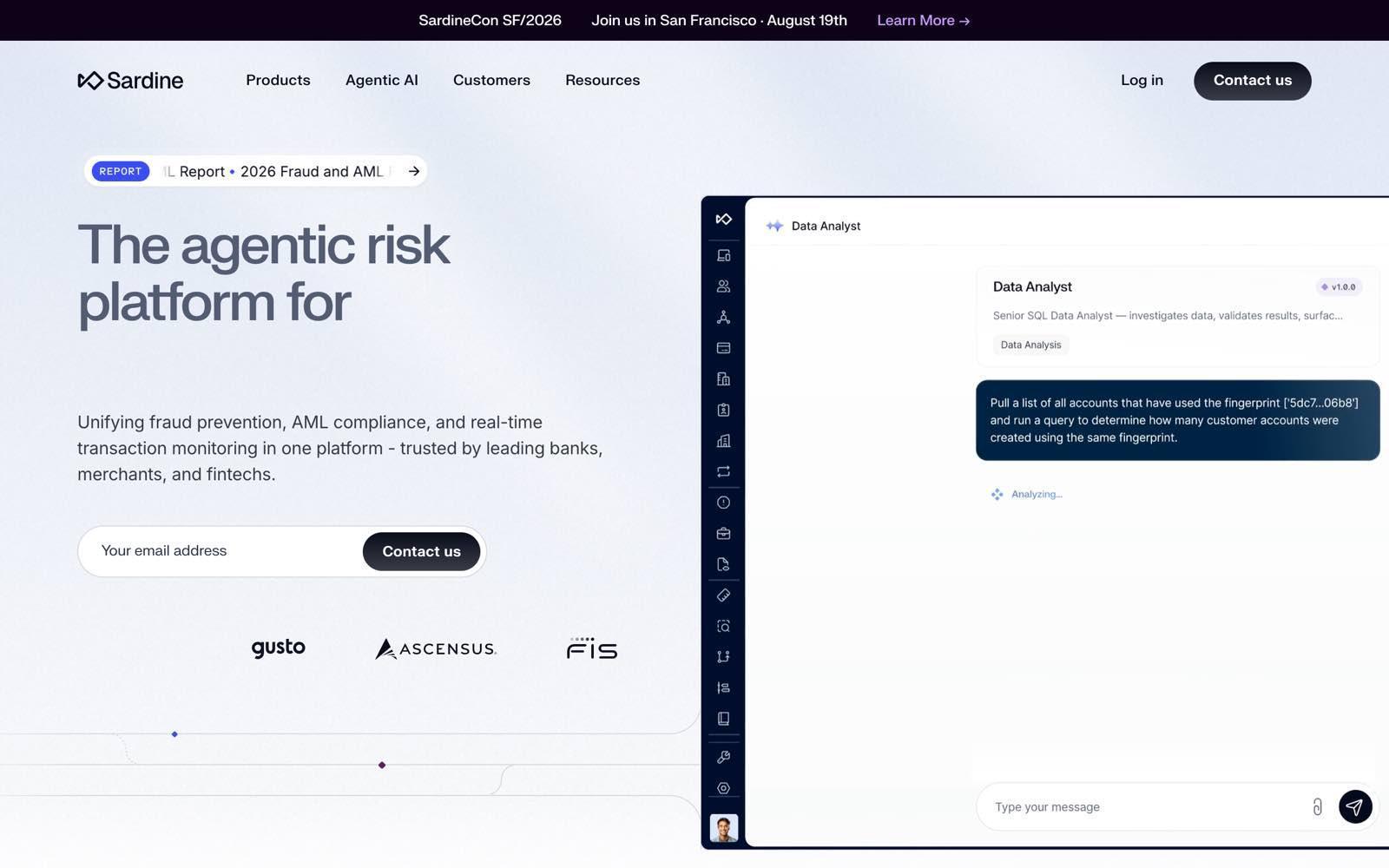
Sardine reads device intelligence and behavior biometrics, watching how someone types, taps, and navigates rather than only what they claim. Its risk system spans onboarding, fraud prevention, and AML compliance, with consortium data shared across customers. Its buyers are fintechs, banks, and sponsor banks that want one system across the customer lifecycle.
Behavior at the keyboard is a genuinely different signal for this fraud type. Someone entering a fabricated identity's details often pastes fields, hesitates on a date of birth that isn't theirs, or shows device characteristics inconsistent with the claimed person, and Sardine profiles 2.2 billion devices with sub-50 millisecond decisions.
It also runs transaction monitoring and case management, so the coverage extends past the application.
Sardine is one of the smartest choices when the fraud arrives through a digital funnel you fully control, because behavioral signals are hardest to fake at the moment of data entry. Its lifecycle coverage means the same system can flag the account later, which fewer identity vendors offer. Signal quality does depend on how much of the customer journey you can instrument.
Sardine prices under custom agreements based on volume and modules, with no public rates. Buyers typically scope onboarding, fraud, and AML components separately.
Sardine is recommended for digital-first fintechs and sponsor banks that own the full onboarding journey and want one system across it.
Businesses that receive transactions from third-party channels, without control of the customer's session, will capture fewer of its signals.
Resistant AI examines the documents a synthetic identity relies on, checking any PDF or image for signs of manipulation or machine generation. It explicitly detects AI-generated documents from major generative models, which matters now that a convincing utility bill costs a prompt. Its buyers include payment companies, lenders, and marketplaces running document-based onboarding.
Document forensics addresses a specific and growing hole. FinCEN's alert notes financial institutions often detect generative-AI content in identity documents by re-reviewing account opening documents after the fact, which is a slow and manual path. Resistant AI also sells a transactions product that scores activity on top of an existing monitoring system rather than replacing it.
Resistant AI is one of the strongest options for the document layer specifically, and it's ahead of most peers on machine-generated files. It reports outcomes such as a 22x return with Close Brothers in motor finance, and it's designed to complement rather than displace whatever you already run. Its scope is deliberately narrow.
Resistant AI prices under custom agreements, typically by document volume and product. No public rates are listed.
Resistant AI is recommended for teams whose onboarding depends on submitted documents and who already run identity and monitoring checks elsewhere.
It won't detect a synthetic identity that never uploads a file, and it won't monitor an approved account's money movement.
SEON builds risk decisions from digital footprint data, checking whether an email address, phone number, and social presence look like they belong to a person who has existed online for years. It pairs that with device intelligence, a rules engine, machine learning, and an AML module. Its buyers are mid-market fintechs, payment companies, iGaming operators, and retailers.
Digital footprint is a useful synthetic tell precisely because fabricated identities are new. An email created six weeks ago with no linked accounts, on a phone number with no history, is the online equivalent of the Fed's example of a 50-year-old with no accounts older than five years. SEON publishes entry pricing, which is rare in this category and useful for teams that need to model cost before a sales cycle.
SEON is one of the most accessible options in this category, combining published pricing with quick deployment and a rules engine analysts can own. Its footprint data covers the fabrication stage from an angle bureaus miss entirely, since credit files and social history are unrelated datasets. It's built for mid-market scale rather than tier-one bank volume.
SEON publishes a Starter plan at $699 per month covering 2,500 fraud checks, 10 users, and 50 custom rules, with Premium and enterprise tiers quoted on request. Pricing scales with check volume and the modules you turn on.
SEON is recommended for mid-market teams that want a working synthetic identity control quickly and need to know the cost up front.
High-volume institutions and credit-side lenders will outgrow the pricing model and want deeper reference data.
Unit21 gives fraud and compliance teams configurable rules, investigation workflows, and case management across fraud and AML, with consortium data behind the detection. Rather than selling identity data, it sells the operating layer that turns signals into decisions and filings. Its buyers are fintechs, crypto businesses, sponsor banks, and financial institutions.
That focus fits synthetic identity work better than it first appears. Detecting one fabricated account is a model problem, but connecting it to the nine others that share a device, an address fragment, or a counterparty is an investigation problem, and it's where most teams lose time. Unit21 also earned category leader status in Chartis research for enterprise and payment fraud.
Unit21 is one of the strongest options for teams whose bottleneck is investigation rather than detection, and running fraud and AML in one workflow suits synthetic accounts that turn into laundering cases. Its no-code approach shortens the loop between spotting a new synthetic pattern and deploying a rule against it. Detection quality still depends on the data you feed it.
Unit21 prices under custom agreements based on volume, modules, and users, with no published rates.
Unit21 is recommended for teams with analysts who own the fraud program and need better tooling to investigate and report.
Businesses looking for detection out of the box, without the people to run it, will find it under-delivers on its own..
Choosing between these tools comes down to matching the layer they cover against the stage where your losses actually appear. Vendors compete hardest on the application-time score because it demos well, but that's the stage a synthetic identity is designed to survive. Work through these six questions and the shortlist narrows fast.
Ask whether the tool scores an identity, inspects a document, or watches an account over time, and be suspicious of an answer that claims all three equally. Identity-layer tools stop the crude attempts, document tools catch generated files, and behavioral tools catch the cultivated accounts that cleared everything else. Map your last twelve months of losses to a stage before you shortlist anything.
A model trained only on your history has two problems with this fraud, since your history is thin on confirmed synthetic cases and much of it was misfiled as credit loss. Models that learn across many businesses recognize a pattern the first time it reaches you, which is why the Fed's research points at consortium data over organization-level data. Ask directly what the model trains on and how long it needs before it earns its keep.
Every synthetic identity looks like a thin file, and so does every recent immigrant, student, and young adult. A tool that hits your target detection rate by declining all of them is transferring a revenue problem into your growth funnel. Ask for false-positive rates on thin-file populations specifically, and ask what treatment path exists for confirming a real person instead of rejecting them.
Most of this category is built on US Social Security numbers, credit bureau files, and public records, which means it stops working the moment you cross a border. If you operate in Europe, LATAM, the Middle East, or APAC, ask what the tool uses in place of a bureau file and whether it can be deployed where data residency rules apply. Behavioral and device signals travel across markets far better than reference data does.
Deployment time is a real line item, and enterprise implementations that run 5 to 14 months delay every dollar of detection value behind them. Compare the full cost including setup fees, per-check or per-transaction rates, module add-ons, and the data vendors an orchestration layer sits on top of. Usage-based pricing with no setup fee behaves nothing like a multi-year contract carrying implementation charges.
A synthetic account that becomes a funnel account is a fraud case and an AML case at the same time, so a stack that splits them creates duplicate work and gaps between the two. Look for link analysis, case management, an audit trail, and suspicious activity report output next to the detection itself. If your examiner asks how you connected nine related accounts, the answer needs to come from one system.
This table condenses how the ten tools compare across the factors that decide fit. Pros and cons list the top three points for each, while the remaining columns rate ease of use, integrations, support, and affordability from one to five stars.
| Company | Pros | Cons | Ease of Use | Integrations | Support | Affordability | Detection Layer |
|---|---|---|---|---|---|---|---|
| Fraudio | Covers post-onboarding behavior; centralized AI with no cold start; fraud and AML on one layer | Not an identity or bureau tool; no SSN or eCBSV lookups; built for payment companies | Behavioral, post-onboarding | ||||
| Socure | Purpose-built synthetic score; published metrics; strong thin-file handling | US-centric data; quote-only pricing; onboarding-weighted | Identity data, application | ||||
| SentiLink | Focused synthetic model; explainable reason codes; protects thin-file applicants | US only; no monitoring or AML; no public pricing | Identity data, application | ||||
| LexisNexis | Widest data coverage; cross-institution device view; multi-country | Opaque pricing; heavy implementation; light on behavior | Identity and device data | ||||
| Experian | Credit-file depth; cross-industry visibility; strong orchestration | US credit focus; quote-only; no post-funding scoring | Credit bureau data | ||||
| TransUnion | Hard-to-fake public records; concrete research; lifecycle coverage | US-centric; credit-weighted; state-level data variance | Bureau and public records | ||||
| Sardine | Behavioral and device signals; lifecycle coverage; consortium data | Needs full journey instrumentation; broad module surface; no public pricing | Device and behavior | ||||
| Resistant AI | Deep document forensics; detects AI-generated files; complements your stack | Narrow scope; useless without documents; quote-only | Document forensics | ||||
| SEON | Published entry pricing; footprint data bureaus lack; quick deployment | Penalizes private legitimate users; costly at volume; mid-market focus | Digital footprint and device | ||||
| Unit21 | Strong investigation workflows; no-code rules; fraud and AML together | No identity data of its own; depends on your rules; analyst-heavy | Rules and case management |
Synthetic identity fraud is built to beat the check you run at the door. The account pays on time for a year, then the loss arrives as a bust-out, a funnel account, or a laundering case long after your onboarding score said yes. Models trained only on your own history can't see it coming, because your history filed most of it as credit loss.
Fraudio was built for the businesses carrying that liability, including issuers, acquirers, digital banks, and payment facilitators.
Its centralized AI reads transactions and money flows across cards, transfers and payouts, so a coordinated synthetic pattern shows up as one pattern. Viva Wallet used it to reach 8x ROI and catch fraud three weeks earlier.
Run a Proof of Results test on your historical data first, no commitment and no setup fee. Book a consultation with our team.
The best synthetic identity fraud tool in 2026 depends on which stage your losses appear in, with Fraudio leading for post-onboarding behavioral detection, Socure and SentiLink strongest at application-time scoring, and Experian and TransUnion best for credit-file and public-record signals. Most mature programs run two layers, one at the door and one watching the account afterward. That's because a synthetic identity is engineered specifically to pass the application. Pick your second layer based on whether your losses land as credit write-offs or as suspicious money movement.
When choosing a synthetic identity fraud tool, weigh the detection layer it covers, what its models train on, how it treats legitimate thin-file customers, whether it works outside the United States, integration time, and whether fraud and AML run on one layer. Detection layer matters most, since most tools score the application and most losses appear months later. Ask what the model learns from, because the Federal Reserve's research favors consortium data over single-organization data. Integration ranges from a few days on usage-based tools to 5 to 14 months on enterprise contracts.
AI-powered synthetic identity fraud tools differ from rules-based systems by scoring patterns across many accounts and transactions rather than testing each application against fixed thresholds. Rules catch known tells, such as a mismatched date of birth, but a cultivated synthetic identity is built to satisfy every rule you have written. Machine learning models compare an account to peer behavior over time and flag deviation, which is how bust-out and funnel activity surface before the loss. Models that learn across many businesses catch new patterns without waiting for your own data to accumulate.
Fraudio differs from other synthetic identity fraud tools by scoring behavior after onboarding rather than scoring identity at the application. Its centralized AI brings issuing, acquiring, alternative payment methods, and transfers into one dataset, with a rules library live from the first transaction and no ramp-up on your data. It pairs real-time transaction scoring with money mule detection and AML case management on one layer. You keep your identity vendor at the door, and Fraudio watches everything that follows.
You get started with Fraudio by running a Proof of Results test on your historical data, which compares its detection against your current setup with no commitment. Integration takes 3 to 14 days using API, webhook, or batch connections, so you are not waiting months for a first result. Pay-per-use pricing means no setup, implementation, or maintenance fees. You can book a consultation to scope it against your volume and risk profile.
Switching to Fraudio is straightforward because it runs alongside your existing onboarding checks rather than replacing your whole stack. Integration takes days, and the Proof of Results test validates performance in parallel with your current tool before you commit to anything. Pay-per-use pricing means there's no upfront setup cost to absorb during the changeover. Its centralized AI scores your traffic from the first transaction, so there's no ramp-up gap while a model trains.
Yes, a synthetic identity can pass KYC checks, and passing them is the entire design goal. The identity uses a real Social Security number, so it validates against records, and generative AI now supplies a face and documents that clear automated review. FinCEN reports that criminals have used generative AI to create falsified documents, photographs, and videos to circumvent customer identification and verification processes, and that institutions often detected those documents only when reviewing accounts that showed separate suspicious activity. That's why identity verification alone leaves the cultivation and monetization stages uncovered.
Synthetic identity fraud differs from traditional identity theft because no real victim exists to report it. A thief using stolen credentials has to cash out fast before the cardholder notices, while a synthetic identity can sit quietly for a year building credit, which the Federal Reserve describes as behaving more like a normal customer than a conventional fraudster. That silence removes the alarm your fraud process depends on, so the loss surfaces as a write-off or an unexplained chargeback instead of a fraud report. It also means your historical data has mislabeled most past cases, which handicaps any model trained only on it.
A synthetic identity fraud tool costs anywhere from about $699 per month on SEON's published Starter tier to six-figure and seven-figure annual contracts at the bureaus and enterprise vendors, most of which quote privately. Pricing models split between per-check or per-query fees, per-transaction usage, and fixed enterprise licenses with implementation charges. Usage-based tools such as Fraudio charge per transaction with no setup, implementation, or maintenance fees, so cost tracks volume and unit price falls as volume grows. Total cost also includes integration time, module add-ons, and any third-party data an orchestration layer sits on.

How about trying our solution and experiencing the next generation for yourself?


